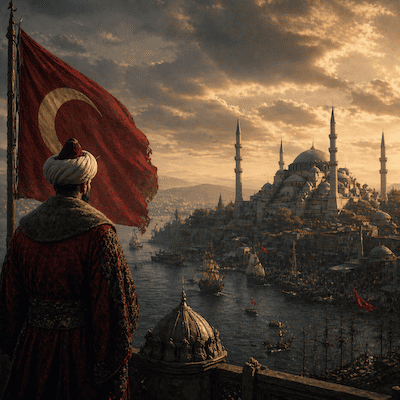
Osmanlı İmparatorluğu'nun Yükselişi ve Mirası
The Rise and Legacy of the Ottoman Empire
 Learn TurkishFree app with audio, quizzes and real books
Key words
- imparatorlukempire
- fetihconquest
- sultansultan
- kuşatmasiege
- başkentcapital city
- mimariarchitecture
- hukuklaw
- toplumsociety
- beylikprincipality
- yönetimadministration / governance
- orduarmy
- ticarettrade / commerce
All 26 words
- mirasheritage / legacy
- medeniyetcivilization
- şehircity
- kültürculture
- padişahsultan / emperor
- reformreform
- anayasaconstitution
- çöküşcollapse / downfall
- modernleşmemodernization
- egemenliksovereignty
- milletnation / community
- medresemadrasa / religious school
- demiryolurailway
- anlaşmaagreement / treaty
Osmanlı İmparatorluğu, dünya tarihinin en uzun ömürlü devletlerinden biridir. 1300 yılı civarında küçük bir Anadolu beyliği olarak ortaya çıkmış ve 1922'ye kadar, yani altı yüz yılı aşkın bir süre ayakta kalmıştır. En güçlü döneminde toprakları üç kıtaya yayılıyor, Budapeşte'den Bağdat'a, Kırım'dan Cezayir'e kadar uzanıyordu.
The Ottoman Empire is one of the longest-lived states in world history. It emerged around 1300 as a small Anatolian principality and lasted until 1922, that is, for more than six hundred years. At its height its lands spread across three continents and stretched from Budapest to Baghdad and from Crimea to Algiers.
Osmanlı mirası yalnızca fetihlerle ölçülemez. Devletin yönetim düzeni, hukuku, camileri, çarşıları ve farklı dinlerden insanları bir arada yaşatan toplum yapısı da bu mirasın bir parçasıdır. Bugünkü Türkiye'nin, Balkanlar'ın ve Orta Doğu'nun pek çok özelliği bu geçmişe dayanır.
The Ottoman legacy cannot be measured by conquests alone. The state's system of government, its law, its mosques and bazaars, and a social order that allowed people of different faiths to live together are also part of this legacy. Many features of today's Türkiye, the Balkans and the Middle East go back to this past.
Küçük Bir Beylikten Büyük Bir İmparatorluğa
From a Small Principality to a Great Empire
Osmanlı Devleti, 13. yüzyılın sonunda Anadolu'nun kuzeybatısında, Söğüt çevresinde kuruldu. Osman Gazi'nin yönetimindeki bu küçük beylik, komşu Türk beylikleri ve Bizans'ın zayıflayan sınır kaleleriyle savaşarak büyüdü. Osmanlılar yalnızca kılıç gücüyle yayılmadı; fethettikleri yerlerde halka iyi davrandılar ve yerel ileri gelenleri kendi saflarına çektiler.
The Ottoman state was founded at the end of the 13th century in north-western Anatolia, around Söğüt. Under Osman Gazi, this small principality grew by fighting neighbouring Turkish principalities and the weakening Byzantine border fortresses. The Ottomans did not expand by the sword alone; they treated the people of the places they conquered well and won local notables over to their side.
Osman Gazi'nin oğlu Orhan Bey, 1326'da Bursa'yı aldı ve bu şehir beyliğin ilk başkenti oldu. Ardından 1331'de İznik, 1337'de ise İzmit fethedildi; Bizans böylece bu bölgedeki son büyük şehirlerini de kaybetti. Osmanlılar, 1354'te Gelibolu'yu alarak Avrupa'ya geçti. Bu adım, devletin geleceğini belirleyen gelişmelerden biri oldu.
Osman Gazi's son Orhan Bey took Bursa in 1326, and the city became the principality's first capital. Iznik (Nicaea) was conquered in 1331 and Izmit (Nicomedia) in 1337; Byzantium thus lost its last large cities in the region. By taking Gallipoli in 1354, the Ottomans crossed into Europe. This step was one of the developments that shaped the state's future.
İstanbul'un Fethi: Bir Çağın Sonu, Bir Çağın Başlangıcı
The Conquest of Istanbul: The End of One Age, the Start of Another
29 Mayıs 1453, dünya tarihinin dönüm noktalarından biridir. 21 yaşındaki Sultan II. Mehmed'in ordusu, 53 gün süren kuşatmanın ardından Konstantinopolis'i aldı. Bin yılı aşkın bir süre Doğu Roma İmparatorluğu'nun başkenti olan şehir, artık Osmanlıların elindeydi. Bazı tarihçiler bu olayı Orta Çağ'ın sonu olarak kabul eder.
29 May 1453 is one of the turning points of world history. After a 53-day siege, the army of the 21-year-old Sultan Mehmed II took Constantinople. The city that had been the capital of the Eastern Roman Empire for more than a thousand years was now in Ottoman hands. Some historians regard this event as the end of the Middle Ages.
II. Mehmed, şehri yıkmak yerine yeniden canlandırmayı seçti. İstanbul imparatorluğun yeni başkenti oldu; sultan, Anadolu'dan ve Balkanlar'dan getirdiği Müslüman, Hristiyan ve Yahudi aileleri şehre yerleştirdi. Ayasofya camiye çevrildi, ancak Rum Ortodoks Patrikhanesi şehirde kaldı ve 1454'te Gennadios patrik seçildi. II. Mehmed, tarihe "Fatih" unvanıyla geçti.
Mehmed II chose to revive the city rather than destroy it. Istanbul became the new capital of the empire, and the sultan settled Muslim, Christian and Jewish families there whom he had brought from Anatolia and the Balkans. Hagia Sophia was turned into a mosque, but the Greek Orthodox Patriarchate remained in the city, and in 1454 Gennadios was chosen as patriarch. Mehmed II went down in history with the title "the Conqueror".
Altın Çağ: Kanuni Sultan Süleyman Dönemi
The Golden Age: The Reign of Suleiman the Magnificent
Osmanlı tarihinin en parlak dönemi, genellikle Kanuni Sultan Süleyman'ın saltanat yılları olarak kabul edilir. Batı'da "Muhteşem Süleyman" adıyla tanınan sultan, 1520'den 1566'ya kadar tam 46 yıl tahtta kaldı. 1526'da Mohaç Meydan Muharebesi'ni kazandı; 1529'da Viyana'yı kuşattı, ancak şehri alamadı. Bağdat ve Kuzey Afrika kıyılarının bir bölümü de onun döneminde Osmanlı topraklarına katıldı.
The reign of Suleiman, whom the Turks call "the Lawgiver", is generally regarded as the most brilliant period in Ottoman history. Known in the West as "Suleiman the Magnificent", the sultan sat on the throne from 1520 to 1566, a full 46 years. He won the Battle of Mohács in 1526; in 1529 he besieged Vienna but failed to take the city. Baghdad and part of the North African coast also came under Ottoman rule in his time.
Kanuni'nin mirası savaşlarla sınırlı değildir. Onun döneminde hazırlanan kanunnameler, yönetim ve vergi düzenini yeniden belirledi; "Kanuni" lakabı da buradan gelir. Mimar Sinan, İstanbul'daki Süleymaniye Camii'ni bu dönemde, 1550 ile 1557 yılları arasında inşa etti. Süleyman, aynı zamanda "Muhibbi" mahlasıyla şiirler yazan bir şairdi.
Suleiman's legacy is not limited to wars. The law codes drawn up in his reign reshaped government and taxation, and this is where his title "the Lawgiver" comes from. In this period, between 1550 and 1557, Mimar Sinan built the Süleymaniye Mosque in Istanbul. Suleiman was also a poet who wrote verse under the pen name "Muhibbi".
Osmanlı Yönetim Sistemi: Merkez ve Taşra
The Ottoman System of Government: Centre and Provinces
Osmanlılar, bu kadar geniş ve çeşitli toprakları yönetmek için ayrıntılı bir düzen kurdu. Merkezde padişah, sadrazam ve devletin önemli işlerinin görüşüldüğü Divan-ı Hümayun bulunuyordu. Taşrada ise beylerbeyleri ve sancakbeyleri, yönetimi padişah adına yürütürdü. Bu düzen, yerel geleneklere de belli ölçüde yer bırakırdı.
To rule such vast and varied lands, the Ottomans built a detailed system. At the centre were the sultan, the grand vizier and the Imperial Council, where the main affairs of state were discussed. In the provinces, governors-general and district governors ran the administration in the sultan's name. The system also left some room for local customs.
Devşirme sistemi, Osmanlı yönetiminin en dikkat çekici uygulamalarından biriydi. Balkanlar'daki Hristiyan ailelerden alınan erkek çocuklar Müslüman olarak yetiştirilir, eğitimlerinin ardından yeniçeri ocağına ya da saraya verilirdi. Bu uygulama çocukları ailelerinden koparıyordu; ancak yetenekli olanlar devletin en yüksek makamlarına kadar yükselebiliyordu. Ünlü sadrazam Sokullu Mehmed Paşa da bir devşirmeydi.
The devshirme system was one of the most striking practices of Ottoman government. Boys taken from Christian families in the Balkans were brought up as Muslims and, after their training, assigned to the Janissary corps or to the palace. The practice tore children away from their families, but the most able could rise as high as the top offices of state. The famous grand vizier Sokollu Mehmed Pasha was himself a devshirme recruit.
Çok Kültürlü Bir İmparatorluk: Millet Sistemi
A Multicultural Empire: The Millet System
Osmanlı İmparatorluğu'nda Müslümanlar, Hristiyanlar ve Yahudiler yüzyıllar boyunca aynı devletin çatısı altında yaşadı. Bunu mümkün kılan düzenlerden birine bugün "millet sistemi" adı verilir. Her dinî topluluk, eğitim, evlilik ve miras gibi işlerini kendi din adamları ve kurumları aracılığıyla yürütürdü.
For centuries Muslims, Christians and Jews lived under the roof of the same state in the Ottoman Empire. One of the arrangements that made this possible is today called the "millet system". Each religious community ran matters such as education, marriage and inheritance through its own clergy and institutions.
Rum Ortodokslar ve Ermeniler kendi patrikleri, Yahudiler ise hahambaşı aracılığıyla devlete bağlıydı. Gayrimüslimler cizye adı verilen ek bir vergi öder ve bazı haklardan yararlanamazdı; dolayısıyla bugünkü anlamda bir eşitlikten söz edilemez. Yine de Avrupa'da din savaşlarının sürdüğü bir çağda farklı inançlar bu topraklarda yan yana yaşayabildi. 1492'de İspanya'dan sürülen Yahudilerin bir kısmı da Osmanlı topraklarına yerleşti.
Greek Orthodox and Armenians were linked to the state through their patriarchs, and Jews through their chief rabbi. Non-Muslims paid an extra tax called the jizya and did not enjoy certain rights, so there can be no talk of equality in today's sense. Even so, at a time when wars of religion were raging in Europe, different faiths were able to live side by side in these lands. Some of the Jews expelled from Spain in 1492 also settled in Ottoman lands.
Osmanlı Ekonomisi: Ticaret Yollarının Kavşağında
The Ottoman Economy: At the Crossroads of Trade Routes
Osmanlı İmparatorluğu, Doğu ile Batı arasındaki büyük ticaret yollarının üzerinde bulunuyordu. Asya'dan Avrupa'ya taşınan ipek ve baharat, Osmanlı limanlarından ve kervan yollarından geçerdi. İstanbul, Bursa, Halep, Selanik ve Kahire, tüccarların ve zanaatkârların buluştuğu büyük ticaret merkezleriydi.
The Ottoman Empire lay across the great trade routes between East and West. Silk and spices carried from Asia to Europe passed through Ottoman ports and along caravan roads. Istanbul, Bursa, Aleppo, Thessaloniki and Cairo were major trading centres where merchants and craftsmen met.
Ticaretin kalbi çarşılarda ve hanlarda atardı. II. Mehmed döneminde temeli atılan Kapalıçarşı ile 17. yüzyılda yapılan Mısır Çarşısı yalnızca alışveriş yerleri değildi; haberler ve fikirler de buralarda dolaşırdı. Ancak Portekizli denizci Vasco da Gama'nın 1498'de Afrika'nın güneyini dolaşarak Hindistan'a ulaşmasının ardından baharat ticaretinin bir kısmı zamanla okyanus yollarına kaydı.
The heart of trade beat in the bazaars and caravanserais. The Grand Bazaar, begun in the time of Mehmed II, and the Spice Bazaar, built in the 17th century, were not just places to shop; news and ideas circulated there too. But after the Portuguese navigator Vasco da Gama sailed round the south of Africa and reached India in 1498, part of the spice trade gradually shifted to the ocean routes.
Osmanlı Mimarisi: Taşa İşlenen Güç ve Estetik
Ottoman Architecture: Power and Beauty Carved in Stone
İmparatorluğun gücü, en açık biçimde mimarisinde görülür. Osmanlı mimarları Selçuklu ve Bizans mirasından yararlanmış, zamanla kendilerine özgü bir üslup geliştirmiştir. Büyük merkezi kubbeler, ince uzun minareler, geniş avlular ve İznik çinileriyle süslenmiş iç mekânlar, bu üslubun en tanınmış özellikleridir.
The empire's power is seen most clearly in its architecture. Ottoman architects drew on the Seljuk and Byzantine heritage and over time developed a style of their own. Great central domes, slender minarets, spacious courtyards and interiors decorated with Iznik tiles are the best-known features of this style.
Bu geleneğin en büyük ustası Mimar Sinan'dır. Sinan, 1588'deki ölümüne kadar yarım asır boyunca saray mimarlarının başında kaldı. Kaynaklarda adı camiler, medreseler, hamamlar ve köprüler olmak üzere üç yüzü aşkın yapıyla birlikte anılır. Kendisi İstanbul'daki Şehzade Camii'ni "çıraklık", Süleymaniye'yi "kalfalık", Edirne'deki Selimiye'yi ise "ustalık" eseri olarak görürdü. Selimiye'nin kubbesi, çap bakımından Ayasofya'nınkiyle neredeyse aynıdır.
The greatest master of this tradition is Mimar Sinan. For half a century, until his death in 1588, he served as chief architect of the court. Sources link his name to more than three hundred buildings, including mosques, madrasas, baths and bridges. He himself saw the Şehzade Mosque in Istanbul as his "apprentice" work, the Süleymaniye as his "journeyman" work and the Selimiye in Edirne as his "master" work. The Selimiye's dome is almost exactly the same diameter as that of Hagia Sophia.
Osmanlı Hakkında İlginç Bilgiler
Interesting Facts About the Ottomans
Osmanlı tahtına toplam 36 padişah çıktı. Saltanat süreleri birkaç aydan 46 yıla kadar değişir; en uzun süre tahtta kalan padişah Kanuni Sultan Süleyman'dır.
Thirty-six sultans in all sat on the Ottoman throne. Their reigns ranged from a few months to 46 years; the longest-reigning sultan was Suleiman the Magnificent.
Kahve, Avrupa'ya büyük ölçüde Osmanlı toprakları üzerinden yayıldı. İstanbul'daki ilk kahvehaneler 1550'lerde açıldı ve kısa sürede insanların sohbet edip tartıştığı mekânlara dönüştü.
Coffee spread to Europe largely by way of Ottoman lands. The first coffeehouses in Istanbul opened in the 1550s and soon became places where people chatted and argued.
Sarayın ve devletin dili olan Osmanlı Türkçesi, Türkçe dil bilgisine dayanıyor, ancak Arapça ve Farsçadan alınmış binlerce kelime içeriyordu. Bu dil, Arap harfleriyle yazılırdı.
Ottoman Turkish, the language of the palace and the state, was based on Turkish grammar but contained thousands of words borrowed from Arabic and Persian. It was written in Arabic script.
16. yüzyılda Osmanlı donanması, Akdeniz'in en güçlü donanmalarından biriydi. Kaptan-ı Derya Barbaros Hayreddin Paşa, 1538'de Preveze'de Avrupalı devletlerin ortak donanmasını yendi.
In the 16th century the Ottoman navy was one of the most powerful in the Mediterranean. In 1538 the grand admiral Hayreddin Barbarossa defeated the combined fleet of several European states at Preveza.
Topkapı Sarayı, yaklaşık dört yüz yıl boyunca padişahların konutu ve devletin yönetim merkezi olarak kullanıldı. Sultan Abdülmecid, 1856'da Dolmabahçe Sarayı'na taşındı.
For nearly four hundred years Topkapı Palace served as the sultans' residence and the seat of government. Sultan Abdulmejid moved to Dolmabahçe Palace in 1856.
Edirne'deki II. Bayezid Külliyesi'nde 1488'de bir darüşşifa, yani hastane açıldı. Kaynaklara göre burada ruh hastalarının tedavisinde müzikten ve su sesinden de yararlanılırdı.
In 1488 a darüşşifa, that is, a hospital, opened in the complex of Bayezid II in Edirne. According to the sources, music and the sound of water were also used there to treat the mentally ill.
Gerileme Dönemi: İçeriden ve Dışarıdan Gelen Sorunlar
The Period of Decline: Problems from Within and Without
17. yüzyıldan itibaren Osmanlı İmparatorluğu'nun eski gücü azalmaya başladı. 1683'teki ikinci Viyana kuşatması bozgunla sonuçlandı. 1699'da imzalanan Karlofça Antlaşması ile Macaristan'ın büyük bölümü elden çıktı. Avrupa'da gelişen bilim, yeni silahlar ve daha sonra Sanayi Devrimi, güç dengesini Batı'nın lehine çevirdi.
From the 17th century onwards the Ottoman Empire's old power began to wane. The second siege of Vienna in 1683 ended in a rout. With the Treaty of Karlowitz, signed in 1699, most of Hungary was lost. Advances in science and new weapons in Europe, and later the Industrial Revolution, tipped the balance of power in the West's favour.
İçeride ise merkezî otorite zayıfladı. Yeniçeriler zamanla siyasete karışan ve padişahları bile tahttan indirebilen bir güce dönüştü; II. Mahmud ocağı ancak 1826'da kaldırabildi. Taşrada yerel güçler büyüdü, uzun savaşlar da hazineyi boşalttı. 19. yüzyılın ortasında Rus Çarı I. Nikolay, imparatorluğu "hasta adam" olarak nitelendirdi ve bu ifade kısa sürede Avrupa'da yaygınlaştı.
At home, central authority weakened. Over time the Janissaries became a force that meddled in politics and could even depose sultans; Mahmud II only managed to abolish the corps in 1826. Local powers grew in the provinces, and long wars drained the treasury. In the mid-19th century the Russian tsar Nicholas I described the empire as "the sick man", and the phrase soon spread across Europe.
Tanzimat ve Modernleşme Çabaları
The Tanzimat and Attempts at Modernisation
19. yüzyılda Osmanlı devlet adamları, imparatorluğu kurtarmanın yolunu Avrupa'dan alınan kurumlarda aradı. Sultan Abdülmecid döneminde, 3 Kasım 1839'da Gülhane Bahçesi'nde okunan Tanzimat Fermanı bu dönemin başlangıcı sayılır. Ferman, Müslüman olsun olmasın bütün tebaanın can ve mal güvenliğini devletin güvencesi altına aldı.
In the 19th century Ottoman statesmen looked for a way to save the empire in institutions borrowed from Europe. The Tanzimat edict, read out in the Gülhane garden on 3 November 1839 under Sultan Abdulmejid, is seen as the start of this period. The edict placed the life and property of all subjects, Muslim or not, under the guarantee of the state.
Tanzimat döneminde hukuk, eğitim, ordu ve basın alanlarında büyük değişiklikler yapıldı. Fransız hukuku örnek alınarak yeni kanunlar hazırlandı, Mekteb-i Mülkiye gibi modern okullar açıldı ve Türkçe özel gazeteler yayımlanmaya başladı. 1876'da ilk Osmanlı anayasası olan Kanun-i Esasi ilan edildi, ertesi yıl da ilk Osmanlı meclisi toplandı. Ancak II. Abdülhamid meclisi 1878'de kapattı; reformlar da imparatorluğun dağılmasını durduramadı.
During the Tanzimat major changes were made in law, education, the army and the press. New laws were drawn up on the model of French law, modern schools such as the Mekteb-i Mülkiye opened, and privately owned Turkish newspapers began to appear. In 1876 the first Ottoman constitution, the Kanun-i Esasi, was proclaimed, and the following year the first Ottoman parliament met. But Abdul Hamid II closed parliament in 1878, and the reforms could not stop the empire from breaking apart.
İmparatorluğun Çöküşü ve Mirası
The Collapse of the Empire and Its Legacy
İmparatorluğun sonunu Birinci Dünya Savaşı getirdi. Osmanlı Devleti, 1914'te Almanya ve Avusturya-Macaristan'ın yanında savaşa girdi. 1915'te Çanakkale'de büyük bir zafer kazandı, ancak savaşın sonunda yenik düştü. 30 Ekim 1918'de Mondros Ateşkesi imzalandı ve İstanbul işgal edildi. 1920'de imzalanan Sevr Antlaşması imparatorluğun topraklarını paylaştırıyordu; ancak bu antlaşma hiçbir zaman uygulanmadı.
The First World War brought the empire to an end. The Ottoman state entered the war in 1914 on the side of Germany and Austria-Hungary. It won a great victory at Gallipoli in 1915 but was defeated by the end of the war. On 30 October 1918 the Armistice of Mudros was signed and Istanbul was occupied. The Treaty of Sèvres, signed in 1920, divided up the empire's lands; however, this treaty was never put into effect.
Mustafa Kemal Atatürk'ün önderliğinde yürütülen Kurtuluş Savaşı, Anadolu'da yeni bir devletin yolunu açtı. 1 Kasım 1922'de saltanat kaldırıldı ve son padişah VI. Mehmed Vahdeddin ülkeden ayrıldı. 1923'te Lozan Antlaşması imzalandı, ardından Türkiye Cumhuriyeti ilan edildi. Osmanlı'nın izleri ise bugün Balkanlar'dan Orta Doğu'ya kadar dilde, mimaride, mutfakta ve ortak hafızada yaşamaya devam eder.
The War of Independence, waged under the leadership of Mustafa Kemal Atatürk, opened the way for a new state in Anatolia. On 1 November 1922 the sultanate was abolished, and the last sultan, Mehmed VI Vahdettin, left the country. In 1923 the Treaty of Lausanne was signed, and the Republic of Türkiye was then proclaimed. The traces of the Ottomans, meanwhile, live on today from the Balkans to the Middle East, in language, architecture, cuisine and shared memory.
Sonuç: Altı Yüz Yıldan Kalanlar
Conclusion: What Remains of Six Hundred Years
Osmanlı tarihi, yalnızca bir devletin doğuşunun ve çöküşünün hikâyesi değildir. Bu imparatorlukta farklı dinlerden ve dillerden insanlar uzun süre aynı devletin çatısı altında yaşadı, güçlü kurumlar yüzyıllarca ayakta kaldı. Ancak devlet, zamanla değişen dünyaya ayak uydurmakta zorlandı.
Ottoman history is not merely the story of a state's rise and fall. In this empire people of different religions and languages lived for a long time under the roof of the same state, and strong institutions endured for centuries. Over time, however, the state struggled to keep up with a changing world.
Bugünkü Türkiye'yi, Balkan ülkelerini ve Orta Doğu'nun haritasını anlamak için Osmanlı geçmişini bilmek gerekir. İstanbul'un siluetinden Saraybosna'nın çarşısına, Balkan ve Türk mutfaklarındaki ortak yemeklere kadar bu altı yüz yılın izleri hâlâ görülür.
To understand today's Türkiye, the Balkan countries and the map of the Middle East, one needs to know the Ottoman past. From the skyline of Istanbul to the bazaar of Sarajevo and the dishes shared by Balkan and Turkish cuisines, the traces of those six hundred years can still be seen.
In the free app you can listen to this text read aloud and tap any word to see what it means.