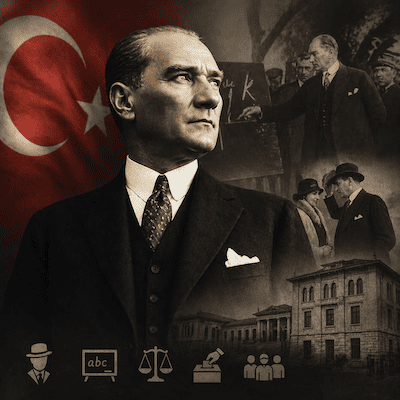
Mustafa Kemal Atatürk
 Learn TurkishFree app with audio, quizzes and real books
Key words
- cumhuriyetrepublic
- reformreform
- imparatorlukempire
- kurtuluşliberation / salvation
- savaşwar
- liderleader
- alfabealphabet
- devrimrevolution
- laikliksecularism
- eğitimeducation
- öğretmenteacher
- kadınwoman
All 26 words
- hakright
- milletvekilimember of parliament
- dillanguage
- sözcükword / vocabulary item
- kıyafetclothing / outfit
- takvimcalendar
- modernleşmemodernization
- kütüphanelibrary
- sanayiindustry
- fabrikafactory
- demiryolurailway
- özgürlükfreedom
- miraslegacy / heritage
- bağımsızlıkindependence
Mustafa Kemal Atatürk, 20. yüzyılın en tanınmış devlet adamlarından biridir. Kurtuluş Savaşı'nı yönetmiş, yıkılan Osmanlı İmparatorluğu'nun yerine Türkiye Cumhuriyeti'ni kurmuştur. Bugün Türkiye'nin hemen her şehrinde onun adını taşıyan okullar, caddeler ve meydanlar bulunur.
Mustafa Kemal Atatürk is one of the best-known statesmen of the 20th century. He led the War of Independence and founded the Republic of Türkiye in place of the collapsing Ottoman Empire. Today there are schools, streets and squares bearing his name in almost every city in Türkiye.
Mustafa Kemal, 1881'de Selanik'te doğdu. Gençlik yıllarında Osmanlı İmparatorluğu'nun çöküşüne tanık oldu. Kurtuluş Savaşı'nın ardından 1923'te cumhuriyeti ilan etti. Ölümüne kadar geçen on beş yılda alfabeden hukuka, takvimden giyim kuşama kadar pek çok alanda köklü reformlar gerçekleştirdi.
Mustafa Kemal was born in Thessaloniki in 1881. As a young man he witnessed the decline of the Ottoman Empire. After the War of Independence he proclaimed the republic in 1923. In the fifteen years until his death he carried out sweeping reforms in many areas, from the alphabet to the law and from the calendar to the way people dressed.
Bir İmparatorluğun Sonu, Bir Cumhuriyetin Başlangıcı
The End of an Empire, the Start of a Republic
Osmanlı İmparatorluğu, Birinci Dünya Savaşı'ndan yenik çıktı. 1918'de imzalanan Mondros Ateşkesi'nin ardından İtilaf Devletleri'nin askerleri İstanbul'a girdi; Anadolu'nun pek çok bölgesi de işgal edildi. O günlerde ülkenin kurtulabileceğine inananların sayısı çok azdı. Mustafa Kemal, 19 Mayıs 1919'da Samsun'a çıkarak direnişi örgütlemeye başladı.
The Ottoman Empire came out of the First World War defeated. In 1918 the Armistice of Mudros was signed, Allied troops entered Istanbul and much of Anatolia was occupied. Very few people believed the country could be saved. On 19 May 1919 Mustafa Kemal landed at Samsun and began to organise the resistance.
Kurtuluş Savaşı'nda Türk kuvvetleri doğuda Ermeni, güneyde Fransız, batıda ise Yunan kuvvetlerine karşı savaştı. Savaş 1922 sonbaharında kazanıldı; Lozan Antlaşması ise 24 Temmuz 1923'te imzalandı. 29 Ekim 1923'te cumhuriyet ilan edildi ve Mustafa Kemal ilk cumhurbaşkanı seçildi. Bu tarih, her yıl Cumhuriyet Bayramı olarak kutlanır.
In the War of Independence, Turkish forces fought Armenian troops in the east, French troops in the south and Greek troops in the west. The war was won in the autumn of 1922, and the Treaty of Lausanne was signed on 24 July 1923. On 29 October 1923 the republic was proclaimed and Mustafa Kemal was elected its first president. This date is celebrated every year as Republic Day.
Harf Devrimi: Arap Harflerinden Latin Harflerine
The Alphabet Reform: From Arabic to Latin Letters
Atatürk'ün en köklü reformlarından biri, 1928'de yapılan Harf Devrimi'dir. Osmanlı Türkçesi yüzyıllar boyunca Arap harfleriyle yazılmıştı. 1 Kasım 1928'de kabul edilen yasayla bu harflerin yerini, Latin alfabesine dayanan 29 harfli yeni Türk alfabesi aldı. Bu değişiklik, birkaç harfi değiştirmekten çok daha büyük bir adımdı; Türkiye bütünüyle farklı bir yazı sistemine geçti.
One of Atatürk's most far-reaching reforms was the alphabet reform of 1928. For centuries Ottoman Turkish had been written in Arabic script. A law passed on 1 November 1928 replaced it with a new 29-letter Turkish alphabet based on Latin letters. This was much bigger than changing a few letters: Türkiye switched to an entirely different writing system.
Atatürk, yeni harfleri tanıtmak için yurdu dolaştı. Meydanlarda ve okullarda kara tahtanın başına geçerek harfleri bizzat öğretti; bu nedenle ona "Başöğretmen" denildi. Arap harfleri, Türkçedeki ünlü seslerin tamamını karşılayamıyordu. Latin harfleriyle ise kelimeler okunduğu gibi yazılabiliyordu. 1929'da açılan Millet Mektepleri'nde yüz binlerce yetişkin okuma yazma öğrendi.
Atatürk travelled around the country to introduce the new letters. In squares and schools he stood at the blackboard and taught them himself, which is why he was called the "Head Teacher". Arabic script could not represent all the vowel sounds of Turkish, whereas with Latin letters words could be written the way they are pronounced. In the Nation's Schools, opened in 1929, hundreds of thousands of adults learned to read and write.
Laiklik: Din ve Devlet İşlerinin Ayrılması
Secularism: Separating Religion and State
Osmanlı Devleti'nde hukukun önemli bir bölümü İslam hukukuna dayanıyordu; padişahlar aynı zamanda halife unvanını da taşıyordu. Saltanat 1 Kasım 1922'de kaldırılmıştı. 3 Mart 1924'te Meclis halifeliği de kaldırdı ve aynı yıl şeriye mahkemeleri kapatıldı.
In the Ottoman state a large part of the law was based on Islamic law, and the sultans also held the title of caliph. The sultanate had been abolished on 1 November 1922. On 3 March 1924 parliament abolished the caliphate as well, and the sharia courts were closed the same year.
1926'da İsviçre Medeni Kanunu örnek alınarak hazırlanan Türk Medeni Kanunu yürürlüğe girdi. Bu kanunla çok eşlilik yasaklandı, resmî nikâh zorunlu hâle geldi ve kız çocukları mirastan erkek kardeşleriyle eşit pay almaya başladı. 1928'de "Devletin dini İslam'dır" ifadesi anayasadan çıkarıldı; laiklik ilkesi ise 1937'de anayasaya girdi. Atatürk'e göre laiklik, dini reddetmek değil, din ile devlet işlerini birbirinden ayırmaktı.
In 1926 the Turkish Civil Code, modelled on the Swiss Civil Code, came into force. Under this code polygamy was banned, civil marriage became compulsory, and daughters began to inherit equal shares with their brothers. In 1928 the phrase "The religion of the state is Islam" was removed from the constitution, and in 1937 the principle of secularism was written into it. For Atatürk, secularism did not mean rejecting religion; it meant keeping religion and the affairs of state apart.
Eğitim Devrimi: Köy Okulundan Üniversiteye
The Education Revolution: From Village School to University
Atatürk, eğitimi bütün reformların temeli sayıyordu. Öğretmenlere seslendiği "Cumhuriyet sizden fikri hür, irfanı hür, vicdanı hür nesiller ister" sözü, bugün de pek çok okulun duvarında yer alır. Cumhuriyetin ilk yıllarında ülkenin dört bir yanında yeni okullar açıldı.
Atatürk saw education as the foundation of all his reforms. His words to teachers, "The Republic wants from you generations free in thought, free in learning and free in conscience", are still written on the walls of many schools today. In the early years of the republic new schools opened all over the country.
3 Mart 1924'te kabul edilen Tevhid-i Tedrisat Kanunu ile bütün okullar devletin denetiminde tek bir çatı altında toplandı, medreseler ise kapatıldı. Kız ve erkek öğrencilerin aynı sınıfta okuduğu karma eğitim yaygınlaştı. 1933 Üniversite Reformu ile Darülfünun kapatılarak yerine İstanbul Üniversitesi kuruldu. Nazi Almanyası'ndan kaçan pek çok bilim insanı bu üniversitede ders verdi ve Türk akademisinin gelişmesine önemli katkılar sağladı.
The Law on the Unification of Education, passed on 3 March 1924, brought all schools together under a single roof under state control, and the madrasas were closed. Coeducation, with girls and boys in the same classroom, became widespread. With the University Reform of 1933 the Darülfünun was closed and Istanbul University was founded in its place. Many scholars who had fled Nazi Germany taught at this university and made an important contribution to the growth of Turkish academia.
Kadın Hakları: Seçme ve Seçilme Hakkı
Women's Rights: The Right to Vote and Stand for Election
Türk kadınları 1930'da belediye seçimlerinde oy kullanma hakkını elde etti. 5 Aralık 1934'te ise milletvekili seçme ve seçilme hakkını kazandılar. Bu haklar, pek çok Avrupa ülkesinden daha önce tanınmıştı: Fransız kadınlar aynı hakka ancak 1944'te, İtalyan kadınlar ise 1945'te kavuştu.
Turkish women won the right to vote in local elections in 1930. On 5 December 1934 they gained the right to vote and stand in parliamentary elections. These rights came earlier than in many European countries: French women only won the same right in 1944, and Italian women in 1945.
1935 seçimlerinde Meclis'e 18 kadın milletvekili girdi. Aynı yıllarda hukuk, tıp ve mühendislik okuyan kadınların sayısı da arttı; Türkiye'nin ilk kadın avukatları ve hâkimleri bu dönemde mesleğe başladı. Atatürk, kadınların eğitim görmesini ve çalışma hayatına katılmasını toplumun ilerlemesi için vazgeçilmez sayıyordu.
In the 1935 election, 18 women entered parliament. In the same years the number of women studying law, medicine and engineering also grew, and Türkiye's first women lawyers and judges began to practise. Atatürk considered women's education and their participation in working life indispensable to the progress of society.
Dil Devrimi: Türkçeyi Sadeleştirme Çabası
The Language Reform: Simplifying Turkish
Atatürk, yalnızca yazıyı değil, dilin kendisini de değiştirmek istiyordu. Osmanlı Türkçesi Arapça ve Farsça kelimelerle doluydu; halkın büyük bölümü bu yazı dilini anlamakta zorlanıyordu. 1932'de bugünkü Türk Dil Kurumu'nun temeli atıldı ve dili sadeleştirme çalışmaları bu kurum aracılığıyla yürütülmeye başlandı.
Atatürk wanted to change not only the script but the language itself. Ottoman Turkish was full of Arabic and Persian words, and most people struggled to understand this written language. In 1932 the forerunner of today's Turkish Language Association was founded, and the work of simplifying the language began to be carried out through this institution.
Yabancı kökenli pek çok kelimenin yerine Türkçe karşılıklar bulundu. Bunun için halk ağzından ve eski Türkçe metinlerden kelimeler derlendi. Atatürk, 1937'de yayımlanan bir geometri kitabı da yazdı; "üçgen", "açı" ve "kenar" gibi terimler bu kitapla yerleşti. Türetilen kelimelerin bir kısmı yapay bulunduğu için benimsenmedi. Yine de bugünkü Türkçe, Osmanlı Türkçesine göre çok daha sade ve anlaşılırdır.
Turkish equivalents were found for many words of foreign origin, and words were collected from everyday speech and old Turkish texts. Atatürk even wrote a geometry book, published in 1937, through which terms such as "üçgen" (triangle), "açı" (angle) and "kenar" (side) took hold. Some of the new words seemed artificial and never caught on. Even so, Turkish today is far simpler and clearer than Ottoman Turkish.
Kıyafet ve Takvim: Gündelik Hayatta Değişim
Clothing and the Calendar: Changes in Daily Life
Reformlar gündelik hayatı da derinden etkiledi. 1925'te çıkarılan Şapka Kanunu ile erkeklerin fes yerine şapka giymesi zorunlu hâle geldi. Atatürk, aynı yılın yazında Kastamonu'yu ziyaret ettiğinde halkı elinde panama şapkasıyla selamlamıştı. Basit bir kıyafet meselesi gibi görünen bu değişiklik, aslında Osmanlı geçmişinden kopuşun simgesiydi.
The reforms also had a deep effect on everyday life. Under the Hat Law of 1925, men were required to wear hats instead of the fez. That summer, on a visit to Kastamonu, Atatürk had greeted the people with a Panama hat in his hand. What looked like a simple matter of dress was in fact a symbol of the break with the Ottoman past.
1 Ocak 1926'dan itibaren Rumi ve Hicri takvimlerin yerine Miladi takvim kullanılmaya başlandı. Günün saatleri de uluslararası sisteme göre düzenlendi. 1931'de metre ve kilogram resmî ölçü birimleri oldu; 1935'te ise hafta tatili cumadan pazara alındı. Böylece Türkiye, gündelik hayatta da dünyanın büyük bölümüyle aynı takvimi ve aynı saati kullanmaya başladı.
From 1 January 1926 the Gregorian calendar came into use in place of the Rumi and Hijri calendars. The hours of the day were also set according to the international system. In 1931 the metre and the kilogram became the official units of measurement, and in 1935 the weekly day off moved from Friday to Sunday. From then on, Türkiye used the same calendar and the same clock as most of the world in daily life too.
Atatürk Hakkında Az Bilinen Bilgiler
Lesser-Known Facts About Atatürk
"Atatürk" soyadı, "Türklerin atası" anlamına gelir. Bu soyadını ona 1934'te Türkiye Büyük Millet Meclisi verdi; çıkarılan bir yasayla da başka kimsenin bu soyadını kullanması yasaklandı.
The surname "Atatürk" means "father of the Turks". The Grand National Assembly of Türkiye gave it to him in 1934, and a law passed for the purpose banned anyone else from using it.
Fransızcayı iyi bilir, Fransızca kitapları aslından okurdu.
He knew French well and read French books in the original.
Kişisel kütüphanesinde 4.000'den fazla kitap bulunuyordu. Okuduğu kitapların kenarlarına sık sık notlar alırdı.
His personal library held more than 4,000 books. He often wrote notes in the margins of the books he read.
1934'te çıkarılan Soyadı Kanunu'ndan önce Türkiye'de resmî soyadı kullanılmıyordu. İnsanlar genellikle lakaplarıyla ya da babalarının adıyla anılırdı.
Before the Surname Law of 1934 there were no official surnames in Türkiye. People were usually known by a nickname or by their father's name.
Kendi çocuğu olmadı; ancak birçok çocuğu manevi evlat edindi. Bunlardan biri, Türkiye'nin ilk kadın askerî pilotu Sabiha Gökçen'dir.
He had no children of his own, but he adopted several children. One of them is Sabiha Gökçen, Türkiye's first woman military pilot.
10 Kasım 1938'de, saat 9.05'te İstanbul'daki Dolmabahçe Sarayı'nda hayatını kaybetti. Türkiye'de her yıl bu saatte sirenler çalar ve herkes bir dakikalık saygı duruşunda bulunur.
He died on 10 November 1938 at 9:05 in the morning at Dolmabahçe Palace in Istanbul. Every year at this time sirens sound across Türkiye and everyone observes a minute's silence.
Ekonomi: Devletçilik ve İlk Fabrikalar
The Economy: Statism and the First Factories
Cumhuriyet kurulduğunda ülkede çok az fabrika vardı. Türkiye tütün, pamuk ve kuru üzüm gibi ham maddeler satıyor, sanayi ürünlerinin büyük bölümünü ise dışarıdan alıyordu. 1929 Dünya Ekonomik Buhranı'nın ardından devlet, ekonomide doğrudan söz sahibi oldu. Bu anlayışa "devletçilik" adı verildi.
When the republic was founded, the country had very few factories. Türkiye sold raw materials such as tobacco, cotton and raisins, and bought most of its manufactured goods from abroad. After the Great Depression of 1929, the state took a direct say in the economy. This approach was called "statism".
1933'te Sümerbank kuruldu, 1934'te ise Birinci Beş Yıllık Sanayi Planı uygulamaya konuldu. Bu dönemde dokuma, şeker, çimento ve kâğıt fabrikaları açıldı; Kayseri'deki büyük dokuma fabrikası bunların en bilinenlerindendir. Karabük Demir Çelik Fabrikası'nın temeli de bu yıllarda atıldı. Atatürk döneminde yaklaşık 3.000 kilometre yeni demiryolu yapıldı.
Sümerbank was founded in 1933, and in 1934 the First Five-Year Industrial Plan was put into practice. In this period textile, sugar, cement and paper factories opened; the large textile mill in Kayseri is among the best known of them. The foundations of the Karabük Iron and Steel Works were also laid in these years. Around 3,000 kilometres of new railway were built in Atatürk's time.
Atatürk'ün Mirası: Bugüne Uzanan İzler
Atatürk's Legacy: Traces That Last to This Day
Atatürk'ün mirası, bugün de hem Türkiye'de hem de dünyada tartışılan bir konudur. Ona hayranlık duyanlar, Atatürk'ü işgal altındaki bir ülkeyi kurtaran, yeni bir devlet kuran ve kadınlara erken dönemde siyasi haklar tanıyan bir lider olarak görür. Eleştirenler ise bazı reformların halka danışılmadan, yukarıdan uygulandığını ve bu süreçte geleneksel yaşamın zorlandığını öne sürer.
Atatürk's legacy is still debated in Türkiye and around the world. His admirers see a leader who saved an occupied country, founded a new state and gave women political rights early on. His critics say that some reforms were imposed from above without asking the people, and that traditional ways of life came under pressure in the process.
Hangi açıdan bakılırsa bakılsın, Atatürk'ün Türkiye'yi derinden değiştirdiği açıktır. Ölümünün üzerinden seksen yılı aşkın bir süre geçmesine rağmen izleri cumhuriyetin hukukunda, alfabesinde ve okullarında hâlâ görülür. Ankara'daki anıt mezarı Anıtkabir'i her yıl milyonlarca kişi ziyaret eder.
Whichever way you look at it, Atatürk changed Türkiye profoundly. More than eighty years have passed since his death, yet his mark can still be seen in the republic's laws, its alphabet and its schools. Millions of people visit Anıtkabir, his mausoleum in Ankara, every year.
In the free app you can listen to this text read aloud and tap any word to see what it means.