Folclore regional
Regional folklore
 Learn SpanishFree app with audio, quizzes and real books
Key words
- folclorefolklore
- península ibéricaIberian Peninsula
- gaitasbagpipes
- castañuelascastanets
- jotajota (folk dance)
- coplaspopular songs / stanzas
- trajes regionalesregional costumes
- muiñeiramuiñeira (Galician dance)
- molinosmills
- sardanasardana (Catalan dance)
- fraternidadfraternity / brotherhood
- coblacobla (traditional music ensemble)
All 25 words
- tenoratenora (shawm instrument)
- sevillanassevillanas (folk dance)
- feriasfairs / festivals
- txalapartatxalaparta (Basque percussion)
- tamboriltabor / small drum
- fiestas patronalespatron saint festivals
- dulzainadulzaina (double-reed instrument)
- timpletimple (Canarian string instrument)
- volantesruffles / flounces
- raícesroots
- certámenescompetitions / contests
- tamborilerodrummer (folk)
- estáticostatic / unchanging
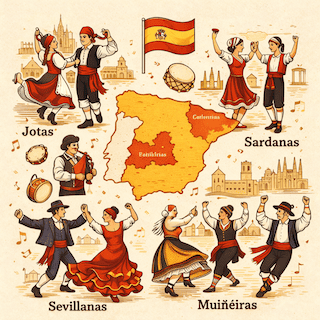
En España casi cada región tiene su propia música tradicional, con sus instrumentos, sus bailes y sus fiestas. Es el resultado de siglos de historia y de la mezcla de los pueblos que han pasado por la península.
In Spain almost every region has its own traditional music, with its own instruments, dances and festivals. It is the result of centuries of history and of the mixing of the many peoples who have passed through the peninsula.
Fuera de España lo más conocido es el flamenco, pero el mapa es mucho más amplio: va de las gaitas de Galicia a las castañuelas de Andalucía, pasando por las dulzainas de Castilla o el timple de Canarias.
Outside Spain, flamenco is the best-known style, but the map is much wider: it runs from the bagpipes of Galicia to the castanets of Andalusia, by way of the dulzainas of Castile and the timple of the Canary Islands.
La jota, un baile de toda España
The jota, a dance for all of Spain
La jota es seguramente el baile tradicional más extendido del país: con distintas variantes, se baila en Aragón, Navarra, Castilla, Valencia y muchas otras regiones. La más famosa es la jota aragonesa, un baile alegre y vivo, en pareja, con muchos saltos y el repiqueteo constante de las castañuelas.
The jota is probably the most widespread traditional dance in the country: in different versions, it is danced in Aragon, Navarre, Castile, Valencia and many other regions. The most famous is the Aragonese jota, a lively, cheerful dance for couples, full of leaps and the constant clatter of castanets.
Los bailadores suelen llevar el traje típico de su tierra, y la música va acompañada de coplas cantadas: estrofas cortas de cuatro versos que hablan de amor, de la vida en el campo, del pueblo o de la Virgen.
The dancers usually wear the traditional dress of their area, and the music comes with sung coplas: short four-line verses about love, life in the countryside, the home village or the Virgin Mary.
El norte: muiñeiras y gaitas
The north: muiñeiras and bagpipes
En Galicia y Asturias la música suena de otra manera. Aquí el instrumento principal es la gaita, que muchos relacionan con el pasado celta de estas tierras. El baile más representativo de Galicia es la muiñeira.
In Galicia and Asturias the music sounds different. Here the main instrument is the gaita, the bagpipe, which many people link to the Celtic past of these lands. The most typical dance of Galicia is the muiñeira.
Es un ritmo rápido y lleno de energía. Su nombre viene de muíño, que en gallego significa 'molino': según la explicación más extendida, se bailaba en los molinos mientras la gente esperaba a que se moliera el trigo o el maíz.
It has a fast, energetic rhythm. Its name comes from muíño, Galician for 'mill': according to the usual explanation, people danced it at the mills while they waited for their wheat or maize to be ground.
Cataluña: la sardana
Catalonia: the sardana
En Cataluña la sardana es mucho más que un baile: es un símbolo de identidad. No se baila en pareja ni en solitario, sino en grupo. Los participantes se dan la mano y forman un corro abierto al que cualquiera puede unirse.
In Catalonia the sardana is much more than a dance: it is a symbol of identity. It is danced neither in couples nor alone, but as a group. The dancers hold hands and form an open ring that anyone can join.
Con los brazos en alto, los bailarines cuentan con cuidado los pasos, cortos y largos, al ritmo de la cobla, una banda de once músicos con instrumentos propios de Cataluña, como la tenora y el tible.
With their arms raised, the dancers carefully count their steps, short and long, to the rhythm of the cobla, an eleven-piece band with instruments unique to Catalonia, such as the tenora and the tible.
Andalucía: sevillanas y flamenco
Andalusia: sevillanas and flamenco
En el sur la música va unida a la fiesta. Las sevillanas son el alma de las ferias andaluzas, sobre todo de la Feria de Abril de Sevilla. Se bailan en pareja y siempre siguen el mismo esquema de cuatro coplas, pero cada pareja les pone su propia gracia.
In the south, music goes hand in hand with festivities. Sevillanas are the soul of the Andalusian fairs, above all Seville's April Fair. They are danced in couples and always follow the same pattern of four coplas, but each couple adds its own flair.
Conviene no confundirlas con el flamenco. El flamenco puede ser íntimo y dramático, mientras que las sevillanas son alegres y sociales, pensadas para que baile todo el mundo.
They shouldn't be confused with flamenco. Flamenco can be intimate and dramatic, while sevillanas are cheerful and sociable, meant for everyone to dance.
Instrumentos típicos
Typical instruments
Los instrumentos cambian mucho de una zona a otra. Estos son algunos de los más característicos del folclore español:
Instruments vary a great deal from one area to another. These are some of the most characteristic in Spanish folk music:
La guitarra española: básica en la música del centro y del sur.
The Spanish guitar: essential in the music of central and southern Spain.
Las castañuelas: dos piezas de madera que se hacen sonar con los dedos.
Castanets: two pieces of wood clicked together with the fingers.
La gaita: lleva la melodía en las fiestas de Galicia y Asturias.
The gaita (bagpipe): carries the melody at festivals in Galicia and Asturias.
La txalaparta: tablas de madera vascas que dos personas golpean con palos.
The txalaparta: Basque wooden boards that two people strike with sticks.
La flauta y el tamboril: típicos de las fiestas de Castilla y León.
Pipe and tabor: typical of festivals in Castile and León.
Castilla y León: jotas, ruedas y dulzainas
Castile and León: jotas, ruedas and dulzainas
En el corazón de la meseta la música suele ser más sobria. Durante las fiestas patronales, en las plazas de los pueblos se bailan jotas, boleros y ruedas, bailes en corro en los que puede participar todo el pueblo.
In the heart of the Meseta, the music tends to be more austere. During the patron saint festivals, village squares fill with jotas, boleros and ruedas, ring dances that the whole village can join.
Los acompaña la dulzaina, un instrumento de viento de sonido fuerte y agudo, parecido al oboe, casi siempre junto a un tamboril. Para muchos castellanos, oír una dulzaina es oír la fiesta del pueblo.
They are accompanied by the dulzaina, a loud, high-pitched wind instrument similar to the oboe, almost always paired with a small drum. For many Castilians, hearing a dulzaina means hearing the village fiesta.
Canarias: la isa y el timple
The Canary Islands: the isa and the timple
Lejos de la península, el folclore también está muy vivo. La música canaria nació de la tradición peninsular, pero el ir y venir de emigrantes la unió también a Cuba y Venezuela. Su instrumento estrella es el timple, una pequeña guitarra que suele tener cinco cuerdas.
Far from the peninsula, folk traditions are also very much alive. Canarian music grew out of mainland Spanish tradition, but the coming and going of emigrants also tied it to Cuba and Venezuela. Its star instrument is the timple, a small guitar that usually has five strings.
La isa es el baile más popular de las islas. Es una variante canaria de la jota, de ritmo rápido y alegre, en la que las parejas cambian de sitio y dibujan figuras en grupo mientras suenan timples y guitarras.
The isa is the most popular dance on the islands. It is a Canarian version of the jota, fast and cheerful, in which couples swap places and form group figures to the sound of timples and guitars.
La importancia del traje
The importance of costume
La música tradicional española no se entiende sin sus trajes. De los trajes charros de Salamanca, llenos de bordados y joyas, a los ligeros trajes de flamenca con volantes, la ropa habla del clima y de la economía de cada región.
Spanish traditional music cannot be understood without its costumes. From the charro outfits of Salamanca, covered in embroidery and jewellery, to the light, ruffled flamenco dresses, clothing tells of the climate and economy of each region.
Muchos de estos trajes pasan de padres a hijos y solo salen del armario en ocasiones especiales, como las fiestas del pueblo o una boda.
Many of these costumes are handed down from parents to children and only come out of the wardrobe on special occasions, such as the village fiesta or a wedding.
El folclore hoy
Folk music today
Hoy muchos artistas jóvenes mezclan estos ritmos con el pop o la música electrónica. Rosalía llevó el flamenco al pop internacional con el disco El mal querer (2018), y el grupo gallego Tanxugueiras combinó panderetas tradicionales y bases electrónicas en el Benidorm Fest de 2022.
Today many young artists blend these rhythms with pop or electronic music. Rosalía took flamenco into international pop with the album El mal querer (2018), and the Galician group Tanxugueiras combined traditional tambourines with electronic beats at the 2022 Benidorm Fest.
Los festivales de música folk también reúnen a mucho público. El Festival de Ortigueira, en Galicia, atrae cada verano a decenas de miles de personas.
Folk festivals also draw big crowds. The Ortigueira Festival in Galicia attracts tens of thousands of people every summer.
Curiosidades
Did you know?
Durante el franquismo, bailar sardanas fue una forma de afirmar la identidad catalana.
Under Franco, dancing the sardana was a way of asserting Catalan identity.
La UNESCO declaró el flamenco Patrimonio Cultural Inmaterial de la Humanidad en 2010.
UNESCO declared flamenco an Intangible Cultural Heritage of Humanity in 2010.
En varias zonas del norte se bailan danzas con palos o con espadas.
In several parts of the north, people perform dances with sticks or swords.
En Aragón se celebran certámenes de jota con premios para cantadores y bailadores.
Aragon holds jota competitions with prizes for singers and dancers.
El tamborilero toca a la vez una flauta con una mano y un tambor con la otra.
The tamborilero plays a pipe with one hand and a drum with the other at the same time.
Para terminar
In closing
Recorrer la música tradicional de España es recorrer el país de pueblo en pueblo. Una muiñeira gallega, una sardana en Barcelona y unas sevillanas en la Feria parecen de mundos distintos, y sin embargo forman parte de la misma cultura.
To travel through Spain's traditional music is to travel the country village by village. A Galician muiñeira, a sardana in Barcelona and sevillanas at the Seville Fair seem to come from different worlds, and yet they belong to the same culture.
Muchas de estas músicas se pueden escuchar todavía en directo: basta con acercarse a las fiestas de cualquier pueblo en verano, cuando la plaza se llena de gaitas, dulzainas o castañuelas.
Much of this music can still be heard live: just go to any village fiesta in summer, when the square fills with bagpipes, dulzainas or castanets.
In the free app you can listen to this text read aloud and tap any word to see what it means.