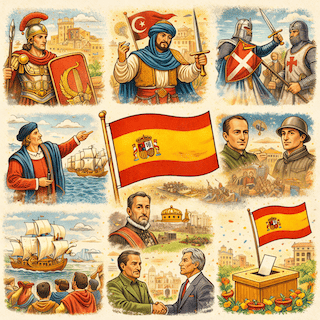
Diez momentos de la historia de España
Ten Moments in Spanish History
 Learn SpanishFree app with audio, quizzes and real books
Key words
- patrimonio culturalcultural heritage
- legado fundamentalfundamental legacy
- acueductosaqueducts
- convivenciacoexistence
- patrociniopatronage / sponsorship
- superpotencia mundialworld superpower
- Siglo de OroGolden Age
- Guerra de SucesiónWar of Succession
- liberales y conservadoresliberals and conservatives
- reformistasreformists
- golpe de estadocoup d'état
- polarización políticapolitical polarization
All 25 words
- dictaduradictatorship
- lenguas regionalesregional languages
- aislamientoisolation
- milagro económicoeconomic miracle
- derechos y libertadesrights and freedoms
- monarquía parlamentariaparliamentary monarchy
- referéndumreferendum
- democracia consolidadaconsolidated democracy
- diversidad regionalregional diversity
- identidad nacionalnational identity
- herencia multiculturalmulticultural heritage
- referencias históricashistorical references
- estallidooutbreak / explosion
La historia de España es larga y está llena de giros. Aquí la recorremos en diez momentos, desde la llegada de los romanos hace más de dos mil años hasta la democracia actual.
Spanish history is long and full of twists. Here we follow it through ten moments, from the arrival of the Romans more than two thousand years ago to today's democracy.
Muchas cosas de la España de hoy vienen de ese pasado: las lenguas que se hablan en sus regiones, las fiestas, los monumentos e incluso las discusiones políticas. Con unas cuantas fechas en la cabeza, el país se entiende bastante mejor.
Much of today's Spain comes from that past: the languages spoken in its regions, its festivals, its monuments and even its political arguments. With a few dates in mind, the country makes a lot more sense.
1. La Hispania romana (218 a. C.-409 d. C.)
1. Roman Hispania (218 BC-409 AD)
Los romanos desembarcaron en Ampurias, en la costa catalana, en el año 218 a. C., en plena Segunda Guerra Púnica contra Cartago. Conquistar la península les costó casi dos siglos: los últimos en caer fueron los cántabros y los astures, en el 19 a. C.
The Romans landed at Empúries, on the Catalan coast, in 218 BC, in the middle of the Second Punic War against Carthage. Conquering the peninsula took them almost two centuries: the last to fall were the Cantabrians and the Astures, in 19 BC.
Roma lo cambió casi todo. Trazó calzadas, levantó puentes, teatros y acueductos y fundó ciudades como Mérida, Zaragoza o Tarragona. El acueducto de Segovia sigue en pie y el teatro de Mérida todavía acoge un festival cada verano. Del latín que hablaban soldados y colonos nacieron el castellano, el catalán y el gallego, y también vienen de Roma muchas bases del derecho español. El emperador Trajano nació en Itálica, cerca de Sevilla.
Rome changed almost everything. It laid roads, built bridges, theatres and aqueducts, and founded cities such as Mérida, Zaragoza and Tarragona. The aqueduct of Segovia still stands, and the theatre at Mérida still hosts a festival every summer. Castilian, Catalan and Galician grew out of the Latin spoken by soldiers and settlers, and much of the groundwork of Spanish law also comes from Rome. The emperor Trajan was born in Italica, near Seville.
2. La conquista musulmana y al-Ándalus (711-1492)
2. The Muslim conquest and al-Andalus (711-1492)
En el año 711, un ejército de árabes y bereberes dirigido por Tariq cruzó el estrecho de Gibraltar y derrotó al rey visigodo Rodrigo. En pocos años dominaba casi toda la península. El nombre de Gibraltar recuerda aquel paso: viene de Yabal Tariq, «el monte de Tariq». El dominio musulmán, sobre un territorio cada vez más pequeño, duró casi ocho siglos.
In 711 an army of Arabs and Berbers led by Tariq crossed the Strait of Gibraltar and defeated the Visigothic king Roderic. Within a few years it controlled almost the whole peninsula. The name Gibraltar recalls that crossing: it comes from Jabal Tariq, "Tariq's mountain". Muslim rule, over an ever-shrinking territory, lasted almost eight centuries.
Durante siglos, al-Ándalus fue una de las regiones más ricas y cultas de Europa. En el siglo X, Córdoba era la capital de un califato y una de las mayores ciudades del continente. De esa época quedan la Mezquita de Córdoba, la Giralda de Sevilla, que fue el alminar de una mezquita, y la Alhambra de Granada. Los andalusíes extendieron cultivos como el arroz, el naranjo amargo y la caña de azúcar, y mejoraron el riego con acequias y norias. Al español pasaron miles de palabras árabes, como aceite, azúcar, almohada u ojalá. Musulmanes, cristianos y judíos vivieron juntos durante largos periodos, aunque no siempre en paz ni en igualdad.
For centuries al-Andalus was one of the richest and most cultured regions of Europe. In the 10th century Córdoba was the capital of a caliphate and one of the largest cities on the continent. From this era come the Mosque of Córdoba, the Giralda in Seville, which was once a mosque's minaret, and the Alhambra in Granada. The people of al-Andalus spread crops such as rice, the bitter orange and sugar cane, and improved irrigation with channels and waterwheels. Thousands of Arabic words passed into Spanish, such as aceite (oil), azúcar (sugar), almohada (pillow) and ojalá (if only). Muslims, Christians and Jews lived side by side for long periods, though not always in peace or as equals.
3. La Reconquista y los Reyes Católicos (722-1492)
3. The Reconquista and the Catholic Monarchs (722-1492)
Mientras tanto, en el norte fueron creciendo reinos cristianos como Asturias, León, Castilla, Navarra y Aragón, que avanzaron poco a poco hacia el sur. La tradición sitúa el comienzo en la batalla de Covadonga, hacia el año 722; el final llegó en 1492, con la caída de Granada. A este proceso de casi ocho siglos se le llama Reconquista.
Meanwhile, Christian kingdoms such as Asturias, León, Castile, Navarre and Aragon grew up in the north and slowly pushed south. Tradition places the beginning at the Battle of Covadonga, around 722; the end came in 1492 with the fall of Granada. This process of almost eight centuries is called the Reconquista.
1492 es quizá el año más famoso de la historia de España. El 2 de enero, los Reyes Católicos, Isabel de Castilla y Fernando de Aragón, entraron en Granada, el último reino musulmán de la península. En marzo firmaron el decreto que obligaba a los judíos a convertirse o a marcharse, y decenas de miles abandonaron el país. Y el 12 de octubre, Cristóbal Colón, con el apoyo de los Reyes Católicos, llegó a una isla del Caribe. Empezaba la conquista de América.
1492 is perhaps the most famous year in Spanish history. On 2 January the Catholic Monarchs, Isabella of Castile and Ferdinand of Aragon, entered Granada, the last Muslim kingdom on the peninsula. In March they signed the decree that forced Jews to convert or leave, and tens of thousands left the country. And on 12 October Christopher Columbus, backed by the Catholic Monarchs, reached an island in the Caribbean. The conquest of the Americas was beginning.
4. El Imperio español (siglos XVI-XVII)
4. The Spanish Empire (16th-17th centuries)
En el siglo XVI, la Monarquía Hispánica se convirtió en la mayor potencia de su tiempo. Tenía territorios en América, en Europa, en el norte de África y en Asia, donde las islas Filipinas llevan el nombre de Felipe II. De ahí la famosa frase de que en sus dominios «no se ponía el sol»: siempre era de día en alguna parte.
In the 16th century the Spanish Monarchy became the greatest power of its time. It held territories in the Americas, in Europe, in North Africa and in Asia, where the Philippines are named after Philip II. Hence the famous saying that the sun "never set" on its lands: it was always daytime somewhere.
Carlos I, que como emperador del Sacro Imperio fue Carlos V, y su hijo Felipe II reinaron en la época de mayor poder. Por Sevilla entraban toneladas de plata americana, aunque buena parte se iba en pagar guerras y deudas con banqueros extranjeros. Fue también el Siglo de Oro de la cultura: Cervantes publicó el Quijote en 1605, Lope de Vega escribió cientos de comedias y Velázquez pintó Las meninas en 1656. Pero las guerras continuas, las bancarrotas de la Corona y la expulsión de los moriscos a partir de 1609 fueron debilitando el país.
Charles I, who as Holy Roman Emperor was Charles V, and his son Philip II ruled at the height of its power. Tonnes of American silver came in through Seville, although much of it went on paying for wars and debts to foreign bankers. It was also the Golden Age of culture: Cervantes published Don Quixote in 1605, Lope de Vega wrote hundreds of plays and Velázquez painted Las Meninas in 1656. But endless wars, the Crown's bankruptcies and the expulsion of the Moriscos from 1609 onwards gradually weakened the country.
5. El declive (siglos XVIII-XIX)
5. Decline (18th-19th centuries)
En 1700 murió sin hijos Carlos II, el último Habsburgo español. Le sucedió Felipe V, nieto del rey francés Luis XIV, que conservó la corona tras la Guerra de Sucesión (1701-1714). Con él llegaron los Borbones, que todavía reinan hoy. Los nuevos reyes centralizaron el Estado y tomaron muchas ideas de Francia. Uno de ellos, Carlos III, llenó Madrid de obras como la Puerta de Alcalá.
In 1700 Charles II, the last Spanish Habsburg, died without children. He was succeeded by Philip V, grandson of the French king Louis XIV, who kept the crown after the War of the Spanish Succession (1701-1714). With him came the Bourbons, who still reign today. The new kings centralised the state and borrowed many ideas from France. One of them, Charles III, filled Madrid with buildings and monuments such as the Puerta de Alcalá.
El siglo XIX fue muy agitado. En 1808 las tropas de Napoleón ocuparon el país y el 2 de mayo Madrid se levantó contra ellas; empezaba la Guerra de la Independencia, que duró hasta 1814. Aprovechando el caos, entre 1810 y 1825 casi todas las colonias americanas se independizaron. El resto del siglo estuvo marcado por las guerras carlistas, los pronunciamientos militares y los cambios de régimen. En 1898, tras una guerra con Estados Unidos, España perdió Cuba, Puerto Rico y Filipinas. Aquel golpe se conoce como «el Desastre del 98».
The 19th century was a turbulent one. In 1808 Napoleon's troops occupied the country, and on 2 May Madrid rose up against them; this was the start of what Spaniards call the War of Independence, which lasted until 1814. Taking advantage of the chaos, almost all the American colonies won their independence between 1810 and 1825. The rest of the century was marked by the Carlist Wars, military uprisings and changes of regime. In 1898, after a war with the United States, Spain lost Cuba, Puerto Rico and the Philippines. That blow is known as "the Disaster of '98".
6. La Segunda República (1931-1939)
6. The Second Republic (1931-1939)
En abril de 1931, las candidaturas republicanas ganaron en las grandes ciudades en unas elecciones municipales. El rey Alfonso XIII se marchó al exilio y el 14 de abril se proclamó la Segunda República.
In April 1931 republican candidates won in the big cities in local elections. King Alfonso XIII went into exile, and on 14 April the Second Republic was proclaimed.
El nuevo régimen quiso transformar el país deprisa: construyó miles de escuelas, empezó una reforma agraria, reformó el ejército y separó la Iglesia del Estado. La Constitución de 1931 dio el voto a las mujeres, que votaron por primera vez en 1933. Pero la sociedad estaba muy dividida entre izquierda y derecha, entre obreros y propietarios, entre defensores de un Estado centralista y partidarios de la autonomía regional. Las huelgas, los atentados y los choques en la calle se hicieron frecuentes, y en 1936 el conflicto estalló en guerra.
The new regime wanted to transform the country quickly: it built thousands of schools, began a land reform, reorganised the army and separated Church and state. The 1931 Constitution gave women the vote, and they voted for the first time in 1933. But society was deeply divided between left and right, between workers and landowners, between supporters of a centralised state and those who wanted regional autonomy. Strikes, attacks and street clashes became common, and in 1936 the conflict exploded into war.
7. La Guerra Civil (1936-1939)
7. The Civil War (1936-1939)
El 17 de julio de 1936 se sublevó el ejército en el Protectorado de Marruecos, y al día siguiente la rebelión se extendió a la península. Entre los generales del golpe estaba Francisco Franco. El golpe solo triunfó en una parte del territorio, y España quedó partida en dos: la zona republicana y la de los sublevados, que se llamaban a sí mismos «nacionales».
On 17 July 1936 the army rose up in the Protectorate of Morocco, and the next day the rebellion spread to the peninsula. Among the generals behind the coup was Francisco Franco. The coup succeeded in only part of the country, and Spain was split in two: the Republican zone and the zone held by the rebels, who called themselves the "Nationalists".
La guerra duró casi tres años y causó, según la mayoría de los historiadores, alrededor de medio millón de muertes, en el frente y en la represión de los dos bandos. Alemania e Italia enviaron soldados y aviones a Franco; la Unión Soviética y México ayudaron a la República. Más de 30.000 voluntarios extranjeros lucharon en las Brigadas Internacionales. En 1937 la aviación alemana bombardeó Guernica, y Picasso pintó su famoso cuadro. El 1 de abril de 1939 Franco dio la guerra por terminada. Cientos de miles de republicanos tuvieron que marcharse al exilio.
The war lasted almost three years and, according to most historians, caused around half a million deaths, at the front and in the repression carried out by both sides. Germany and Italy sent soldiers and planes to Franco; the Soviet Union and Mexico helped the Republic. Over 30,000 foreign volunteers fought in the International Brigades. In 1937 German planes bombed Guernica, and Picasso painted his famous picture. On 1 April 1939 Franco declared the war over. Hundreds of thousands of Republicans had to go into exile.
8. La dictadura de Franco (1939-1975)
8. The Franco dictatorship (1939-1975)
Tras la guerra, Franco concentró todo el poder. Se prohibieron los partidos políticos y los sindicatos libres, la prensa pasó por la censura y el catalán, el vasco y el gallego quedaron fuera de la escuela y de la vida pública. En los primeros años de posguerra hubo miles de fusilamientos y las cárceles se llenaron de presos políticos.
After the war Franco concentrated all power in his own hands. Political parties and free trade unions were banned, the press was censored, and Catalan, Basque and Galician were pushed out of schools and public life. In the first years after the war thousands of people were executed and the prisons filled with political prisoners.
Después de la Segunda Guerra Mundial, el régimen quedó aislado por su cercanía a Hitler y Mussolini. Los años cuarenta fueron los «años del hambre», con cartillas de racionamiento hasta 1952. Las cosas cambiaron en los cincuenta, con el acuerdo de 1953 con Estados Unidos, y sobre todo en los sesenta: llegaron millones de turistas, crecieron las fábricas y muchos españoles emigraron a Alemania, Francia o Suiza. A ese crecimiento se le llamó «el milagro español». La libertad política, sin embargo, no llegó. Franco murió el 20 de noviembre de 1975.
After the Second World War the regime was isolated because of its closeness to Hitler and Mussolini. The 1940s were the "years of hunger", with ration books until 1952. Things changed in the 1950s, with the 1953 agreement with the United States, and above all in the 1960s: millions of tourists arrived, factories grew and many Spaniards emigrated to Germany, France or Switzerland. This growth was called "the Spanish miracle". Political freedom, however, did not come. Franco died on 20 November 1975.
9. La Transición (1975-1982)
9. The Transition (1975-1982)
La Transición se suele citar como ejemplo de paso pacífico de una dictadura a una democracia, aunque en aquellos años también hubo violencia. Dos días después de la muerte de Franco, Juan Carlos I fue proclamado rey. En 1976 nombró presidente del Gobierno a Adolfo Suárez, que desmontó las instituciones franquistas y en junio de 1977 ganó las primeras elecciones libres desde 1936.
The Transition is often cited as an example of a peaceful move from dictatorship to democracy, although there was violence in those years too. Two days after Franco's death, Juan Carlos I was proclaimed king. In 1976 he appointed Adolfo Suárez prime minister; Suárez dismantled the Francoist institutions and in June 1977 won the first free elections since 1936.
En diciembre de 1978, los españoles aprobaron en referéndum la Constitución, que convirtió a España en una monarquía parlamentaria. El 23 de febrero de 1981, un grupo de guardias civiles al mando del teniente coronel Antonio Tejero asaltó el Congreso pistola en mano. El golpe fracasó, y el mensaje del rey en televisión esa misma noche fue decisivo. En octubre de 1982 el PSOE de Felipe González ganó con mayoría absoluta, y por primera vez desde la guerra gobernó la izquierda.
In December 1978 Spaniards approved the Constitution in a referendum, making Spain a parliamentary monarchy. On 23 February 1981 a group of Civil Guards led by Lieutenant Colonel Antonio Tejero stormed parliament, pistols in hand. The coup failed, and the King's television address that same night was decisive. In October 1982 Felipe González's PSOE won an absolute majority, and the left governed for the first time since the war.
10. La España democrática (1982-hoy)
10. Democratic Spain (1982-today)
Desde entonces, el país ha cambiado muchísimo. El 1 de enero de 1986, España entró en la Comunidad Económica Europea, la actual Unión Europea. Y 1992 fue su gran año de escaparate: Barcelona organizó los Juegos Olímpicos, Sevilla la Exposición Universal, y empezó a circular entre Madrid y Sevilla el primer AVE, el tren de alta velocidad.
Since then the country has changed enormously. On 1 January 1986 Spain joined the European Economic Community, today's European Union. And 1992 was its great year in the spotlight: Barcelona hosted the Olympic Games, Seville the World Expo, and the first AVE, the high-speed train, began running between Madrid and Seville.
En 2002 los españoles cambiaron la peseta por el euro. Hubo también momentos muy duros: los atentados de ETA, que anunció el fin de la violencia en 2011 y se disolvió en 2018; los atentados yihadistas del 11 de marzo de 2004 en Madrid; la crisis económica que empezó en 2008, y la tensión con Cataluña, que llegó a su punto más alto en 2017 con un referéndum de independencia suspendido por el Tribunal Constitucional. En 2014 Juan Carlos I abdicó en su hijo, Felipe VI. Hoy España es una democracia asentada, miembro de la Unión Europea y de la OTAN.
In 2002 Spaniards swapped the peseta for the euro. There were also very hard times: the attacks by ETA, which announced the end of its violence in 2011 and dissolved in 2018; the jihadist bombings in Madrid on 11 March 2004; the economic crisis that began in 2008; and the tension with Catalonia, which peaked in 2017 with an independence referendum suspended by the Constitutional Court. In 2014 Juan Carlos I abdicated in favour of his son, Felipe VI. Today Spain is a well-established democracy and a member of the European Union and NATO.
Lo que queda del pasado
What remains of the past
En España la historia se ve en la calle. Un solo paseo por Córdoba puede llevar de un puente romano a una mezquita, una sinagoga y una catedral. Hay iglesias construidas sobre mezquitas y palacios cristianos decorados al estilo árabe, como el Alcázar de Sevilla.
In Spain history is visible in the street. A single walk through Córdoba can take you from a Roman bridge to a mosque, a synagogue and a cathedral. There are churches built on top of mosques and Christian palaces decorated in Arabic style, such as the Alcázar of Seville.
También se ve en la lengua: junto a sus palabras latinas, el español conserva miles de origen árabe, y el mapa de las lenguas, con el catalán, el gallego y el euskera, refleja en parte los antiguos reinos y territorios. Las tensiones entre el centro y las regiones, el recuerdo de la Guerra Civil o el papel de la monarquía siguen apareciendo en los debates de hoy.
It shows in the language, too: alongside its Latin words, Spanish keeps thousands of Arabic origin, and the map of its languages, with Catalan, Galician and Basque, partly reflects the old kingdoms and territories. Tensions between the centre and the regions, the memory of the Civil War and the role of the monarchy still come up in today's debates.
Por eso conviene conocer algunas fechas. Expresiones como «el 23-F», «el Siglo de Oro» o «el Desastre del 98» aparecen a menudo en la prensa, en la televisión y en las conversaciones, y quien conoce la historia que hay detrás las entiende a la primera.
That is why it helps to know a few dates. Expressions such as "el 23-F", "el Siglo de Oro" or "el Desastre del 98" come up often in the press, on television and in conversation, and anyone who knows the history behind them understands them straight away.
In the free app you can listen to this text read aloud and tap any word to see what it means.