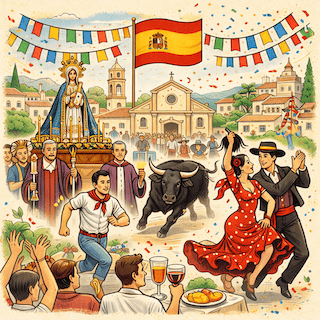
Pueblos en fiesta
Towns in Fiesta
 Learn SpanishFree app with audio, quizzes and real books
Key words
- fiestas patronalespatron saint festivals
- devocióndevotion / piety
- paganaspagan
- romeríaspilgrimages
- cuaresmaLent
- procesiónprocession
- calderetasstews (meat or fish)
- hospitalidadhospitality
- encierrosbull runs
- vínculosbonds / links
- peñassocial clubs / festival groups
- voluntariosvolunteers
All 25 words
- camaraderíacamaraderie / fellowship
- verbenasopen-air festivals / street parties
- pecado originaloriginal sin
- despoblacióndepopulation
- sosteniblesustainable
- éticoethical
- discapacidaddisability
- cohesión socialsocial cohesion
- compromisocommitment
- aglomeracionescrowds / gatherings
- resistencia culturalcultural resistance
- particularidadesparticularities / unique features
- hermitashermitages / small chapels
En España casi no hay pueblo sin fiesta. Entre la primavera y el otoño, y sobre todo en agosto, cada localidad, por pequeña que sea, cuelga banderines en las calles, monta un escenario en la plaza y celebra sus días grandes, casi siempre en las mismas fechas.
In Spain there is hardly a town without its fiesta. Between spring and autumn, and above all in August, every place, however small, hangs bunting across its streets, puts up a stage in the square and celebrates its big days, almost always on the same dates.
Las fiestas cuentan mucho de un lugar: a qué santo se encomendaron sus vecinos, qué hechos recuerdan, qué se cosechaba allí. Durante unos días, los que viven en el pueblo y los que se marcharon vuelven a encontrarse en la calle.
A fiesta tells you a lot about a place: which saint its people entrusted themselves to, which events they remember, what was harvested there. For a few days, those who live in the town and those who left meet again in the street.
De dónde vienen las fiestas patronales
Where patron saint festivals come from
La mayoría de los pueblos españoles celebra sus fiestas en honor de un santo patrón o de una Virgen. La costumbre viene de la Edad Media, cuando cada comunidad se ponía bajo la protección de un santo.
Most Spanish towns hold their fiestas in honour of a patron saint or of a Virgin. The custom goes back to the Middle Ages, when each community placed itself under the protection of a saint.
Al patrón se le pedía ayuda contra las epidemias, las sequías o las plagas que arruinaban las cosechas. Por eso su día era el más señalado del año: había misa solemne, procesión y, después, comida y baile.
People prayed to the patron for help against epidemics, droughts or the pests that ruined the harvest. That is why the saint's day was the most important of the year: there was a solemn Mass, a procession and, afterwards, food and dancing.
Con los siglos, la parte religiosa se fue mezclando con costumbres más antiguas ligadas al campo y a las estaciones, como las hogueras de la noche de San Juan. De esa mezcla nacen muchas de las fiestas actuales.
Over the centuries, the religious side gradually blended with older customs tied to farming and the seasons, such as the bonfires on the night of Saint John. Many of today's fiestas grew out of that mix.
Tipos de fiestas
Types of fiestas
Según su origen, las fiestas españolas se suelen agrupar en unos cuantos tipos, aunque muchas mezclan rasgos de varios.
By origin, Spanish fiestas are usually grouped into a handful of types, although many combine features of several.
Fiestas patronales: en honor del santo o la Virgen que protege el pueblo
Patron saint festivals: in honour of the saint or Virgin who protects the town
Fiestas agrícolas: marcan la cosecha, la vendimia o el cambio de estación
Farming festivals: mark the harvest, the grape harvest or the change of season
Fiestas históricas: recuerdan un hecho del pasado, como los Moros y Cristianos de Alcoy
Historical festivals: recall an event from the past, like the Moors and Christians of Alcoy
Romerías: peregrinaciones a una ermita, como la del Rocío, en Almonte (Huelva)
Romerías: pilgrimages to a hermitage, like the one to El Rocío, in Almonte (Huelva)
Ferias: nacieron como mercados de ganado; hoy tienen casetas, baile y atracciones
Ferias: began as livestock markets; today they have casetas, dancing and fairground rides
Carnavales: disfraces y desfiles antes de la Cuaresma, como en Cádiz o en Tenerife
Carnivals: costumes and parades before Lent, as in Cádiz or Tenerife
Lo que nunca falta
What is always there
Cada fiesta tiene su propio carácter, pero en casi todas se repiten los mismos ingredientes: misa, procesión, música, verbena y fuegos artificiales.
Every fiesta has its own character, but almost all of them share the same ingredients: Mass, a procession, music, an open-air dance and fireworks.
La procesión es el momento más solemne. Los vecinos sacan a hombros la imagen del santo o de la Virgen y la llevan por las calles del pueblo, detrás de la banda de música y entre balcones adornados.
The procession is the most solemn moment. Local people carry the image of the saint or the Virgin on their shoulders through the streets of the town, behind the brass band and past decorated balconies.
La música y el baile son imprescindibles, y cada región tiene los suyos: sevillanas en Andalucía, jotas en Aragón, muiñeiras en Galicia. Por la noche, en la verbena, una orquesta toca en la plaza y la gente baila hasta la madrugada.
Music and dancing are essential, and every region has its own: sevillanas in Andalusia, jotas in Aragon, muiñeiras in Galicia. At night, at the verbena, a band plays in the square and people dance until the small hours.
La comida de las fiestas
Fiesta food
En las fiestas se come mucho y bien. Muchos pueblos tienen un plato o un dulce que solo se prepara esos días.
At fiestas people eat a lot, and eat well. Many towns have a dish or a sweet that is only made on those days.
Es muy común la comida popular: el ayuntamiento o la comisión de fiestas cocina para todos en la plaza y reparte raciones gratis o a un precio simbólico. Se preparan paellas gigantes, calderetas de cordero, migas o cocidos en ollas enormes.
The communal meal is very common: the town hall or the fiesta committee cooks for everyone in the square and hands out portions free or for a token price. There are giant paellas, lamb stews, migas or cocidos in huge pots.
Esas comidas son como una reunión familiar a lo grande. Se montan mesas largas en la calle y se sientan juntos los vecinos, los parientes que vuelven por unos días y los forasteros que estaban de paso.
These meals are like a family gathering on a grand scale. Long tables are set up in the street, and neighbours, relatives back for a few days and strangers who happened to be passing all sit down together.
Fiestas famosas
Famous fiestas
Algunas fiestas locales se han hecho tan famosas que atraen a visitantes de todo el mundo, aunque siguen siendo, ante todo, la fiesta de su ciudad.
Some local fiestas have become so famous that they draw visitors from all over the world, though they are still, above all, their own city's fiesta.
En los Sanfermines de Pamplona, del 7 al 14 de julio, los toros recorren cada mañana a las ocho las calles del casco viejo con cientos de corredores delante. Hemingway los hizo famosos con su novela «Fiesta» (1926). En Buñol (Valencia), el último miércoles de agosto, miles de personas se tiran tomates maduros en la Tomatina.
During San Fermín in Pamplona, from 7 to 14 July, bulls run through the streets of the old town every morning at eight with hundreds of runners ahead of them. Hemingway made the festival famous with his novel The Sun Also Rises (1926). In Buñol (Valencia), on the last Wednesday in August, thousands of people pelt each other with ripe tomatoes at La Tomatina.
En las Fallas de Valencia se levantan por toda la ciudad enormes monumentos llenos de figuras satíricas, que arden la noche del 19 de marzo, día de San José. Y en Semana Santa, las hermandades de Sevilla sacan sus pasos a la calle ante cientos de miles de personas.
During the Fallas in Valencia, huge monuments full of satirical figures go up all over the city and are burned on the night of 19 March, Saint Joseph's Day. And in Holy Week, the brotherhoods of Seville carry their floats through the streets in front of hundreds of thousands of people.
Fiestas pequeñas, gran significado
Small fiestas, big meaning
La mayoría de las fiestas no sale en la televisión. En miles de pueblos pequeños se celebran fiestas modestas que para sus vecinos importan tanto como los Sanfermines para Pamplona.
Most fiestas never make it onto television. In thousands of small towns, modest fiestas are held that matter as much to the locals as San Fermín does to Pamplona.
A veces no participan más que unos cientos de personas, pero esos días se junta todo el pueblo: los jóvenes en sus peñas, los mayores sentados a la fresca, las familias en la plaza.
Sometimes only a few hundred people take part, but on those days the whole town comes together: young people in their peñas, older people sitting outside in the cool of the evening, families in the square.
En agosto, muchos pueblos de Castilla o de Aragón multiplican su población. Vuelven los que emigraron a Madrid, a Barcelona o al extranjero, con sus hijos y nietos, que siguen sintiendo el pueblo como suyo.
In August many towns in Castile or Aragon multiply their population. People who emigrated to Madrid, Barcelona or abroad come back with their children and grandchildren, who still feel the town is theirs.
Peñas y comisiones de fiestas
Peñas and fiesta committees
Detrás de cada fiesta hay meses de trabajo, y casi todo lo hacen voluntarios: la comisión de fiestas, que a menudo cambia cada año, y las peñas.
Behind every fiesta there are months of work, and nearly all of it is done by volunteers: the fiesta committee, which often changes every year, and the peñas.
Las peñas son grupos de amigos que viven la fiesta juntos. Tienen su local, muchas veces un bajo o una bodega, y se distinguen por el color de la camiseta o del blusón. En Pamplona, las peñas animan la plaza de toros con sus charangas.
Peñas are groups of friends who celebrate the fiesta together. They have their own clubhouse, often a ground-floor room or a cellar, and stand out by the colour of their T-shirts or smocks. In Pamplona the peñas liven up the bullring with their brass bands.
La comisión se ocupa de lo práctico: contrata la orquesta, organiza la verbena, pide los permisos y recoge dinero puerta a puerta o con rifas. Sin ella, muchas fiestas pequeñas no podrían celebrarse.
The committee deals with the practical side: it hires the band, organises the verbena, applies for permits and raises money door to door or with raffles. Without it, many small fiestas could not take place.
Costumbres curiosas
Curious customs
Algunas costumbres sorprenden a quien llega de fuera, pero para los vecinos tienen siglos de historia y un sentido muy claro.
Some customs surprise outsiders, but for the locals they have centuries of history and a very clear meaning.
En Castrillo de Murcia (Burgos), durante el Corpus, se celebra El Colacho. Los bebés nacidos ese año se colocan sobre colchones en la calle y un hombre vestido de diablo salta por encima de ellos. Según la tradición, así quedan libres del pecado original.
In Castrillo de Murcia (Burgos), during Corpus Christi, El Colacho is held. Babies born that year are laid on mattresses in the street and a man dressed as the devil jumps over them. According to tradition, this frees them from original sin.
En Piornal (Cáceres), cada mes de enero, en las fiestas de San Sebastián, el Jarramplas recorre las calles con una máscara de cuernos y un traje de colores mientras los vecinos le lanzan nabos. En el carnaval de Laza (Ourense), la gente se arroja tierra mezclada con hormigas vivas.
In Piornal (Cáceres), every January, during the feast of Saint Sebastian, the Jarramplas walks the streets in a horned mask and a colourful costume while the locals throw turnips at him. At the carnival in Laza (Ourense), people throw earth mixed with live ants at each other.
Fiestas y economía local
Fiestas and the local economy
Para muchos pueblos pequeños, las fiestas son también un buen negocio. Hay bares que en esa semana hacen buena parte de la caja de todo el año.
For many small towns, fiestas are also good business. Some bars take in a large share of their whole year's earnings in that one week.
Los visitantes llenan bares, restaurantes y tiendas. Se montan terrazas, puestos de comida y atracciones, y las casas rurales cuelgan el cartel de completo.
Visitors fill the bars, restaurants and shops. Terraces, food stalls and rides are set up, and the rural guesthouses put up the "no vacancies" sign.
En la España vaciada, donde muchos pueblos pierden habitantes año tras año, las fiestas ayudan a que el lugar no se olvide. Algunas, como El Colacho o el Jarramplas, han puesto en el mapa a pueblos muy pequeños.
In "empty Spain", where many villages lose inhabitants year after year, fiestas help keep a place from being forgotten. Some, like El Colacho or the Jarramplas, have put very small towns on the map.
Tradiciones que cambian
Traditions that change
Las fiestas también cambian con los tiempos. Algunas costumbres que hoy se consideran peligrosas o crueles se han suavizado o han desaparecido.
Fiestas change with the times too. Some customs now seen as dangerous or cruel have been toned down or have disappeared.
El debate sobre los animales en las fiestas sigue abierto. En 2016, la Junta de Castilla y León prohibió matar al toro en el Toro de la Vega de Tordesillas; otros pueblos, en cambio, defienden sus festejos taurinos como parte de su identidad.
The debate about animals in fiestas is still open. In 2016 the regional government of Castile and León banned the killing of the bull at the Toro de la Vega in Tordesillas; other towns, by contrast, defend their bull events as part of their identity.
También la tecnología ha llegado a la fiesta: el programa se consulta en el móvil, las peñas se organizan por WhatsApp y las orquestas viajan con escenarios, luces y sonido dignos de un concierto.
Technology has reached the fiesta as well: the programme is checked on a phone, the peñas organise themselves on WhatsApp, and bands travel with stages, lights and sound worthy of a concert.
Fiestas para todos
Fiestas for everyone
Hoy se procura que haya algo para cada edad: hinchables y concursos para los niños, campeonatos de mus o de petanca y bailes de tarde para los mayores.
Today organisers try to offer something for every age: bouncy castles and contests for children, championships of mus or pétanque, and afternoon dances for older people.
Cada vez más localidades piensan también en las personas con discapacidad, con accesos adaptados y espacios reservados. En muchas ferias hay incluso una hora en la que las atracciones apagan la música para los niños con autismo.
More and more towns also think about people with disabilities, with step-free access and reserved areas. At many fairs there is even an hour when the rides switch off their music for children with autism.
En los pueblos donde se han instalado familias de otros países, muchas ya participan en las peñas y en la organización, y a veces la fiesta incorpora música o platos de sus lugares de origen.
In towns where families from other countries have settled, many already take part in the peñas and in the organisation, and sometimes the fiesta takes on music or dishes from their home countries.
Lo que una fiesta cuenta de su pueblo
What a fiesta says about its town
Mirando una fiesta se aprende mucho de un pueblo: si pesa más la religión, el recuerdo de una batalla o simplemente las ganas de pasarlo bien juntos.
Watching a fiesta teaches you a lot about a town: whether religion matters most, the memory of a battle, or simply the wish to have a good time together.
También dice mucho quién la organiza. Donde cada año sobran voluntarios para la comisión, el pueblo suele estar vivo; donde ya nadie se presenta, la fiesta acaba encogiéndose.
Who organises it also says a lot. Where there are more than enough volunteers for the committee every year, the town is usually thriving; where nobody comes forward any more, the fiesta ends up shrinking.
Casi todas mezclan lo antiguo y lo nuevo: por la mañana, la procesión del santo; por la noche, una orquesta que toca las canciones del verano.
Almost all of them mix old and new: in the morning, the saint's procession; at night, a band playing the summer hits.
Consejos para disfrutar de las fiestas
Tips for enjoying fiestas
Si vas a una fiesta de pueblo en España, estos consejos te ayudarán a vivirla mejor.
If you go to a town fiesta in Spain, these tips will help you make the most of it.
Infórmate antes sobre las costumbres de la fiesta y consulta el programa
Find out about the fiesta's customs beforehand and check the programme
Viste como los demás: en Pamplona, por ejemplo, todo el mundo va de blanco con pañuelo rojo
Dress like everyone else: in Pamplona, for example, everybody wears white with a red neckerchief
Respeta las costumbres locales, aunque no las entiendas del todo
Respect local customs, even if you don't fully understand them
Habla con los vecinos: nadie conoce mejor la fiesta
Talk to the locals: nobody knows the fiesta better
Participa: baila en la verbena o apúntate a la comida popular
Join in: dance at the verbena or sign up for the communal meal
Prueba el plato típico de la fiesta
Try the fiesta's typical dish
Cuenta con otros horarios: se cena tarde y la verbena dura hasta la madrugada
Expect different hours: dinner is late and the verbena goes on until the small hours
Ten paciencia con el gentío y el ruido: forman parte de la fiesta
Be patient with the crowds and the noise: they are part of the fiesta
Para terminar
To finish
Grandes o pequeñas, las fiestas son la manera que tiene cada pueblo de contar quién es: a qué santo reza, qué recuerda y qué come cuando está de celebración.
Big or small, fiestas are each town's way of saying who it is: which saint it prays to, what it remembers and what it eats when it celebrates.
Aunque en todo el país suenen las mismas canciones en la radio, cada fiesta conserva algo que solo existe allí: un baile, un dulce, una costumbre que los de fuera no entienden a la primera.
Even though the same songs play on the radio all over the country, every fiesta keeps something that exists only there: a dance, a sweet, a custom that outsiders don't understand at first.
Y casi siempre recibe bien al visitante. Basta con sentarse a una mesa larga en la plaza o quedarse a la verbena para que alguien empiece a contarte la historia de su fiesta.
And it almost always welcomes visitors. Just sit down at a long table in the square or stay for the verbena, and someone will soon start telling you the story of their fiesta.
In the free app you can listen to this text read aloud and tap any word to see what it means.