Todo Flamenco
All About Flamenco
 Learn SpanishFree app with audio, quizzes and real books
Key words
- Patrimonio Cultural InmaterialIntangible Cultural Heritage
- duendemystical inspiration / spirit
- marginaciónmarginalization
- gitanosGypsies / Romani people
- fusión de culturasfusion of cultures
- canto gregorianoGregorian chant
- jornalerosday laborers
- canteflamenco singing
- toqueflamenco guitar playing
- guturalguttural
- rasgueostrumming
- zapateadofootwork
All 25 words
- palosflamenco styles / forms
- compásrhythm / beat
- improvisaciónimprovisation
- persecuciónpersecution
- cafés cantantesmusic cafés
- virtuosismovirtuosity
- trap urbanourban trap
- palmashandclapping
- tablaosflamenco venues
- peñas flamencasflamenco clubs
- juergasspontaneous gatherings / parties
- catarsiscatharsis
- adversidadadversity
El flamenco es cante, guitarra y baile, pero también una manera de estar en el mundo. Nació en Andalucía, sobre todo entre Sevilla, Jerez y Cádiz, en ambientes de gitanos, jornaleros y gente humilde que cantaba lo que vivía. En 2010 la UNESCO lo declaró Patrimonio Cultural Inmaterial de la Humanidad.
Flamenco is singing, guitar and dance, but it is also a way of being in the world. It was born in Andalusia, mainly in the area between Seville, Jerez and Cádiz, among Roma, farm labourers and poor people who sang about their own lives. In 2010 UNESCO declared it part of the Intangible Cultural Heritage of Humanity.
Para entenderlo no basta con oírlo de fondo en un bar. Los aficionados hablan del duende, ese momento en que el artista deja de lucir la técnica y consigue estremecer al público. Las letras tratan de la pena, el amor, la muerte, la fiesta y el orgullo, y el flamenco no ha dejado de cambiar desde que empezó a sonar en público hace más de siglo y medio.
To understand it, hearing it in the background in a bar is not enough. Aficionados talk about duende, the moment when the artist stops showing off technique and manages to send a shiver through the audience. The lyrics deal with sorrow, love, death, celebration and pride, and flamenco has never stopped changing since it was first performed in public more than a century and a half ago.
Un origen mestizo
Mixed Origins
El flamenco tal y como lo conocemos se fue formando a finales del siglo XVIII y principios del XIX en la Baja Andalucía, en barrios como Triana, en Sevilla, o Santiago, en Jerez. Los gitanos fueron decisivos. Sus antepasados habían salido de la India siglos antes y llegaron a la Península en el siglo XV, después de atravesar Europa. En Andalucía se asentaron en barrios donde el cante se transmitía en familia, de padres a hijos.
Flamenco as we know it took shape in the late 18th and early 19th centuries in Lower Andalusia, in neighbourhoods such as Triana in Seville and Santiago in Jerez. The Roma (Gitanos) played a decisive part. Their ancestors had left India centuries earlier and reached the Iberian Peninsula in the 15th century after crossing Europe. In Andalusia they settled in neighbourhoods where singing was passed down within the family, from parents to children.
Pero el flamenco no es solo gitano. Muchos estudiosos ven en él huellas de la música andalusí, de los cantos religiosos y del folclore andaluz y castellano, aunque esas influencias son difíciles de demostrar. Hasta el nombre es un misterio: no se sabe con seguridad por qué, hacia mediados del siglo XIX, se empezó a llamar «flamenco» a esta música. Lo que sí está claro es que surgió entre los pobres: gitanos, jornaleros del campo y artesanos que cantaban en tabernas, fraguas y corrales de vecinos.
But flamenco is not only Gitano. Many scholars see traces in it of the music of al-Andalus, of religious chant and of Andalusian and Castilian folk music, although these influences are hard to prove. Even the name is a mystery: nobody knows for sure why, around the middle of the 19th century, people began calling this music "flamenco". What is clear is that it arose among the poor: Gitanos, farm labourers and craftsmen who sang in taverns, forges and shared courtyards.
Cante, toque y baile
Song, Guitar and Dance
El flamenco tiene tres pilares: el cante (la voz), el toque (la guitarra) y el baile. Cada uno exige años de aprendizaje, pero el flamenco cobra vida de verdad cuando los tres se juntan, en un escenario o en una reunión de amigos.
Flamenco rests on three pillars: cante (the voice), toque (the guitar) and baile (the dance). Each takes years to learn, but flamenco really comes alive when all three come together, on a stage or at a gathering of friends.
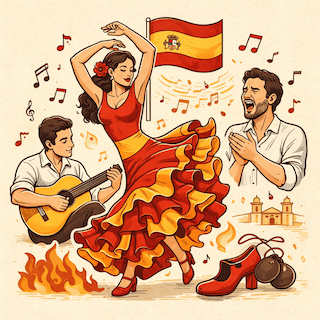
El cante es el centro de todo. La voz flamenca es áspera, a veces rota, y está muy lejos de la limpieza del canto lírico. Al cantaor no se le pide una voz bonita, sino verdad: que transmita lo que dice la letra. La guitarra acompaña y marca el ritmo con técnicas propias, como el rasgueado, en el que los dedos golpean las cuerdas en abanico, o el picado, nota a nota. El bailaor o la bailaora combina el movimiento de brazos y manos con el zapateado, golpes de los pies que suenan como un instrumento más. Los tres se escuchan y se responden: el cantaor alarga un verso, el guitarrista lo sigue y la bailaora lo remata con los pies.
Singing is at the heart of it all. The flamenco voice is rough, sometimes cracked, and far removed from the polish of classical singing. Nobody expects a cantaor to have a pretty voice, but they do expect truth: the singer must convey what the lyrics say. The guitar accompanies and keeps the rhythm with its own techniques, such as rasgueado, in which the fingers strike the strings in a fan-like motion, or picado, note by note. The dancer combines arm and hand movements with zapateado, footwork whose beats sound like another instrument. All three listen and respond to one another: the singer draws out a line, the guitarist follows, and the dancer closes it with her feet.
Los palos: los estilos del flamenco
Palos: the Styles of Flamenco
El flamenco no es un estilo único, sino una familia de palos, que es como se llama a cada uno de sus estilos. Según cómo se cuenten, hay unos cincuenta, cada uno con su ritmo, su melodía y su carácter. Tradicionalmente, los aficionados distinguen el cante jondo, es decir, hondo, grave y serio, del cante chico, más ligero y festivo.
Flamenco is not a single style but a family of palos, the name given to each of its styles. Depending on how you count them, there are about fifty, each with its own rhythm, melody and character. Traditionally, aficionados distinguish cante jondo, meaning "deep" song, grave and serious, from cante chico, which is lighter and more festive.
Entre los palos más jondos están la soleá, cuyo nombre viene de «soledad»; la seguiriya, considerada el más trágico de todos; y las tonás, como el martinete, que se cantan sin guitarra. En el lado alegre están las alegrías de Cádiz y las bulerías de Jerez, rápidas y juguetonas, con las que suelen acabar las fiestas. Los fandangos tienen muchas variantes locales, sobre todo en Huelva. Las sevillanas, que se bailan en la Feria de Abril y en las romerías, son más folclore andaluz que flamenco propiamente dicho, aunque a menudo se meten en el mismo saco. Cada palo tiene su compás, pero dentro de esas reglas el artista tiene mucha libertad.
Among the deepest palos are the soleá, whose name comes from soledad ("solitude"); the seguiriya, considered the most tragic of all; and the tonás, such as the martinete, which are sung without guitar. On the cheerful side are the alegrías from Cádiz and the bulerías from Jerez, fast and playful, which often bring a party to a close. Fandangos have many local variants, especially in Huelva. Sevillanas, danced at the Seville April Fair and on pilgrimages, are more Andalusian folk music than flamenco proper, although they are often lumped together with it. Each palo has its own compás, but within those rules the artist has a great deal of freedom.
El duende
Duende
El duende es una idea central en el flamenco y muy difícil de explicar. No es solo emoción ni solo técnica, sino una especie de trance en el que el artista parece ir más allá de sí mismo.
Duende is a central idea in flamenco and very hard to explain. It is not just emotion or just technique, but a kind of trance in which the artist seems to go beyond themselves.
Quien mejor escribió sobre él fue el poeta Federico García Lorca, en su conferencia «Juego y teoría del duende», que pronunció en Buenos Aires en 1933. Para Lorca, el duende no viene de fuera, como la musa o el ángel, sino que sube por dentro, desde la planta de los pies, como le había oído decir a un viejo guitarrista, y tiene mucho que ver con la muerte. Un artista puede cantar o bailar sin un fallo y no tener duende, mientras que otro, menos pulido, puede tenerlo durante unos segundos inolvidables. El público lo nota enseguida: se le pone la piel de gallina y se le escapa un «¡olé!».
No one wrote about it better than the poet Federico García Lorca, in his lecture "Play and Theory of the Duende", which he gave in Buenos Aires in 1933. For Lorca, duende does not come from outside, like the muse or the angel; it rises from within, up from the soles of the feet, as he had once heard an old guitarist say, and it has a great deal to do with death. An artist can sing or dance without a single mistake and have no duende, while another, less polished, may have it for a few unforgettable seconds. The audience notices at once: they get goosebumps and an "¡olé!" slips out.
El dolor hecho cante
Sorrow Turned into Song
Muchas letras flamencas hablan de penas: amores perdidos, muertes, cárceles, hambre. No es casualidad. El flamenco nació entre gente que vivió durante siglos en la pobreza y, en el caso de los gitanos, también en la persecución.
Many flamenco lyrics are about sorrow: lost loves, deaths, prison, hunger. That is no coincidence. Flamenco was born among people who lived in poverty for centuries and, in the case of the Gitanos, under persecution as well.
Desde 1499, cuando los Reyes Católicos dictaron la primera ley contra ellos, los gitanos fueron obligados una y otra vez a abandonar su lengua, su forma de vestir y su vida itinerante. En 1749, en la llamada Gran Redada, miles de gitanos fueron detenidos en una operación organizada a la vez en toda España. Los jornaleros andaluces, por su parte, trabajaban de sol a sol en los cortijos por un jornal mínimo. El flamenco dio voz a esas vidas que nadie más contaba. Pero no es solo queja: en él hay también orgullo, humor y dignidad, y cantar la pena es una manera de ponerse por encima de ella. Por eso emociona incluso a quien no entiende las letras.
From 1499, when the Catholic Monarchs issued the first law against them, the Gitanos were forced again and again to give up their language, their way of dressing and their travelling life. In 1749, in what is known as the Great Round-up, thousands of Gitanos were arrested in an operation carried out simultaneously across Spain. Andalusian farm labourers, for their part, worked from dawn to dusk on the big estates for a pittance. Flamenco gave a voice to lives that nobody else told. But it is not only lament: there is also pride, humour and dignity in it, and singing about sorrow is a way of rising above it. That is why it moves even people who do not understand the words.
La edad de oro de los cafés cantantes
The Golden Age of the Cafés Cantantes
Durante mucho tiempo el flamenco se cantaba en casa, en bodas, bautizos y fiestas privadas. En la segunda mitad del siglo XIX pasó a los cafés cantantes, locales de Sevilla, Cádiz, Málaga, Madrid y otras ciudades donde el público pagaba la consumición y veía actuar a artistas profesionales.
For a long time flamenco was sung at home, at weddings, christenings and private parties. In the second half of the 19th century it moved into the cafés cantantes, venues in Seville, Cádiz, Málaga, Madrid and other cities where the audience paid for their drinks and watched professional artists perform.
Los cafés profesionalizaron el flamenco y lo acercaron a la clase media. El cantaor Silverio Franconetti, sevillano de padre italiano, abrió en Sevilla uno de los más famosos. En locales como estos empezó, casi una niña, Pastora Pavón, «La Niña de los Peines», una de las grandes voces del siglo XX. No todos estaban contentos: algunos creían que el flamenco perdía pureza al adaptarse al gusto del público. En 1922, Manuel de Falla y Lorca organizaron en Granada el Concurso de Cante Jondo para salvar el cante antiguo. Para entonces los cafés ya estaban en declive, pero el flamenco se había convertido para siempre en un arte de escenario.
The cafés turned flamenco into a profession and brought it closer to the middle class. The singer Silverio Franconetti, a Sevillian with an Italian father, opened one of the most famous of them in Seville. It was in venues like these that Pastora Pavón, "La Niña de los Peines", one of the great voices of the 20th century, started out when she was little more than a child. Not everyone was pleased: some believed flamenco was losing its purity by adapting to public taste. In 1922 Manuel de Falla and Lorca organised the Cante Jondo Competition in Granada to rescue the old style of singing. By then the cafés were already in decline, but flamenco had become a stage art for good.
Grandes nombres
Great Names
Pocos artistas han marcado tanto el flamenco del siglo XX como Camarón de la Isla (1950-1992), nacido en San Fernando, en Cádiz. Con discos como «La leyenda del tiempo» (1979), en el que mezcló el cante con sonidos de rock y jazz, abrió el flamenco a un público joven. Murió con solo 41 años de un cáncer de pulmón, y a su entierro en San Fernando acudieron miles de personas.
Few artists left as deep a mark on 20th-century flamenco as Camarón de la Isla (1950-1992), born in San Fernando, in the province of Cádiz. With albums such as "La leyenda del tiempo" (1979), in which he blended flamenco singing with sounds from rock and jazz, he opened flamenco up to a young audience. He died of lung cancer at just 41, and thousands of people attended his funeral in San Fernando.
Paco de Lucía (1947-2014), de Algeciras, convirtió la guitarra en protagonista. Su rumba «Entre dos aguas» (1973) fue un éxito enorme, y fue él quien introdujo en el flamenco el cajón peruano, hoy imprescindible. En el baile, la barcelonesa Carmen Amaya asombró al mundo con un zapateado rapidísimo y se atrevió a bailar con pantalones, algo insólito en una mujer de su época. Más tarde, Antonio Gades y Cristina Hoyos llevaron el baile al teatro y al cine, sobre todo en las películas de Carlos Saura, como «Bodas de sangre» (1981) y «Carmen» (1983).
Paco de Lucía (1947-2014), from Algeciras, made the guitar the star. His rumba "Entre dos aguas" (1973) was a huge hit, and it was he who brought the Peruvian cajón into flamenco, where it is now indispensable. In dance, Carmen Amaya, from Barcelona, amazed the world with her lightning-fast footwork and dared to dance in trousers, something unheard of for a woman of her time. Later, Antonio Gades and Cristina Hoyos took flamenco dance to the theatre and the cinema, above all in Carlos Saura's films, such as "Blood Wedding" (1981) and "Carmen" (1983).
El flamenco hoy
Flamenco Today
El flamenco de hoy es muy variado. Hay artistas que lo mezclan con jazz, rock, música electrónica o rap. La más conocida fuera de España es Rosalía, una cantante catalana que estudió flamenco y que en su disco «El mal querer» (2018) unió el cante con el pop y la música urbana. Tuvo un éxito internacional enorme y también críticas de quienes la acusaban de apropiarse de una tradición ajena.
Flamenco today is very diverse. Some artists mix it with jazz, rock, electronic music or rap. The best known outside Spain is Rosalía, a Catalan singer who studied flamenco and who, on her album "El mal querer" (2018), combined flamenco singing with pop and urban music. She had huge international success, and also drew criticism from those who accused her of appropriating someone else's tradition.
El flamenco también se ha hecho global. Japón tiene una de las mayores aficiones fuera de España, con cientos de academias, y hay escuelas en Estados Unidos, Alemania y muchos otros países. El debate sigue abierto: unos piensan que el duende solo se alcanza si se ha crecido dentro de esta cultura, y otros creen que las fusiones y los artistas extranjeros mantienen vivo el flamenco. Mientras tanto, cada generación lo cambia un poco sin dejar de mirar a los maestros.
Flamenco has also gone global. Japan has one of the largest followings outside Spain, with hundreds of academies, and there are schools in the United States, Germany and many other countries. The debate is still open: some think duende can only be reached by those who grew up inside this culture, while others believe fusions and foreign artists keep flamenco alive. Meanwhile, each generation changes it a little without losing sight of the masters.
El compás
Compás
El compás es el esquema rítmico de cada palo. No es un ritmo rígido, sino un marco dentro del cual se improvisa. Sin entender el compás es difícil disfrutar del flamenco, e imposible interpretarlo.
Compás is the rhythmic pattern of each palo. It is not a rigid beat but a framework within which artists improvise. Without understanding compás it is hard to enjoy flamenco, and impossible to perform it.
La soleá se cuenta en ciclos de 12 tiempos, con acentos en el 3, el 6, el 8, el 10 y el 12. Las bulerías usan un ciclo parecido, pero mucho más rápido y juguetón. La seguiriya también tiene 12 pulsos, aunque agrupados de forma irregular, lo que le da su aire inquieto. Los tangos, en cambio, van en 4 tiempos, y por eso resultan más fáciles para un oído no acostumbrado. El compás se marca con palmas, pitos (chasquidos de dedos), golpes en la mesa y zapateado. Los artistas lo llevan tan dentro que pueden jugar con él sin perderse nunca.
The soleá is counted in cycles of 12 beats, with accents on 3, 6, 8, 10 and 12. Bulerías use a similar cycle, but much faster and more playful. The seguiriya also has 12 pulses, though grouped irregularly, which gives it its restless feel. Tangos, by contrast, are in 4 beats, which is why they are easier for an untrained ear. Compás is marked with palmas (handclaps), pitos (finger snaps), knocks on the table and zapateado. Artists carry it so deep inside them that they can play with it without ever getting lost.
Tablaos, peñas y juergas
Tablaos, Peñas and Juergas
Los tablaos son locales donde se ofrecen espectáculos de flamenco cada noche; su nombre viene de «tablado», el pequeño escenario de madera. Se extendieron en los años cincuenta y sesenta, con la llegada del turismo, y hoy son la forma más habitual de ver flamenco profesional en Madrid, Sevilla o Barcelona. En Madrid, el Corral de la Morería abrió en 1956 y sigue funcionando.
Tablaos are venues that put on flamenco shows every night; the name comes from tablado, the small wooden stage. They spread in the 1950s and 1960s with the arrival of tourism, and today they are the most common way to see professional flamenco in Madrid, Seville or Barcelona. In Madrid, the Corral de la Morería opened in 1956 and is still going.
Muchos aficionados, sin embargo, prefieren las peñas flamencas, asociaciones que organizan recitales en locales pequeños, o las juergas, reuniones informales entre amigos y familia. En el tablao el espectáculo está pensado para un público que paga y que a menudo viene de fuera; en la peña o en la juerga todo es más espontáneo y la gente participa con palmas y jaleos. Las dos cosas tienen su sitio: el tablao ofrece artistas de primera fila a cualquier visitante, y la peña permite ver el flamenco de cerca, entre quienes lo viven a diario.
Many aficionados, however, prefer the peñas flamencas, associations that organise recitals in small venues, or juergas, informal gatherings of friends and family. In a tablao the show is designed for a paying audience that often comes from elsewhere; at a peña or a juerga everything is more spontaneous, and people join in with handclaps and shouts of encouragement. Both have their place: the tablao offers any visitor top-class artists, and the peña lets you see flamenco up close, among people who live it every day.
El flamenco como identidad
Flamenco as Identity
Para muchos andaluces y gitanos, el flamenco no es solo un arte, sino parte de lo que son. Hay sagas familiares que lo transmiten desde hace generaciones, como los Habichuela en Granada o los Farruco en Sevilla, en las que los niños aprenden a cantar, tocar y bailar en casa.
For many Andalusians and Gitanos, flamenco is not just an art but part of who they are. Some family dynasties have been passing it down for generations, such as the Habichuelas in Granada or the Farrucos in Seville, where children learn to sing, play and dance at home.
El flamenco es también una seña de pertenencia. El Estatuto de Autonomía de Andalucía de 2007 lo menciona expresamente como parte del patrimonio andaluz, y en muchas familias saber estar en una juerga, llevar el compás con las palmas o reconocer un cante es algo que se aprende desde pequeño. Por eso algunas fusiones despiertan rechazo: no se ven solo como un cambio de estilo, sino como algo que afecta a la propia identidad. La discusión entre puristas e innovadores es casi tan antigua como el propio flamenco.
Flamenco is also a sign of belonging. Andalusia's Statute of Autonomy of 2007 explicitly names it as part of the region's heritage, and in many families knowing how to behave at a juerga, keep the compás with your hands or recognise a style of cante is something you learn as a child. That is why some fusions meet resistance: they are seen not only as a change of style but as something that touches people's very identity. The argument between purists and innovators is almost as old as flamenco itself.
Para terminar
To Sum Up
El flamenco nació de la pobreza y la marginación, pero no se limita a lamentarse: convierte la pena en música y la muestra con orgullo. Por eso un buen cante por seguiriyas puede dejar en silencio una sala entera, y una bulería al final de la noche puede ponerla a dar palmas.
Flamenco was born of poverty and marginalisation, but it does not just lament: it turns sorrow into music and displays it with pride. That is why a fine seguiriya can silence an entire room, and a bulería at the end of the night can get the same room clapping.
Hoy el flamenco se escucha en grandes festivales, como la Bienal de Flamenco de Sevilla, que se celebra desde 1980, o el Festival del Cante de las Minas de La Unión, en Murcia, que nació en 1961. Pero sigue vivo también en peñas de pueblo, en patios y en fiestas familiares. Para un estudiante de español es, además, una buena puerta al habla andaluza: en las letras se oye «cantaor» en lugar de «cantador» o «quejío» en lugar de «quejido», y una forma de pronunciar que no aparece en los libros de texto.
Today flamenco can be heard at major festivals such as the Seville Flamenco Biennial, held since 1980, or the Cante de las Minas Festival in La Unión, Murcia, which began in 1961. But it also lives on in village peñas, in courtyards and at family parties. For a learner of Spanish it is also a good way into Andalusian speech: in the lyrics you hear cantaor instead of cantador, or quejío instead of quejido, and a way of pronouncing words that you won't find in textbooks.
In the free app you can listen to this text read aloud and tap any word to see what it means.