Comer tarde
Eating Late in Spain
 Learn SpanishFree app with audio, quizzes and real books
Key words
- huso horariotime zone
- tardíoslate
- raícesroots
- sincronizarto synchronize
- longitudlongitude / length
- prolongadaprolonged / extended
- siestanap / siesta
- jornada laboralworkday / working day
- partidasplit / divided
- persistepersists / continues
- tentempiésnack / bite to eat
- sobremesaafter-dinner conversation
All 25 words
- impensableunthinkable
- arraigadadeep-rooted
- llevaderabearable / manageable
- déficitdeficit / shortage
- alinearto align
- promoviendopromoting
- madrugadaearly morning / dawn
- identidadidentity
- equilibriobalance
- disminuyedecreases / diminishes
- peculiaridadpeculiarity / quirk
- bocadillosandwich (baguette style)
- hábitoshabits
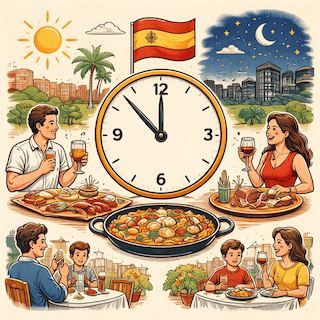
España tiene fama de comer tarde. En buena parte de Europa se cena entre las seis y las siete de la tarde, mientras que en España lo normal es sentarse a la mesa entre las nueve y las diez de la noche. Detrás de esta costumbre hay razones históricas, climáticas y sociales.
Spain is known for eating late. In much of Europe people have dinner between six and seven in the evening, while in Spain it is normal to sit down to eat between nine and ten at night. There are historical, climatic and social reasons behind this habit.
A muchos visitantes extranjeros les sorprende encontrar los restaurantes vacíos a las ocho de la tarde. Para los españoles, en cambio, cenar a las diez es lo más normal del mundo.
Many foreign visitors are surprised to find restaurants empty at eight in the evening. For Spaniards, on the other hand, having dinner at ten is the most normal thing in the world.
El problema del huso horario
The time zone problem
Una de las explicaciones más citadas es el huso horario. Por su posición en el mapa, la España peninsular debería tener la misma hora que Portugal y el Reino Unido, la del meridiano de Greenwich (GMT). Sin embargo, sigue la hora de Europa Central (GMT+1), como Francia o Alemania. Solo Canarias tiene una hora menos.
One of the most frequently cited explanations is the time zone. Given its position on the map, mainland Spain ought to have the same time as Portugal and the United Kingdom, Greenwich Mean Time (GMT). Instead, it follows Central European Time (GMT+1), like France or Germany. Only the Canary Islands are an hour behind.
El cambio llegó en marzo de 1940, en plena dictadura de Franco: el Gobierno adelantó los relojes una hora para igualarlos con los de la Alemania nazi y la Italia fascista. Al terminar la Segunda Guerra Mundial nadie dio marcha atrás, y España se ha quedado con esa hora hasta hoy.
The change came in March 1940, during Franco's dictatorship: the government put the clocks forward an hour to bring them into line with Nazi Germany and Fascist Italy. When the Second World War ended, nobody reversed it, and Spain has kept that time ever since.
Por eso, según el reloj, en España el sol sale y se pone más tarde que en otros países situados a la misma longitud. En junio, en Galicia el sol se pone hacia las diez de la noche, y en Madrid, poco antes. Con tanta luz por la tarde, las comidas y la hora de irse a dormir se retrasan.
As a result, by the clock, the sun rises and sets later in Spain than in other countries at the same longitude. In June the sun sets around ten at night in Galicia, and a little earlier in Madrid. With so much daylight in the evening, meals and bedtime get pushed back.
El calor del verano
The summer heat
El clima también influye. En verano, en ciudades como Sevilla o Córdoba el termómetro supera a menudo los 40 grados. Por eso la comida principal se toma hacia las dos o las tres de la tarde, y después se evita salir a la calle en las horas de más calor.
The climate plays a part too. In summer, the thermometer often goes above 40 degrees in cities like Seville or Córdoba. That is why the main meal is eaten around two or three in the afternoon, and afterwards people avoid going outside during the hottest hours.
Tradicionalmente, después de comer muchos españoles echaban la siesta. Así descansaban mientras fuera apretaba el calor y recuperaban fuerzas para la tarde y la noche. Hoy, sobre todo en las ciudades, pocos pueden dormirla a diario.
Traditionally, many Spaniards had a siesta after lunch. That way they rested while the heat was at its worst outside and recharged for the afternoon and evening. Today, especially in cities, few people can take one every day.
Cuando cae el sol y baja la temperatura, la calle se llena de vida. En verano es habitual ver a familias enteras paseando a las diez de la noche o tomando algo en una terraza. Cenar tarde permite aprovechar esas horas más frescas.
When the sun goes down and the temperature drops, the streets come to life. In summer it is common to see whole families out for a walk at ten at night or having a drink on a terrace. Eating dinner late makes the most of those cooler hours.
La jornada partida
The split working day
Durante décadas, en España ha sido muy común la jornada partida. Se entraba a trabajar a las nueve, se paraba entre las dos y las cuatro para comer y descansar, y se volvía a la oficina o a la tienda hasta las ocho de la tarde.
For decades, the split working day was very common in Spain. People started work at nine, stopped between two and four to eat and rest, and went back to the office or shop until eight in the evening.
Con este horario, mucha gente no llega a casa hasta las ocho y media o las nueve. Luego hay que preparar la cena, así que no es raro sentarse a la mesa a las diez.
With this schedule, many people don't get home until half past eight or nine. Then dinner has to be made, so it's not unusual to sit down to eat at ten.
Cada vez más empresas, sobre todo en las grandes ciudades, han pasado a la jornada continua. Aun así, la costumbre de comer y cenar tarde se mantiene, y los restaurantes, los bares y las tiendas siguen organizando sus horarios en torno a ella.
More and more companies, especially in big cities, have switched to a continuous working day. Even so, the habit of having lunch and dinner late lives on, and restaurants, bars and shops still plan their opening hours around it.
Cinco comidas al día
Five meals a day
Los españoles no solo comen tarde: también reparten lo que comen en más momentos del día. Un día típico puede tener cinco comidas:
Spaniards don't just eat late: they also spread what they eat over more points in the day. A typical day can include five meals:
Desayuno (7:00-9:00): algo ligero, como café con tostadas o con galletas.
Breakfast (7:00-9:00): something light, such as coffee with toast or biscuits.
Almuerzo o media mañana (11:00-12:00): un bocadillo o una pieza de fruta.
Almuerzo or mid-morning snack (11:00-12:00): a sandwich or a piece of fruit.
Comida (14:00-16:00): la comida principal del día, con primero, segundo y postre.
Lunch (14:00-16:00): the main meal of the day, with a first course, a second course and dessert.
Merienda (17:00-18:00): algo ligero, muy típico de los niños.
Merienda (17:00-18:00): something light, very typical for children.
Cena (21:00-23:00): más ligera que la comida, pero sigue siendo una comida completa.
Dinner (21:00-23:00): lighter than lunch, but still a full meal.
Repartir así la comida a lo largo del día ayuda a aguantar las largas jornadas de trabajo sin pasar hambre hasta la hora de la cena.
Spreading meals out over the day like this helps people get through long working days without going hungry until dinnertime.
Comer en compañía
Eating together
En España, comer no es solo alimentarse: es un acto social. La comida y la cena sirven para reunirse con la familia o con los amigos y charlar sin prisa. Después del postre llega la sobremesa, ese rato en el que nadie se levanta de la mesa y que puede alargarse durante horas.
In Spain, eating isn't just about food: it's a social occasion. Lunch and dinner are a chance to get together with family or friends and chat without hurrying. After dessert comes the sobremesa, the time when nobody gets up from the table, which can stretch on for hours.
Las encuestas sobre el uso del tiempo lo confirman: los españoles, igual que los franceses o los italianos, pasan bastante más tiempo a la mesa que, por ejemplo, los británicos.
Time use surveys bear this out: Spaniards, like the French or the Italians, spend considerably more time at the table than, say, the British.
Para muchos españoles, comer deprisa y solo delante del ordenador es casi impensable. La comida es un momento para estar con los demás, no un trámite entre dos tareas.
For many Spaniards, eating quickly and alone in front of the computer is almost unthinkable. A meal is a time to be with other people, not a chore squeezed between two tasks.
Ir de tapas
Going for tapas
Las tapas encajan muy bien con estos horarios. Entre la comida y la cena pasan muchas horas, así que hacia las siete u ocho de la tarde es habitual quedar con amigos o compañeros de trabajo para tomar unas cañas y algo de picar.
Tapas fit these hours very well. There are many hours between lunch and dinner, so around seven or eight in the evening it's common to meet friends or colleagues for a few small beers and something to nibble.
Así la espera hasta la cena se hace más corta. En ciudades como Granada, León o Almería, donde con cada bebida sale una tapa gratis, ir de tapas es casi un ritual diario.
That makes the wait for dinner feel shorter. In cities like Granada, León or Almería, where every drink comes with a free tapa, going for tapas is almost a daily ritual.
Efectos en la salud y el sueño
Effects on health and sleep
Estos horarios tienen un precio. Muchos españoles cenan y se acuestan tarde, pero el despertador suena igual de temprano que en el resto de Europa, de modo que acaban durmiendo menos de lo que necesitan.
These hours come at a price. Many Spaniards eat dinner and go to bed late, but the alarm goes off just as early as in the rest of Europe, so they end up sleeping less than they need.
Los médicos recuerdan que acostarse poco después de una cena copiosa puede dificultar la digestión y empeorar el sueño. Algunos estudios relacionan además las cenas muy tardías con un mayor riesgo de obesidad.
Doctors point out that going to bed soon after a heavy dinner can make digestion harder and sleep worse. Some studies also link very late dinners to a higher risk of obesity.
Cambios recientes y debate social
Recent changes and public debate
Desde hace años se discute en España si conviene cambiar la hora oficial y los horarios de trabajo. En 2013, una subcomisión del Congreso recomendó volver a la hora de Greenwich, pero la propuesta no salió adelante.
For years Spain has debated whether to change its official time and working hours. In 2013 a subcommittee of the Spanish parliament recommended going back to Greenwich time, but the proposal went nowhere.
Asociaciones como ARHOE, que lleva años pidiendo unos horarios más racionales, defienden además la jornada continua, por ejemplo de nueve de la mañana a cinco o seis de la tarde, con una pausa corta para comer. Así la gente llegaría antes a casa y podría cenar más temprano.
Associations such as ARHOE, which has spent years calling for more sensible hours, also argue for a continuous working day, for example from nine in the morning to five or six in the evening, with a short lunch break. That way people would get home earlier and could have dinner sooner.
Pero una costumbre tan arraigada no cambia de un día para otro. Muchos españoles no quieren renunciar a sus horarios: para ellos, las tardes largas y las cenas tardías forman parte de su manera de vivir.
But such a deep-rooted habit doesn't change overnight. Many Spaniards don't want to give up their hours: for them, long evenings and late dinners are part of their way of life.
Otros países del Mediterráneo
Other Mediterranean countries
En otros países del sur de Europa, como Italia o Grecia, también se come y se cena más tarde que en el norte del continente. Aun así, España está entre los países donde se cena más tarde.
In other southern European countries, such as Italy or Greece, people also have lunch and dinner later than in the north of the continent. Even so, Spain is among the countries where dinner is eaten latest.
En Italia, por ejemplo, se suele cenar hacia las ocho de la noche, una o dos horas antes que en España. En Portugal, con un clima parecido pero con la hora de Greenwich, también se cena antes. Todo indica que el clima influye, pero que el reloj y los horarios de trabajo pesan tanto o más.
In Italy, for example, people usually have dinner around eight in the evening, one or two hours earlier than in Spain. In Portugal, which has a similar climate but uses Greenwich time, dinner is also earlier. Everything suggests that the climate plays a part, but that the clock and working hours matter just as much or more.
Algunas curiosidades
Some curiosities
En España, el horario de máxima audiencia de la televisión empieza hacia las 22:00 o las 22:30, uno de los más tardíos de Europa.
In Spain, television prime time starts around 22:00 or 22:30, one of the latest in Europe.
Los españoles suelen cenar unas dos horas más tarde que los alemanes o los británicos.
Spaniards usually have dinner about two hours later than Germans or the British.
En verano no es raro ver a niños jugando en los parques a las once de la noche.
In summer it's not unusual to see children playing in parks at eleven at night.
Muchos restaurantes no empiezan a servir cenas hasta las 20:30 o las 21:00.
Many restaurants don't start serving dinner until 20:30 or 21:00.
La «madrugada» son las horas entre la medianoche y el amanecer, y un sábado es normal volver a casa de madrugada.
The "madrugada" is the time between midnight and dawn, and on a Saturday it's normal to get home in the madrugada.
Conclusión
Conclusion
Los horarios españoles son el resultado de varios factores a la vez: un reloj adelantado desde 1940, unos veranos muy calurosos, la jornada partida y una vida social que gira en torno a la mesa.
Spain's eating hours are the result of several factors at once: clocks set an hour ahead since 1940, very hot summers, the split working day and a social life that revolves around the table.
Tienen sus inconvenientes, sobre todo para el sueño, y el debate sobre cambiarlos sigue abierto. Pero, de momento, quien visite España tendrá que acostumbrarse a comer a las dos y media y a cenar a las diez.
They have their drawbacks, especially for sleep, and the debate about changing them is still open. But for now, anyone visiting Spain will have to get used to having lunch at half past two and dinner at ten.
In the free app you can listen to this text read aloud and tap any word to see what it means.