Guerra Civil
The Spanish Civil War
 Learn SpanishFree app with audio, quizzes and real books
Key words
- bando republicanoRepublican side
- bando nacionalNationalist side
- golpe militarmilitary coup
- reforma agrariaagrarian reform
- terratenienteslandowners
- polarizaciónpolarization
- fuerzas lealesloyalist forces
- brigadas internacionalesinternational brigades
- ensayo generaldress rehearsal
- no intervenciónnon-intervention
- guerra de desgastewar of attrition
- retaguardiarear / behind the lines
All 20 words
- ejecuciones extrajudicialesextrajudicial executions
- exilioexile
- fosas comunesmass graves
- memoria históricahistorical memory
- transición a la democraciatransition to democracy
- pacto del olvidopact of forgetting
- consenso políticopolitical consensus
- heridas que sanarwounds to heal
La Guerra Civil española enfrentó a los españoles entre julio de 1936 y abril de 1939. En menos de tres años murieron unas 500.000 personas, según las estimaciones más citadas: soldados caídos en el frente, víctimas de los bombardeos y miles de civiles asesinados lejos de las trincheras.
The Spanish Civil War set Spaniards against each other from July 1936 to April 1939. In less than three years, around 500,000 people died, according to the most widely cited estimates: soldiers killed at the front, victims of air raids and thousands of civilians murdered far from the trenches.
Fue también un conflicto internacional. Alemania e Italia ayudaron a un bando, la Unión Soviética al otro, y miles de voluntarios extranjeros vinieron a luchar a España. Muchas cosas de la España actual, desde sus debates políticos hasta las fosas comunes que todavía se excavan, solo se entienden a partir de esta guerra.
It was also an international conflict. Germany and Italy helped one side, the Soviet Union the other, and thousands of foreign volunteers came to fight in Spain. Much of present-day Spain, from its political debates to the mass graves still being excavated, can only be understood in light of this war.
Las raíces del conflicto
The roots of the conflict
A principios del siglo XX, España estaba dividida por varias fracturas a la vez. Unas pocas familias poseían enormes fincas, sobre todo en Andalucía y Extremadura, mientras cientos de miles de jornaleros solo encontraban trabajo unos meses al año. Además, chocaban el poder central y las regiones que pedían autogobierno, y los partidarios de modernizar el país con los defensores de la tradición.
In the early 20th century, Spain was split along several fault lines at once. A handful of families owned huge estates, especially in Andalusia and Extremadura, while hundreds of thousands of day labourers could only find work a few months a year. On top of that, the central government clashed with regions demanding self-rule, and those who wanted to modernise the country clashed with the defenders of tradition.
La Iglesia católica tenía una enorme influencia y dirigía buena parte de los colegios. El ejército, con demasiados oficiales para su tamaño, intervenía a menudo en la política: entre 1923 y 1930, el general Miguel Primo de Rivera gobernó como dictador con el apoyo del rey. En Cataluña y el País Vasco, fuertes movimientos nacionalistas pedían que se reconocieran su lengua y sus propias instituciones. Ningún gobierno logró resolver estas tensiones por la vía pacífica.
The Catholic Church had enormous influence and ran a large share of the schools. The army, which had far too many officers for its size, often meddled in politics: from 1923 to 1930, General Miguel Primo de Rivera ruled as dictator with the king's backing. In Catalonia and the Basque Country, strong nationalist movements wanted their language and their own institutions recognised. No government managed to resolve these tensions peacefully.
La Segunda República (1931-1936)
The Second Republic (1931-1936)
El 12 de abril de 1931, los partidos republicanos ganaron las elecciones municipales en casi todas las grandes ciudades. Dos días después se proclamó la Segunda República, y el rey Alfonso XIII se marchó al exilio. Miles de personas salieron a la calle a celebrarlo, convencidas de que empezaba una época de reformas.
On 12 April 1931, the republican parties won the municipal elections in almost every large city. Two days later the Second Republic was proclaimed, and King Alfonso XIII went into exile. Thousands of people took to the streets to celebrate, convinced that an era of reform was beginning.
La nueva Constitución separó la Iglesia del Estado y reconoció el voto femenino. El gobierno de Manuel Azaña aprobó una reforma agraria y una reforma militar, y en 1932 Cataluña obtuvo su Estatuto de Autonomía. Estos cambios irritaron a la Iglesia, a los grandes propietarios y a parte del ejército, mientras muchos obreros y campesinos se quejaban de que la reforma agraria avanzaba demasiado despacio. En 1933 ganó la derecha; en octubre de 1934, el ejército aplastó una revolución obrera en Asturias, y en febrero de 1936 venció el Frente Popular, una coalición de izquierdas. La primavera de 1936 fue de huelgas, iglesias incendiadas y asesinatos políticos por ambas partes.
The new Constitution separated Church and State and gave women the vote. Manuel Azaña's government passed a land reform and a military reform, and in 1932 Catalonia obtained its Statute of Autonomy. These changes angered the Church, the big landowners and part of the army, while many workers and peasants complained that land reform was moving far too slowly. In 1933 the right won; in October 1934 the army crushed a workers' revolution in Asturias; and in February 1936 the Popular Front, a left-wing coalition, came to power. The spring of 1936 brought strikes, burned churches and political killings on both sides.
El golpe de julio de 1936
The coup of July 1936
El 17 de julio de 1936, las tropas destinadas en el Marruecos español se sublevaron contra el gobierno del Frente Popular, y al día siguiente la rebelión se extendió a la Península. La había planeado el general Emilio Mola. Francisco Franco tomó el mando del ejército de África, y José Sanjurjo, que debía encabezar el levantamiento, murió el 20 de julio en un accidente de avioneta. Los conspiradores contaban con hacerse con el poder en pocos días.
On 17 July 1936, the troops stationed in Spanish Morocco rose up against the Popular Front government, and the next day the rebellion spread to the mainland. It had been planned by General Emilio Mola. Francisco Franco took command of the Army of Africa, and José Sanjurjo, who was meant to lead the uprising, died in a light-aircraft crash on 20 July. The plotters expected to seize power within a few days.
Pero el golpe solo triunfó en parte. Fracasó en Madrid, Barcelona, Valencia y Bilbao, donde los sindicatos, los partidos obreros y las fuerzas de orden público que se mantuvieron leales lo frenaron en la calle. Los sublevados, que pronto se llamaron a sí mismos "nacionales", dominaban Galicia, Navarra, Castilla la Vieja y parte de Andalucía, con ciudades como Sevilla y Zaragoza. España quedó partida en dos zonas, y lo que había empezado como un golpe se convirtió en una guerra de casi tres años.
But the coup only partly succeeded. It failed in Madrid, Barcelona, Valencia and Bilbao, where the trade unions, the workers' parties and the police forces that stayed loyal stopped it in the streets. The rebels, who soon called themselves "Nationalists", held Galicia, Navarre, Old Castile and part of Andalusia, including cities such as Seville and Zaragoza. Spain was split into two zones, and what had begun as a coup turned into a war lasting nearly three years.
Los dos bandos
The two sides
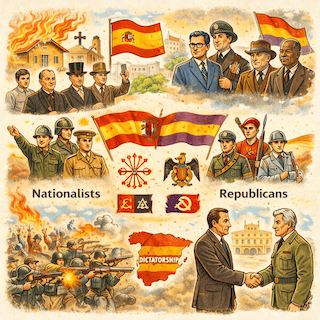
El bando republicano reunía a fuerzas muy distintas: republicanos de izquierda, socialistas, comunistas, anarquistas de la CNT, el POUM y los nacionalistas vascos y catalanes. Lo apoyaban también muchos maestros, escritores y artistas. Pero las diferencias entre ellos eran profundas. Unos querían ante todo ganar la guerra; otros, hacer al mismo tiempo la revolución. En mayo de 1937, anarquistas y comunistas llegaron a enfrentarse a tiros en las calles de Barcelona.
The Republican side brought together very different forces: left-wing republicans, socialists, communists, the anarchists of the CNT, the POUM, and Basque and Catalan nationalists. Many teachers, writers and artists supported it too. But the differences between them ran deep. Some wanted above all to win the war; others wanted to make a revolution at the same time. In May 1937, anarchists and communists even exchanged fire in the streets of Barcelona.
En el bando sublevado estaban buena parte del ejército, la mayoría de la Iglesia, los grandes propietarios, los monárquicos, los carlistas y la Falange, un partido de corte fascista fundado en 1933 por José Antonio Primo de Rivera. Decían luchar por el orden, la religión y la unidad de España. En octubre de 1936, Franco fue nombrado jefe del Estado y Generalísimo, y en abril de 1937 unió por decreto a falangistas y carlistas en un partido único bajo su mando. Así fue concentrando en sus manos todo el poder.
On the rebel side were a large part of the army, most of the Church, the big landowners, the monarchists, the Carlists and the Falange, a fascist-style party founded in 1933 by José Antonio Primo de Rivera. They claimed to be fighting for order, religion and the unity of Spain. In October 1936, Franco was named head of state and Generalísimo, and in April 1937 he merged the Falangists and Carlists by decree into a single party under his command. In this way he gradually gathered all power into his own hands.
Una guerra con ayuda extranjera
A war with foreign help
La guerra traspasó enseguida las fronteras de España. Varias potencias europeas tomaron partido, y muchos historiadores la ven como un ensayo general de la Segunda Guerra Mundial, que estalló apenas cinco meses después de que terminara.
The war quickly spilled beyond Spain's borders. Several European powers took sides, and many historians see it as a dress rehearsal for the Second World War, which broke out just five months after it ended.
La Alemania de Hitler y la Italia de Mussolini enviaron a Franco aviones, tanques y armas. Italia mandó además decenas de miles de soldados, y Alemania, la Legión Cóndor, una unidad de aviación. El 26 de abril de 1937, aviones de la Legión Cóndor, con apoyo italiano, bombardearon Guernica, la villa más simbólica del País Vasco; ese mismo año, Picasso pintó su famoso cuadro sobre la matanza. La Unión Soviética vendió armas a la República y envió asesores, y la Internacional Comunista organizó las Brigadas Internacionales, en las que lucharon más de 30.000 voluntarios de unos 50 países. Francia y el Reino Unido, en cambio, impulsaron un acuerdo de no intervención que Alemania e Italia firmaron sin cumplirlo, y que dejó a la República casi sin poder comprar armas.
Hitler's Germany and Mussolini's Italy sent Franco aircraft, tanks and weapons. Italy also sent tens of thousands of soldiers, and Germany the Condor Legion, an air unit. On 26 April 1937, Condor Legion planes, with Italian support, bombed Guernica, the most symbolic town in the Basque Country; that same year, Picasso painted his famous picture of the massacre. The Soviet Union sold weapons to the Republic and sent advisers, and the Communist International organised the International Brigades, in which more than 30,000 volunteers from some 50 countries fought. France and Britain, by contrast, pushed for a non-intervention agreement that Germany and Italy signed without honouring, and which left the Republic almost unable to buy arms.
Tres años de guerra
Three years of war
Los dos bandos esperaban una victoria rápida, pero la guerra se alargó casi tres años. Hubo grandes ofensivas, batallas de desgaste en pleno invierno, como la de Teruel, y largos periodos de frente quieto, con trincheras parecidas a las de la Primera Guerra Mundial.
Both sides expected a quick victory, but the war dragged on for almost three years. There were major offensives, battles of attrition in the depths of winter, such as Teruel, and long periods when the front stood still, with trenches like those of the First World War.
En noviembre de 1936, las tropas de Franco llegaron a las afueras de Madrid, pero la ciudad resistió con el lema "¡No pasarán!" y no cayó hasta el final de la guerra. En 1937, los nacionales conquistaron el norte, con Bilbao, Santander y Asturias, y en abril de 1938 llegaron al Mediterráneo y partieron en dos la zona republicana. La batalla del Ebro, entre julio y noviembre de 1938, fue la más larga y sangrienta de la guerra. Gracias a la ayuda alemana e italiana, el ejército de Franco tenía más aviones y mejor armamento. Barcelona cayó el 26 de enero de 1939, y el 28 de marzo las tropas nacionales entraron en Madrid.
In November 1936, Franco's troops reached the outskirts of Madrid, but the city held out under the slogan "They shall not pass!" and did not fall until the end of the war. In 1937 the Nationalists conquered the north, including Bilbao, Santander and Asturias, and in April 1938 they reached the Mediterranean and cut the Republican zone in two. The Battle of the Ebro, from July to November 1938, was the longest and bloodiest of the war. Thanks to German and Italian aid, Franco's army had more aircraft and better weapons. Barcelona fell on 26 January 1939, and on 28 March Nationalist troops entered Madrid.
La violencia en la retaguardia
Violence behind the lines
Lejos de los frentes también se mataba. En las dos zonas hubo detenciones, "paseos" nocturnos y fusilamientos sin juicio, y muchas veces la violencia enfrentó a vecinos del mismo pueblo.
Killing went on far from the front as well. In both zones there were arrests, night-time "rides" (paseos) and executions without trial, and the violence often pitted neighbours from the same village against each other.
En la zona republicana, sobre todo en los primeros meses, grupos armados asesinaron a religiosos, propietarios y personas de derechas. Murieron casi 7.000 sacerdotes, frailes y monjas, y en noviembre de 1936 miles de presos sacados de las cárceles de Madrid fueron fusilados en Paracuellos. En la zona sublevada, la represión fue sistemática y se ordenaba desde arriba: se fusiló a alcaldes, maestros, sindicalistas y a cualquiera sospechoso de simpatizar con la República. En agosto de 1936 mataron cerca de Granada al poeta Federico García Lorca. Los historiadores calculan que hubo unos 50.000 muertos en la retaguardia republicana y más de 100.000 en la de los sublevados.
In the Republican zone, especially in the first months, armed groups murdered clergy, property owners and people seen as right-wing. Nearly 7,000 priests, monks and nuns were killed, and in November 1936 thousands of prisoners taken from Madrid's jails were shot at Paracuellos. In the rebel zone, the repression was systematic and ordered from above: mayors, teachers, trade unionists and anyone suspected of sympathising with the Republic were shot. In August 1936 the poet Federico García Lorca was killed near Granada. Historians estimate that around 50,000 people were killed behind the Republican lines and more than 100,000 behind the rebel lines.
La victoria de Franco
Franco's victory
El 1 de abril de 1939, el último parte de guerra del cuartel general de Franco anunciaba: "La guerra ha terminado". No hubo reconciliación. Franco gobernó España como dictador durante 36 años, hasta su muerte el 20 de noviembre de 1975.
On 1 April 1939, the last war report from Franco's headquarters announced: "The war is over." There was no reconciliation. Franco ruled Spain as dictator for 36 years, until his death on 20 November 1975.
Para los vencidos empezó una larga posguerra. Decenas de miles de personas fueron fusiladas después de 1939, y cientos de miles pasaron por cárceles y campos de concentración. Ya en el invierno de 1939, casi medio millón de personas habían cruzado a pie la frontera francesa; muchas se quedaron para siempre en el exilio, en Francia, México y otros países de América. El régimen prohibió los partidos y los sindicatos libres, y persiguió el uso público del catalán, el vasco y el gallego. Fueron los "años del hambre": las cartillas de racionamiento duraron hasta 1952, y en 1946 la ONU pidió a sus miembros que retiraran a sus embajadores de Madrid.
For the defeated, a long post-war period began. Tens of thousands of people were executed after 1939, and hundreds of thousands passed through prisons and concentration camps. As early as the winter of 1939, nearly half a million people had crossed the French border on foot; many stayed in exile for good, in France, Mexico and other countries in the Americas. The regime banned political parties and free trade unions, and suppressed the public use of Catalan, Basque and Galician. These were the "years of hunger": ration books lasted until 1952, and in 1946 the UN asked its members to withdraw their ambassadors from Madrid.
Lo que dejó la guerra
What the war left behind
Unas 500.000 personas murieron en la guerra, entre combatientes y civiles. Muchos pueblos quedaron en ruinas, igual que puentes, carreteras, vías de tren y fábricas. Belchite, en Aragón, quedó tan destrozado que se construyó un pueblo nuevo al lado; las ruinas del viejo siguen hoy en pie.
Around 500,000 people died in the war, soldiers and civilians alike. Many villages lay in ruins, as did bridges, roads, railway lines and factories. Belchite, in Aragon, was so badly destroyed that a new town was built next to it; the ruins of the old one still stand today.
Las heridas sociales duraron mucho más. Durante décadas, España estuvo dividida en "vencedores" y "vencidos", y muchas familias se rompieron: hermanos que habían luchado en bandos opuestos, padres e hijos separados por el exilio. Bajo la dictadura reinaron el miedo y el silencio, y en muchas casas no se hablaba de la guerra. El país perdió además a muchos de sus mejores maestros, científicos y artistas. Antonio Machado murió en Colliure, en Francia, en febrero de 1939, y Luis Buñuel, Pau Casals o el futuro premio Nobel Severo Ochoa vivieron y trabajaron durante décadas lejos de España.
The social wounds lasted much longer. For decades, Spain was divided into "victors" and "vanquished", and many families were torn apart: brothers who had fought on opposite sides, parents and children separated by exile. Under the dictatorship, fear and silence reigned, and in many homes the war was never mentioned. The country also lost many of its best teachers, scientists and artists. Antonio Machado died in Collioure, France, in February 1939, and Luis Buñuel, Pau Casals and the future Nobel laureate Severo Ochoa lived and worked far from Spain for decades.
La memoria histórica
Historical memory
Tras la muerte de Franco en 1975, España pasó a la democracia sin una ruptura violenta. Para lograrlo, los principales partidos aceptaron no remover el pasado, y la Ley de Amnistía de 1977 impidió juzgar los crímenes de la dictadura. A este acuerdo tácito se le suele llamar "pacto del olvido".
After Franco's death in 1975, Spain moved to democracy without a violent break. To make this possible, the main parties agreed not to dig up the past, and the 1977 Amnesty Law prevented the dictatorship's crimes from being tried. This tacit agreement is often called the "pact of forgetting".
Aquel pacto facilitó la Transición, pero dejó muchas cuentas pendientes. Decenas de miles de personas siguen enterradas en fosas comunes, en cunetas y junto a las tapias de los cementerios, y sus familias todavía buscan sus restos. En 2007 se aprobó la Ley de Memoria Histórica, que reconoció a las víctimas de la guerra y la dictadura, y en 2022, la Ley de Memoria Democrática. En 2019, los restos de Franco salieron del Valle de los Caídos, hoy llamado Valle de Cuelgamuros. Aun así, la guerra sigue siendo un tema delicado, y cada paso provoca debates políticos.
That pact smoothed the Transition, but it left a lot of unfinished business. Tens of thousands of people still lie in mass graves, in roadside ditches and along cemetery walls, and their families are still searching for their remains. In 2007 the Historical Memory Law was passed, recognising the victims of the war and the dictatorship, followed in 2022 by the Democratic Memory Law. In 2019, Franco's remains were removed from the Valley of the Fallen, now called the Valley of Cuelgamuros. Even so, the war remains a sensitive subject, and every step sparks political debate.
La guerra, hoy
The war today
La Guerra Civil no estalló de repente. Fue el final violento de décadas de conflictos sin resolver, entre ricos y pobres, entre el poder central y las regiones, entre la Iglesia y quienes querían un Estado laico. La República no logró cerrarlos, y un golpe militar los convirtió en guerra.
The Civil War did not come out of nowhere. It was the violent end point of decades of unresolved conflicts: between rich and poor, between the central government and the regions, between the Church and those who wanted a secular state. The Republic failed to settle them, and a military coup turned them into war.
Sus huellas siguen visibles en la España actual. El Guernica de Picasso cuelga desde 1992 en el Museo Reina Sofía de Madrid. Cada año se abren nuevas fosas y se publican libros y novelas sobre la guerra, como "Soldados de Salamina", de Javier Cercas. Y la Constitución de 1978 la redactaron juntos políticos herederos de los dos bandos, entre ellos un comunista y un antiguo ministro de Franco.
Its traces are still visible in Spain today. Picasso's Guernica has hung in Madrid's Reina Sofía Museum since 1992. Every year new graves are opened and new books and novels about the war come out, such as Javier Cercas's "Soldiers of Salamis". And the 1978 Constitution was drafted jointly by politicians descended from both sides, among them a communist and a former minister of Franco's.
In the free app you can listen to this text read aloud and tap any word to see what it means.