Al-Ándalus
Al-Andalus
 Learn SpanishFree app with audio, quizzes and real books
Key words
- dominio musulmánMuslim rule
- sentar las basesto lay the foundations
- califatocaliphate
- eruditosscholars / pundits
- arcos de herradurahorseshoe arches
- astrolabioastrolabe
- acequiairrigation ditch / canal
- noriawaterwheel
- mozárabeMozarab (Christian living under Muslim rule)
- moriscoMorisco (Muslim convert to Christianity)
- estilo mudéjarMudejar style
- yeseríasplasterwork / stucco work
All 25 words
- azulejotile
- mocárabesmuqarnas / honeycomb vaulting
- laúdlute
- trovadorestroubadours
- amor cortéscourtly love
- huertaorchard / vegetable garden
- tratados de agronomíatreatises on agronomy
- injertografting
- puente culturalcultural bridge
- alcantarilladosewage system
- instrumentos quirúrgicossurgical instruments
- trascendentaltranscendental / fundamental
- caligrafíacalligraphy
Al-Ándalus es el nombre que los árabes dieron a los territorios de la península ibérica bajo dominio musulmán, desde el desembarco de 711 hasta la caída de Granada en 1492. Durante casi ocho siglos, sus ciudades estuvieron entre las más ricas y cultas de la Europa medieval.
Al-Andalus is the name the Arabs gave to the parts of the Iberian Peninsula under Muslim rule, from the landing of 711 to the fall of Granada in 1492. For almost eight centuries, its cities were among the richest and most cultured in medieval Europe.
Su huella llegó mucho más allá de los Pirineos. Libros de medicina, astronomía y filosofía escritos o estudiados en al-Ándalus se tradujeron al latín y se leyeron en las universidades europeas. Y en España esa herencia sigue a la vista: en miles de palabras del español, en monumentos como la Alhambra o la Mezquita de Córdoba y en lo que comemos cada día.
Its influence reached far beyond the Pyrenees. Books on medicine, astronomy and philosophy written or studied in al-Andalus were translated into Latin and read in Europe's universities. And in Spain that heritage is still easy to see: in thousands of Spanish words, in monuments such as the Alhambra and the Mosque of Córdoba, and in what people eat every day.
Conquista y nacimiento de al-Ándalus
The conquest and the birth of al-Andalus
En la primavera de 711, un ejército de unos pocos miles de hombres, en su mayoría bereberes, cruzó el Estrecho desde el norte de África al mando de Tariq ibn Ziyad. De su nombre viene Gibraltar: Yabal Tariq, «el monte de Tariq». El reino visigodo estaba dividido por luchas internas, y ese verano, junto al río Guadalete, los recién llegados derrotaron al rey Rodrigo, que murió o desapareció en la batalla.
In the spring of 711, an army of a few thousand men, mostly Berbers, crossed the Strait from North Africa under the command of Tariq ibn Ziyad. Gibraltar takes its name from him: Jabal Tariq, "Tariq's mountain". The Visigothic kingdom was torn by internal feuds, and that summer, by the river Guadalete, the newcomers defeated King Roderic, who was killed or vanished in the battle.
La conquista fue asombrosamente rápida. En pocos años, los musulmanes dominaban casi toda la península, salvo las montañas del norte. Muchas ciudades se rindieron sin combatir y firmaron pactos. El más famoso, el del noble visigodo Teodomiro en 713, permitía a los cristianos de la zona de Murcia conservar su fe y sus iglesias a cambio de un tributo anual. Cristianos y judíos pagaban además un impuesto personal, la yizya. Esta tolerancia limitada marcó buena parte de la historia de al-Ándalus.
The conquest was astonishingly fast. Within a few years, the Muslims controlled almost the whole peninsula apart from the mountains in the north. Many cities surrendered without a fight and signed treaties. The best known, made with the Visigothic noble Theodemir in 713, let the Christians around Murcia keep their faith and their churches in return for an annual tribute. Christians and Jews also paid a poll tax, the jizya. This limited tolerance shaped much of the history of al-Andalus.
Córdoba, capital del saber
Córdoba, capital of learning
En 929, Abderramán III se proclamó califa, y Córdoba pasó a ser la capital de un estado poderoso que duró hasta 1031. Era entonces una de las mayores ciudades de Europa. Nadie sabe con exactitud cuántos habitantes tenía: las estimaciones van de unos 100.000 a varios cientos de miles, cuando París o Londres eran mucho más pequeñas.
In 929, Abd al-Rahman III proclaimed himself caliph, and Córdoba became the capital of a powerful state that lasted until 1031. At the time it was one of the largest cities in Europe. Nobody knows exactly how many people lived there: estimates range from about 100,000 to several hundred thousand, at a time when Paris and London were far smaller.
Las crónicas árabes describen una ciudad deslumbrante, con baños públicos, mercados, jardines y calles empedradas. El califa al-Hakam II reunió una biblioteca enorme: según los cronistas, unos 400.000 volúmenes, aunque la cifra seguramente es exagerada. A pocos kilómetros, Abderramán III mandó construir Medina Azahara, una ciudad palacio que impresionaba a los embajadores de Bizancio y de los reinos cristianos, y que fue saqueada en 1010. Poetas, médicos y sabios llegaban a Córdoba desde todo el mundo islámico.
Arabic chronicles describe a dazzling city with public baths, markets, gardens and paved streets. Caliph al-Hakam II built up a huge library: about 400,000 volumes according to the chroniclers, though the figure is almost certainly exaggerated. A few kilometres away, Abd al-Rahman III had Madinat al-Zahra built, a palace city that impressed ambassadors from Byzantium and the Christian kingdoms and was sacked in 1010. Poets, doctors and scholars came to Córdoba from all over the Islamic world.
Ciencia y matemáticas
Science and mathematics
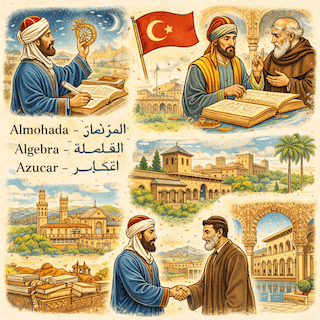
En al-Ándalus se estudiaban las matemáticas que llegaban de Bagdad, y por esta vía Europa conoció los números indoarábigos, con el cero, que facilitaban mucho los cálculos. El monje Gerberto de Aurillac, futuro papa Silvestre II, los aprendió en Cataluña hacia el año 970. La palabra «álgebra» viene del árabe al-yabr, del título de un libro de al-Juarismi, un sabio de Bagdad del siglo IX, y de su nombre procede «algoritmo».
In al-Andalus people studied the mathematics that came from Baghdad, and this was one of the routes by which Europe learned about Hindu-Arabic numerals, including zero, which made calculation much easier. The monk Gerbert of Aurillac, later Pope Sylvester II, learned them in Catalonia around 970. The word "algebra" comes from the Arabic al-jabr, from the title of a book by al-Khwarizmi, a ninth-century scholar in Baghdad, and his name gave us "algorithm".
En astronomía destacó Azarquiel, que trabajó en Toledo en el siglo XI: perfeccionó el astrolabio y participó en las Tablas toledanas, que se usaron en Europa durante generaciones. En medicina sobresalió Abulcasis (al-Zahrawi), nacido cerca de Córdoba y muerto hacia 1013, que escribió una enorme enciclopedia médica. La parte dedicada a la cirugía describe y dibuja unos 200 instrumentos, como bisturíes, pinzas y ganchos. Se tradujo al latín en el siglo XII y se estudió en Europa durante siglos.
In astronomy the leading figure was al-Zarqali (Arzachel), who worked in Toledo in the 11th century: he improved the astrolabe and helped compile the Toledan Tables, which were used in Europe for generations. In medicine the great name was Abulcasis (al-Zahrawi), born near Córdoba and died around 1013, who wrote a vast medical encyclopedia. Its section on surgery describes and draws some 200 instruments, such as scalpels, forceps and hooks. It was translated into Latin in the 12th century and studied in Europe for centuries.
Filosofía y traducciones
Philosophy and translation
En la Europa latina se habían perdido muchas obras de los antiguos griegos, sobre todo de ciencia y filosofía. En el mundo islámico, en cambio, se habían traducido al árabe desde el siglo IX, y en al-Ándalus se leían y comentaban textos de Aristóteles, Euclides, Ptolomeo o Galeno.
Latin Europe had lost many works by the ancient Greeks, especially in science and philosophy. In the Islamic world, by contrast, they had been translated into Arabic since the ninth century, and in al-Andalus scholars read and commented on texts by Aristotle, Euclid, Ptolemy and Galen.
El cordobés Averroes (Ibn Rushd, 1126-1198) escribió comentarios tan completos sobre Aristóteles que en Europa lo llamaban simplemente «el Comentador». Maimónides, judío nacido también en Córdoba, intentó conciliar la fe con la filosofía de Aristóteles en su Guía de perplejos. Tras la conquista cristiana de Toledo en 1085, la ciudad se llenó de traductores que pasaron al latín muchas obras árabes; solo Gerardo de Cremona tradujo más de setenta. Así llegaron estas ideas a las universidades de París y Oxford en el siglo XIII.
Averroes (Ibn Rushd, 1126-1198), from Córdoba, wrote such thorough commentaries on Aristotle that in Europe he was simply called "the Commentator". Maimonides, a Jew also born in Córdoba, tried to reconcile faith with Aristotle's philosophy in his Guide for the Perplexed. After the Christian conquest of Toledo in 1085, the city filled with translators who turned many Arabic works into Latin; Gerard of Cremona alone translated more than seventy. That is how these ideas reached the universities of Paris and Oxford in the 13th century.
Arquitectura: una herencia a la vista
Architecture: a heritage in plain sight
La arquitectura es la herencia más visible de al-Ándalus. La Mezquita de Córdoba, empezada por Abderramán I hacia 785 y ampliada varias veces durante dos siglos, impresiona por su bosque de columnas y sus arcos de herradura con dovelas rojas y blancas. Desde 1236 es la catedral de la ciudad.
Architecture is the most visible legacy of al-Andalus. The Mosque of Córdoba, begun by Abd al-Rahman I around 785 and enlarged several times over two centuries, is striking for its forest of columns and its horseshoe arches with red and white voussoirs. Since 1236 it has been the city's cathedral.
La Alhambra de Granada, levantada sobre todo en el siglo XIV por los reyes nazaríes, es la cumbre de este arte: patios con fuentes, como el de los Leones, techos de mocárabes, zócalos de azulejos y paredes cubiertas de yeserías e inscripciones en árabe. En Sevilla, la Giralda fue el alminar de la gran mezquita almohade, construido a finales del siglo XII. Para subir no tiene escaleras, sino rampas, y el campanario de lo alto se añadió en el siglo XVI. Tras la conquista cristiana, muchos artesanos musulmanes siguieron trabajando para reyes y obispos. Así nació el arte mudéjar, que puede verse, por ejemplo, en el Alcázar de Sevilla.
The Alhambra in Granada, built mostly in the 14th century by the Nasrid kings, is the high point of this art: courtyards with fountains, such as the Court of the Lions, muqarnas ceilings, tiled dados and walls covered in carved plaster and Arabic inscriptions. In Seville, the Giralda was the minaret of the great Almohad mosque, built at the end of the 12th century. Instead of stairs it has ramps, and the bell tower at the top was added in the 16th century. After the Christian conquest, many Muslim craftsmen went on working for kings and bishops. This gave rise to Mudéjar art, which can be seen, for example, in the Alcázar of Seville.
El árabe en el español
Arabic in Spanish
El árabe dejó una huella profunda en el español. Se calcula que unas 4.000 palabras, contando las derivadas, tienen origen árabe. Después del latín, es una de las lenguas que más vocabulario han aportado, y muchas de esas palabras se usan a diario.
Arabic left a deep mark on Spanish. It is estimated that some 4,000 words, counting derivatives, are of Arabic origin. After Latin, it is one of the languages that have contributed the most vocabulary, and many of these words are used every day.
Del campo y la cocina: acequia, aceite, aceituna, algodón, azúcar, zanahoria, berenjena, albahaca. De la casa: azotea, alcoba, aldea, tabique, azulejo. De la ciencia: álgebra, cifra, alquimia. De la administración: alcalde, aduana, alguacil. Muchas empiezan por «al», el artículo árabe, que se quedó pegado a la palabra. Hasta «ojalá» viene del árabe hispánico law sha Allah, «si Dios quiere». Ocho siglos de vida en común dejaron su marca en la lengua de todos los días.
From farming and cooking: acequia (irrigation channel), aceite (oil), aceituna (olive), algodón (cotton), azúcar (sugar), zanahoria (carrot), berenjena (aubergine), albahaca (basil). From the home: azotea (flat roof), alcoba (bedroom), aldea (village), tabique (partition wall), azulejo (glazed tile). From science: álgebra (algebra), cifra (figure), alquimia (alchemy). From administration: alcalde (mayor), aduana (customs), alguacil (bailiff). Many begin with "al", the Arabic article, which stayed stuck to the word. Even "ojalá" comes from the Andalusi Arabic law sha Allah, "if God wills". Eight centuries of life side by side left their mark on everyday language.
Agricultura y regadío
Farming and irrigation
Los andalusíes transformaron la agricultura de la península. Trajeron o extendieron cultivos de Oriente que en Europa eran nuevos o raros: la naranja amarga, el limón, la berenjena, la espinaca, la alcachofa, el arroz, el algodón y la caña de azúcar. Muchos de sus nombres en español vienen precisamente del árabe.
The people of al-Andalus transformed farming in the peninsula. They brought in or spread crops from the East that were new or rare in Europe: bitter oranges, lemons, aubergines, spinach, artichokes, rice, cotton and sugar cane. Many of their Spanish names come from Arabic.
También perfeccionaron el regadío. Construyeron acequias, norias que subían el agua de los ríos y qanats, galerías subterráneas que la traían desde lejos. Gracias a ellos florecieron las huertas de Valencia y Murcia. Agrónomos como el sevillano Ibn al-Awwam, a finales del siglo XII, escribieron tratados sobre injertos, abonos y cuidado de los frutales. En Valencia, el Tribunal de las Aguas, que según la tradición viene de aquella época, sigue reuniéndose cada jueves a la puerta de la catedral para resolver los conflictos del riego.
They also improved irrigation. They built irrigation channels, waterwheels that lifted water from rivers, and qanats, underground tunnels that carried it from far away. Thanks to them the market gardens of Valencia and Murcia flourished. Agronomists such as Ibn al-Awwam of Seville, at the end of the 12th century, wrote treatises on grafting, manure and the care of fruit trees. In Valencia, the Water Tribunal, which tradition traces back to that period, still meets every Thursday at the door of the cathedral to settle disputes over irrigation.
La convivencia: mito y realidad
Convivencia: myth and reality
La llamada «convivencia» entre musulmanes, cristianos y judíos es uno de los temas más discutidos de al-Ándalus. En algunas épocas, sobre todo bajo el califato, hubo bastante tolerancia: las tres comunidades vivían en las mismas ciudades, compraban en los mismos mercados y a veces trabajaban juntas.
The so-called "convivencia", or coexistence, of Muslims, Christians and Jews is one of the most debated subjects in the history of al-Andalus. In some periods, especially under the caliphate, there was considerable tolerance: the three communities lived in the same cities, shopped in the same markets and sometimes worked together.
Los cristianos, llamados mozárabes, y los judíos podían practicar su religión si pagaban la yizya, pero tenían menos derechos que los musulmanes. Los judíos vivieron aquí una edad de oro: Hasdai ibn Shaprut fue médico y diplomático de Abderramán III, y Samuel ibn Nagrela llegó a visir en Granada. Pero también hubo violencia. En 1066, una multitud mató a numerosos judíos en Granada. Con los almorávides y los almohades, que llegaron del norte de África a finales del siglo XI y a mediados del XII, la presión creció: muchos cristianos fueron deportados a África y muchos judíos huyeron, entre ellos la familia de Maimónides. La realidad fue compleja: ni un paraíso de tolerancia ni una opresión constante.
Christians, known as Mozarabs, and Jews could practise their religion if they paid the jizya, but they had fewer rights than Muslims. Jews enjoyed a golden age here: Hasdai ibn Shaprut was physician and diplomat to Abd al-Rahman III, and Samuel ibn Naghrela rose to be vizier in Granada. But there was violence too. In 1066 a mob killed large numbers of Jews in Granada. Under the Almoravids and the Almohads, who came from North Africa at the end of the 11th century and in the mid-12th century, the pressure grew: many Christians were deported to Africa and many Jews fled, among them the family of Maimonides. The reality was complex: neither a paradise of tolerance nor constant oppression.
Música y poesía
Music and poetry
Al-Ándalus fue también tierra de músicos y poetas. En 822 llegó a Córdoba desde Bagdad Ziryab, un músico famoso que, según se cuenta, añadió una quinta cuerda al laúd y fundó una escuela de canto. El laúd, cuyo nombre viene del árabe al-ud, y el rabel pasaron a la música de la Europa cristiana. Hay quien ve ecos de esta música en el flamenco, aunque la relación es discutida.
Al-Andalus was also a land of musicians and poets. In 822 Ziryab, a famous musician, came to Córdoba from Baghdad; he is said to have added a fifth string to the lute and founded a school of singing. The lute, whose name comes from the Arabic al-ud, and the rebec passed into the music of Christian Europe. Some hear echoes of this music in flamenco, although the link is disputed.
La poesía alcanzó un gran refinamiento. Junto a la poesía árabe clásica nacieron formas nuevas, como la moaxaja, que solía cerrarse con unos versos en romance, las jarchas, y el zéjel, escrito en el árabe que se hablaba en la calle. Las jarchas están entre los textos más antiguos de la lírica en lengua romance. En el siglo XI, la princesa Wallada y el poeta Ibn Zaydún vivieron en Córdoba una historia de amor que se hizo famosa por sus versos. Algunos estudiosos creen que esta poesía amorosa influyó en los trovadores provenzales y en el amor cortés, pero es un tema muy debatido.
Poetry reached great refinement. Alongside classical Arabic poetry, new forms emerged, such as the muwashshah, which usually ended with a few lines in Romance, the kharjas, and the zajal, written in the Arabic spoken in the street. The kharjas are among the oldest surviving lyric texts in a Romance language. In the 11th century, Princess Wallada and the poet Ibn Zaydun had a love affair in Córdoba that became famous through their verses. Some scholars believe this love poetry influenced the Provençal troubadours and courtly love, but the question is hotly debated.
El fin de al-Ándalus
The end of al-Andalus
Con el avance de los reinos cristianos, el territorio de al-Ándalus se fue reduciendo. Alfonso VI de Castilla tomó Toledo en 1085. Tras la victoria cristiana de Las Navas de Tolosa, en 1212, Fernando III conquistó Córdoba en 1236 y Sevilla en 1248. Solo quedó el reino nazarí de Granada, que resistió dos siglos y medio más.
As the Christian kingdoms advanced, the territory of al-Andalus shrank. Alfonso VI of Castile took Toledo in 1085. After the Christian victory at Las Navas de Tolosa in 1212, Ferdinand III conquered Córdoba in 1236 and Seville in 1248. Only the Nasrid kingdom of Granada remained, and it held out for another two and a half centuries.
El 2 de enero de 1492, el sultán Boabdil entregó Granada a los Reyes Católicos. Fue el final político de al-Ándalus, pero no el de su gente. A principios del siglo XVI, los musulmanes que se habían quedado fueron obligados a bautizarse, y se les llamó moriscos. Muchos siguieron hablando árabe y conservando sus costumbres en secreto, hasta que entre 1609 y 1614 unos 300.000 fueron expulsados de España. Su herencia, sin embargo, sigue viva en el idioma, en los campos de regadío, en la cocina y en los edificios de media España.
On 2 January 1492, Sultan Boabdil handed Granada over to the Catholic Monarchs. It was the political end of al-Andalus, but not the end of its people. In the early 16th century, the Muslims who had stayed were forced to be baptised, and they became known as Moriscos. Many went on speaking Arabic and keeping their customs in secret, until between 1609 and 1614 some 300,000 of them were expelled from Spain. Their heritage, however, lives on in the language, in the irrigated fields, in the cooking and in buildings across much of Spain.
Datos curiosos sobre al-Ándalus
Curious facts about al-Andalus
En el siglo X, Córdoba era una de las mayores ciudades de Europa.
In the 10th century, Córdoba was one of the largest cities in Europe.
La Mezquita de Córdoba conserva 856 columnas, muchas reaprovechadas de edificios romanos y visigodos.
The Mosque of Córdoba still has 856 columns, many of them reused from Roman and Visigothic buildings.
El tratado de cirugía de Abulcasis, con dibujos de sus instrumentos, se estudió en Europa durante siglos.
Abulcasis's treatise on surgery, with drawings of his instruments, was studied in Europe for centuries.
En Xàtiva (Valencia) ya se fabricaba papel en el siglo XII, uno de los primeros lugares de Europa en hacerlo.
Paper was already being made in Xàtiva (Valencia) in the 12th century, one of the first places in Europe to do so.
A Ziryab, músico llegado de Bagdad en 822, se le atribuye haber puesto orden en la mesa, de la sopa al postre, y haber traído a Córdoba ropa distinta para cada estación.
Ziryab, a musician who came from Baghdad in 822, is credited with bringing order to meals, from soup to dessert, and with introducing different clothes for each season in Córdoba.
Las universidades europeas enseñaban medicina con libros árabes traducidos en Toledo, como el Canon de Avicena.
European universities taught medicine with Arabic books translated in Toledo, such as Avicenna's Canon.
Una herencia viva
A living heritage
Al-Ándalus fue uno de los capítulos más ricos y complejos de la historia de Europa. Durante casi ocho siglos, sus ciudades unieron Oriente y Occidente: recogieron el saber griego y el de Bagdad, lo ampliaron con trabajos propios en medicina, astronomía y filosofía, y dejaron obras de arte que todavía hoy se visitan.
Al-Andalus was one of the richest and most complex chapters in European history. For almost eight centuries its cities linked East and West: they gathered the learning of the Greeks and of Baghdad, added their own work in medicine, astronomy and philosophy, and left works of art that people still visit today.
Su herencia no se limita a España, porque sus libros, traducidos al latín, se leyeron en toda Europa. Pero es aquí donde más se nota. Cada año, millones de personas recorren la Alhambra y la Mezquita de Córdoba, y casi a diario, sin darnos cuenta, decimos palabras como aceite, azúcar, almohada u ojalá, que llegaron con el árabe hace más de mil años.
Its legacy is not confined to Spain, because its books, translated into Latin, were read all over Europe. But it is here that it shows most. Every year millions of people walk through the Alhambra and the Mosque of Córdoba, and almost every day, without realising it, we say words such as aceite, azúcar, almohada (pillow) or ojalá, which arrived with Arabic more than a thousand years ago.
In the free app you can listen to this text read aloud and tap any word to see what it means.