Las muchas Españas
The Many Spains
 Learn SpanishFree app with audio, quizzes and real books
Key words
- mosaico de culturasmosaic of cultures
- raíces históricashistorical roots
- fuerosregional charters / historical laws
- autogobiernoself-government
- independentismoindependence movement
- lengua romanceRomance language
- tradiciones ancestralesancestral traditions
- sistema fiscaltax system
- gaitabagpipe
- peregrinaciónpilgrimage
- arquitectura moriscaMoorish architecture
- Patrimonio de la HumanidadWorld Heritage
All 19 words
- plurilingüemultilingual
- comunidad autónomaautonomous community
- competenciaspowers / jurisdictions
- estereotipostereotype
- ahorradorthrifty / saver
- procesionesprocessions
- encierrorunning of the bulls
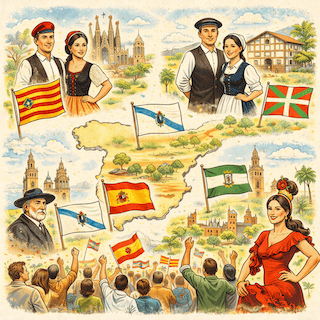
Pocas cosas sorprenden tanto al viajero como lo distinta que es España de una región a otra. Entre Santiago de Compostela y Cádiz cambian el paisaje, la cocina, el acento y, a veces, hasta la lengua. España no es un país uniforme, sino un mosaico de culturas e identidades que comparten un mismo Estado.
Few things surprise travellers as much as how different Spain is from one region to the next. Between Santiago de Compostela and Cádiz the landscape, the food, the accent and sometimes even the language change. Spain is not a uniform country but a mosaic of cultures and identities sharing a single state.
Esas diferencias no son solo folclore para turistas. Tienen raíces históricas y lingüísticas profundas, han dado al país una enorme riqueza cultural y también han provocado fuertes tensiones políticas. Para muchos españoles, sentirse catalán, vasco o gallego es tan importante como sentirse español, o incluso más.
These differences are not just folklore for tourists. They have deep historical and linguistic roots, they have given the country enormous cultural wealth, and they have also caused serious political tensions. For many Spaniards, feeling Catalan, Basque or Galician matters as much as feeling Spanish, or even more.
Las raíces de la diversidad
The roots of diversity
La explicación está en la historia. En la Edad Media, la península ibérica estaba repartida entre varios reinos: Castilla, Aragón, Navarra y Portugal en el norte y el centro, y el reino musulmán de Granada en el sur. Cada uno tenía sus propias leyes, sus costumbres y, a menudo, su propia lengua. La unificación fue lenta y nunca llegó a ser completa: Portugal acabó siendo un país independiente.
The explanation lies in history. In the Middle Ages the Iberian Peninsula was divided among several kingdoms: Castile, Aragon, Navarre and Portugal in the north and centre, and the Muslim kingdom of Granada in the south. Each had its own laws, its own customs and often its own language. Unification was slow and never complete: Portugal ended up as an independent country.
En 1469 se casaron Isabel de Castilla y Fernando de Aragón, los Reyes Católicos, y diez años después sus dos coronas quedaron unidas. Pero no crearon un Estado centralizado: cada territorio conservó sus instituciones y sus leyes propias, los fueros. Además, las montañas dificultaban la comunicación entre regiones, y cada zona fue desarrollando su propio carácter. Hubo intentos serios de centralizar el país, sobre todo con los Borbones en el siglo XVIII y durante la dictadura de Franco, pero ninguno logró borrar las identidades regionales.
In 1469 Isabella of Castile and Ferdinand of Aragon, the Catholic Monarchs, married, and ten years later their two crowns were united. But they did not create a centralised state: each territory kept its own institutions and its own laws, the fueros. On top of that, the mountains made communication between regions difficult, and each area developed its own character. There were serious attempts to centralise the country, above all under the Bourbons in the 18th century and during Franco's dictatorship, but none managed to erase the regional identities.
Cataluña: lengua, cultura e independentismo
Catalonia: language, culture and independence
Pocas regiones tienen una identidad tan fuerte como Cataluña. Está en el noreste, su capital es Barcelona y tiene lengua propia, el catalán, además de tradiciones muy suyas, como los castells, las torres humanas. Su autogobierno viene de lejos: en 1359 nació la Generalitat, que todavía hoy da nombre a su gobierno.
Few regions have an identity as strong as Catalonia's. It lies in the northeast, its capital is Barcelona, and it has its own language, Catalan, as well as traditions all of its own, such as the castells, or human towers. Its self-government goes back a long way: the Generalitat was founded in 1359, and its name is still used for the Catalan government today.
El catalán es una lengua romance distinta del castellano. Lo hablan unos diez millones de personas en Cataluña, la Comunidad Valenciana, las Baleares y Andorra, donde es la única lengua oficial. Durante el franquismo quedó apartado de la vida pública, y defenderlo se convirtió en una forma de resistencia. Hoy Cataluña es una de las regiones más ricas de España y también el centro del debate sobre la independencia. Durante años, las encuestas han mostrado a los catalanes divididos casi a partes iguales entre quienes quieren separarse y quienes prefieren seguir en España con más autonomía. La tensión llegó a su punto más alto el 1 de octubre de 2017, con un referéndum de independencia que el Tribunal Constitucional había prohibido.
Catalan is a Romance language distinct from Castilian Spanish. It is spoken by about ten million people in Catalonia, the Valencian Community, the Balearic Islands and Andorra, where it is the only official language. Under Franco it was pushed out of public life, and defending it became a form of resistance. Today Catalonia is one of the richest regions in Spain and also the centre of the debate on independence. For years, polls have shown Catalans split almost evenly between those who want to break away and those who prefer to stay in Spain with more autonomy. Tension peaked on 1 October 2017, with an independence referendum that the Constitutional Court had banned.
País Vasco: el euskera y una identidad única
The Basque Country: Basque and a unique identity
El País Vasco, Euskadi en euskera, tiene una de las identidades más antiguas y singulares de Europa. Lo más llamativo es su lengua: el euskera no está emparentado con ninguna otra lengua conocida. Es anterior a la llegada de las lenguas indoeuropeas y ha sobrevivido miles de años en estos valles de montaña.
The Basque Country, Euskadi in Basque, has one of the oldest and most distinctive identities in Europe. The most striking thing is its language: Basque, or Euskara, is not related to any other known language. It predates the arrival of the Indo-European languages and has survived for thousands of years in these mountain valleys.
La identidad vasca se apoya en la lengua, en tradiciones muy antiguas, como el deporte rural de levantar piedras o cortar troncos, y en la conciencia de ser un pueblo distinto. Durante décadas, la banda terrorista ETA usó la violencia para conseguir la independencia: mató a más de 800 personas, anunció el fin de sus atentados en 2011 y se disolvió en 2018. Hoy el País Vasco tiene un nivel de autogobierno muy alto, con su propia Hacienda y su propia policía, la Ertzaintza. El independentismo existe, pero es menos fuerte que en Cataluña, y muchos vascos se sienten cómodos con este modelo dentro de España.
Basque identity rests on the language, on very old traditions such as the rural sports of stone lifting and log chopping, and on a sense of being a distinct people. For decades the terrorist group ETA used violence to win independence: it killed more than 800 people, announced an end to its attacks in 2011 and disbanded in 2018. Today the Basque Country has a very high degree of self-government, with its own tax authority and its own police force, the Ertzaintza. Support for independence exists, but it is weaker than in Catalonia, and many Basques are comfortable with this arrangement within Spain.
Galicia: verde y atlántica
Galicia: green and Atlantic
Galicia, en el noroeste, rompe con la imagen típica de España. Con su lluvia, sus prados verdes y su costa atlántica llena de rías, recuerda más a Irlanda o a Escocia que a Andalucía. Por eso se la llama a menudo «la Galicia celta», y la gaita es su instrumento más popular. Sin embargo, esa imagen celta se construyó sobre todo en el siglo XIX, y los historiadores todavía discuten cuánto tenían de celtas sus antiguos pobladores.
Galicia, in the northwest, breaks with the typical image of Spain. With its rain, green meadows and Atlantic coast full of estuaries, it is more reminiscent of Ireland or Scotland than of Andalusia. That is why people often speak of "Celtic Galicia", and the bagpipe is its most popular instrument. However, this Celtic image was built mainly in the 19th century, and historians still debate how Celtic its ancient inhabitants really were.
El gallego es una lengua romance muy cercana al portugués: en la Edad Media eran prácticamente la misma lengua. Los gallegos están muy orgullosos de su cultura, de su cocina, sobre todo del marisco y del pulpo, y de sus costumbres, pero el independentismo es muy minoritario. Durante generaciones, cientos de miles de gallegos emigraron a América, tantos que en Argentina todavía se llama «gallegos» a todos los españoles. En Santiago de Compostela termina el Camino de Santiago, una de las grandes rutas de peregrinación del cristianismo.
Galician is a Romance language very close to Portuguese: in the Middle Ages they were practically the same language. Galicians are very proud of their culture, their food, especially seafood and octopus, and their customs, but support for independence is tiny. For generations, hundreds of thousands of Galicians emigrated to the Americas, so many that in Argentina all Spaniards are still called "gallegos". Santiago de Compostela is where the Way of St James ends, one of the great pilgrimage routes of Christianity.
Andalucía: más allá del tópico
Andalusia: beyond the cliché
Andalucía, en el sur, es la región que mejor encaja en la imagen de España que tienen muchos extranjeros: flamenco, toros, sol, playas y palacios de estilo árabe. Pero quedarse en ese tópico sería injusto con una región tan rica y variada.
Andalusia, in the south, is the region that best fits the image many foreigners have of Spain: flamenco, bullfighting, sun, beaches and Moorish palaces. But stopping at that cliché would be unfair to such a rich and varied region.
Su identidad está marcada por casi ocho siglos de Al Ándalus, desde la llegada de los musulmanes en 711 hasta la conquista de Granada en 1492. Esa herencia se ve en la Alhambra de Granada y en la Mezquita de Córdoba, y se oye en el castellano, que tomó del árabe miles de palabras, como aceite, azúcar o almohada. El flamenco, Patrimonio Cultural Inmaterial de la Humanidad desde 2010, nació entre gitanos y andaluces, aunque a menudo se le atribuyen también raíces árabes y judías. Andalucía no tiene lengua propia, pero su acento se reconoce en cuanto alguien abre la boca. El independentismo andaluz es prácticamente inexistente.
Its identity is shaped by almost eight centuries of al-Andalus, from the arrival of the Muslims in 711 to the conquest of Granada in 1492. That legacy can be seen in the Alhambra in Granada and the Mosque of Córdoba, and heard in Spanish, which took thousands of words from Arabic, such as aceite (oil), azúcar (sugar) and almohada (pillow). Flamenco, on UNESCO's list of Intangible Cultural Heritage since 2010, was born among Gitanos and Andalusians, although it is often credited with Arab and Jewish roots too. Andalusia has no language of its own, but its accent is recognisable the moment someone opens their mouth. Andalusian separatism is practically non-existent.
Otras regiones con carácter propio
Other regions with a character of their own
Las cuatro regiones anteriores no son las únicas con una identidad marcada. En la Comunidad Valenciana se habla valenciano, que los lingüistas consideran una variedad del catalán, y de allí son la paella y las Fallas. Asturias, en el norte, presume de que allí empezó la Reconquista: según la tradición, en Covadonga, hacia el año 722. Es tierra de gaitas, de sidra y de fabada.
These four regions are not the only ones with a strong identity. In the Valencian Community people speak Valencian, which linguists consider a variety of Catalan, and it is the home of paella and the Fallas. Asturias, in the north, prides itself on being where the Reconquista began: according to tradition, at Covadonga, around the year 722. It is a land of bagpipes, cider and fabada bean stew.
Navarra fue un reino independiente hasta 1512 y hoy es famosa en todo el mundo por los Sanfermines de Pamplona. Las Canarias, un archipiélago frente a la costa de África, tienen un acento parecido al del Caribe y lazos muy estrechos con Cuba y Venezuela, adonde emigraron muchos canarios. Aragón, con capital en Zaragoza, fue en la Edad Media el centro de una corona que dominó buena parte del Mediterráneo, y sus habitantes conservan un fuerte orgullo regional.
Navarre was an independent kingdom until 1512 and is now world-famous for the San Fermín festival in Pamplona. The Canary Islands, an archipelago off the coast of Africa, have an accent similar to Caribbean Spanish and very close ties with Cuba and Venezuela, where many Canary Islanders emigrated. Aragon, with its capital in Zaragoza, was in the Middle Ages the heart of a crown that ruled much of the Mediterranean, and its people keep a strong regional pride.
Las lenguas de España
The languages of Spain
El castellano, o español, es la lengua oficial de todo el Estado y lo hablan prácticamente todos los españoles. Pero no es la única: los estatutos de autonomía reconocen como cooficiales el catalán (llamado valenciano en la Comunidad Valenciana), el euskera, el gallego y el aranés, una variedad del occitano que se habla en el Valle de Arán, en el Pirineo catalán.
Castilian, or Spanish, is the official language of the whole state and is spoken by practically all Spaniards. But it is not the only one: the regional statutes of autonomy recognise Catalan (called Valencian in the Valencian Community), Basque, Galician and Aranese as co-official. Aranese is a variety of Occitan spoken in the Val d'Aran, in the Catalan Pyrenees.
Más o menos el 40 % de los españoles vive en una comunidad con dos lenguas oficiales. Allí los documentos públicos se publican en ambas y la escuela enseña las dos; en Cataluña, el catalán es la lengua principal de las clases. Es un asunto políticamente delicado. Para unos, estas lenguas son un patrimonio que hay que proteger; para otros, su promoción separa a los españoles. Durante el franquismo fueron perseguidas y expulsadas de la vida pública, y precisamente por eso se convirtieron en símbolos de identidad y de resistencia.
Roughly 40% of Spaniards live in a region with two official languages. There, public documents are published in both and schools teach both; in Catalonia, Catalan is the main language of instruction. It is a politically sensitive issue. For some, these languages are a heritage that must be protected; for others, promoting them divides Spaniards. Under Franco they were persecuted and driven out of public life, and that is precisely why they became symbols of identity and resistance.
El sistema de comunidades autónomas
The system of autonomous communities
Para dar cabida a esta diversidad, la Constitución de 1978 permitió que las regiones se organizaran como comunidades autónomas. Entre 1979 y 1983 nacieron las 17 que existen hoy, y en 1995 Ceuta y Melilla se convirtieron en ciudades autónomas. Cada comunidad tiene su gobierno, su parlamento y competencias en asuntos como la educación, la sanidad o la cultura.
To make room for this diversity, the 1978 Constitution allowed the regions to organise themselves as autonomous communities. The 17 that exist today were created between 1979 and 1983, and in 1995 Ceuta and Melilla became autonomous cities. Each community has its own government, its own parliament and powers over areas such as education, healthcare and culture.
Sin embargo, no todas tienen el mismo grado de autonomía. El País Vasco y Navarra recaudan sus propios impuestos, y solo unas pocas, como el País Vasco, Cataluña y Navarra, tienen una policía propia con amplias funciones. A Cataluña, el País Vasco y Galicia, que ya habían votado un estatuto de autonomía durante la Segunda República, se las suele llamar «nacionalidades históricas». El sistema ha permitido conservar la diversidad sin romper la unidad del Estado, aunque no ha resuelto las tensiones territoriales, sobre todo con Cataluña.
However, they do not all have the same degree of autonomy. The Basque Country and Navarre collect their own taxes, and only a few, such as the Basque Country, Catalonia and Navarre, have their own police force with wide powers. Catalonia, the Basque Country and Galicia, which had already voted on a statute of autonomy during the Second Republic, are often called "historic nationalities". The system has preserved diversity without breaking the unity of the state, although it has not resolved the territorial tensions, especially with Catalonia.
Tópicos regionales
Regional clichés
Como en cualquier país con regiones muy distintas, en España circulan tópicos sobre la gente de cada sitio. Son exageraciones, y los propios españoles suelen usarlas en broma, en chistes y en conversaciones de bar.
As in any country with very different regions, Spain has its share of clichés about the people from each place. They are exaggerations, and Spaniards themselves tend to use them in jest, in jokes and in bar-room conversation.
Según estos tópicos, los catalanes son trabajadores y tacaños, los andaluces graciosos y juerguistas, y los vascos serios, fuertes y grandes comedores. De los gallegos se dice que, si te encuentras a uno en una escalera, nunca sabes si sube o baja. Los madrileños tienen fama de chulos, y los valencianos, de ruidosos, por su pasión por la pólvora y los petardos. Muchos de estos tópicos hacen gracia, pero también pueden alimentar prejuicios, y dentro de cada región la gente es tan variada como de una región a otra.
According to these clichés, Catalans are hard-working and stingy, Andalusians witty and fond of partying, and Basques serious, strong and big eaters. It is said of Galicians that if you meet one on a staircase, you never know whether they are going up or down. Madrileños have a reputation for being cocky, and Valencians for being noisy, given their love of gunpowder and firecrackers. Many of these clichés are funny, but they can also feed prejudice, and people within each region are as varied as people from one region to another.
Fiestas y tradiciones regionales
Regional festivals and traditions
Donde más se nota la identidad de cada región es en sus fiestas. Muchas solo se celebran en un lugar y recuerdan episodios de su historia o costumbres que se han mantenido durante siglos.
It is in their festivals that each region's identity shows most. Many are celebrated in only one place and recall episodes from local history or customs that have lasted for centuries.
El 11 de septiembre, Cataluña celebra la Diada, su fiesta nacional, que recuerda la caída de Barcelona en 1714, durante la Guerra de Sucesión, y suele haber grandes manifestaciones. La Semana Santa de Sevilla, con sus pasos y sus saetas, se vive de una forma muy distinta a la de Castilla, más sobria y silenciosa. En las Fallas de Valencia, la noche del 19 de marzo se queman enormes figuras de cartón y madera. En los Sanfermines, del 6 al 14 de julio, los encierros llenan de visitantes las calles de Pamplona. Y cada 17 de mayo Galicia celebra el Día de las Letras Gallegas, dedicado a su lengua y a sus escritores.
On 11 September Catalonia celebrates the Diada, its national day, which commemorates the fall of Barcelona in 1714 during the War of the Spanish Succession, and there are usually large demonstrations. Holy Week in Seville, with its floats and its saetas, is experienced very differently from Holy Week in Castile, which is more sober and silent. During the Fallas in Valencia, huge figures made of cardboard and wood are burned on the night of 19 March. During San Fermín, from 6 to 14 July, the bull runs fill the streets of Pamplona with visitors. And every 17 May Galicia celebrates Galician Literature Day, dedicated to its language and its writers.
El debate sobre la identidad nacional
The debate on national identity
La relación entre la identidad regional y la española es compleja y, a veces, conflictiva. Muchos españoles tienen una identidad doble y se sienten a la vez catalanes y españoles, vascos y españoles o andaluces y españoles. Otros, en cambio, sienten que tienen que elegir.
The relationship between regional and Spanish identity is complex and sometimes fraught. Many Spaniards have a dual identity and feel both Catalan and Spanish, Basque and Spanish, or Andalusian and Spanish. Others, however, feel they have to choose.
Las encuestas muestran que en Cataluña y el País Vasco una parte importante de la población se siente solo catalana o solo vasca. En la mayor parte de España, en cambio, la gente se siente española sin problemas y, además, orgullosa de su tierra. Los partidos nacionalistas subrayan las diferencias y piden más autogobierno o la independencia, mientras que los grandes partidos de ámbito estatal insisten en lo que une a todos los españoles. Ese equilibrio marca buena parte de la política española actual.
Polls show that in Catalonia and the Basque Country a significant share of the population feels only Catalan or only Basque. In most of Spain, by contrast, people feel Spanish without any problem and are also proud of where they come from. Nationalist parties stress the differences and call for more self-government or independence, while the big nationwide parties emphasise what unites all Spaniards. That balance shapes much of Spanish politics today.
Un país, muchas Españas
One country, many Spains
La diversidad regional es a la vez una de las grandes riquezas de España y uno de sus mayores retos. La convivencia de varias lenguas, culturas y tradiciones en un mismo Estado da lugar a una sociedad viva y compleja, pero también a tensiones políticas que hay que gestionar día a día.
Regional diversity is at once one of Spain's great riches and one of its biggest challenges. The coexistence of several languages, cultures and traditions within one state makes for a lively and complex society, but also for political tensions that have to be managed day by day.
Por eso se habla a menudo de «las Españas», en plural: territorios distintos que conviven, discuten y negocian su relación. Quien aprende español lo nota enseguida en las noticias, en la política y en la conversación diaria. Basta con viajar de Bilbao a Sevilla para oír otro acento, probar otra cocina y encontrar otra manera de vivir el mismo país.
That is why people often speak of "the Spains", in the plural: different territories that live side by side, argue and negotiate their relationship. Anyone learning Spanish notices it straight away in the news, in politics and in everyday conversation. A trip from Bilbao to Seville is enough to hear another accent, taste another cuisine and find another way of living in the same country.
In the free app you can listen to this text read aloud and tap any word to see what it means.