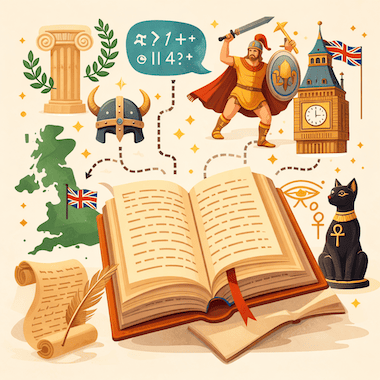
The Story Behind Everyday Words
Het verhaal achter alledaagse woorden
 Learn EnglishGratis app met audio, quizzes en echte boeken
Belangrijke woorden
- etymologyetymologie
- vocabularywoordenschat
- conquestverovering
- aristocracyaristocratie
- commodityhandelswaar
- indigenousinheems
- distilledgedistilleerd
- mosaicmozaïek
- nobilityadel
- labyrinthlabyrint
- linguistlinguïst
- borrowontlenen
Alle 30 woorden
- medievalmiddeleeuws
- dialectdialect
- translationvertaling
- peasantboer
- alphabetalfabet
- invasioninvasie
- blendvermenging
- archivearchief
- scholargeleerde
- fossilfossiel
- legacyerfenis
- catastrophecatastrofe
- warriorkrijger
- repurposeherbestemmen
- civilizationbeschaving
- mathematicswiskunde
- empirekeizerrijk
- frenzyrazernij
English is a great borrower. Around its old Germanic core, it has taken in words from Latin, French, Old Norse, Greek, Arabic and dozens of other languages. Many words that sound completely ordinary today came from far away, and some changed their meaning beyond recognition on the way.
Het Engels leent graag woorden. Rond zijn oude Germaanse kern heeft het woorden opgenomen uit het Latijn, het Frans, het Oudnoords, het Grieks, het Arabisch en tientallen andere talen. Veel woorden die nu heel gewoon klinken, kwamen van ver, en sommige veranderden onderweg zo sterk van betekenis dat ze onherkenbaar werden.
Each of these words records a moment when peoples met: a conquest, a trade route, a new food on the table. When you say 'salary', 'sky', 'disaster' or 'avocado', you are using words with long and unexpected histories. Here are some of the best stories behind everyday English words, along with a few popular ones that turn out to be myths.
Elk van die woorden legt een moment vast waarop volken elkaar ontmoetten: een verovering, een handelsroute, een nieuw gerecht op tafel. Wie ‘salary’ (salaris), ‘sky’ (lucht), ‘disaster’ (ramp) of ‘avocado’ zegt, gebruikt woorden met een lange en onverwachte geschiedenis. Hier volgen enkele van de mooiste verhalen achter alledaagse Engelse woorden, en een paar bekende verhalen die mythes blijken te zijn.
Words from Latin and Ancient Rome
Woorden uit het Latijn en het oude Rome
Latin came into English through several doors: Roman trade, the Church, and later scholars and scientists. The word 'salary' comes from the Latin 'salarium', which is related to 'sal', meaning salt. You may have heard that Roman soldiers were paid in salt. It's a nice story, but no ancient source says so, and historians still don't know exactly what the salarium had to do with salt.
Het Latijn kwam via verschillende deuren het Engels binnen: de Romeinse handel, de Kerk en later geleerden en wetenschappers. Het woord ‘salary’ (salaris) komt van het Latijnse ‘salarium’, dat verwant is aan ‘sal’, zout. Misschien heb je gehoord dat Romeinse soldaten in zout werden betaald. Het is een mooi verhaal, maar geen enkele antieke bron vermeldt het, en historici weten nog altijd niet precies wat het salarium met zout te maken had.
'Disaster' reached English in the 1590s, through French, from the Italian 'disastro'. It is built from 'dis-' (bad) and 'astro' (star), from the Latin 'astrum'. A disaster was literally an event under an unlucky star, an idea that comes from astrology. 'January' is named after Janus, the Roman god of doorways and beginnings, who was shown with two faces, one looking back and one looking forward. 'Calendar' comes from 'calendae', the first day of each Roman month, when debts had to be paid.
‘Disaster’ (ramp) kwam in de jaren 1590 via het Frans in het Engels terecht, uit het Italiaanse ‘disastro’. Het woord bestaat uit ‘dis-’ (slecht) en ‘astro’ (ster), van het Latijnse ‘astrum’. Een disaster was dus letterlijk een gebeurtenis onder een ongelukkige ster, een idee uit de astrologie. ‘January’ (januari) is genoemd naar Janus, de Romeinse god van deuren en het begin, die werd afgebeeld met twee gezichten, het ene naar achteren en het andere naar voren gericht. ‘Calendar’ (kalender) komt van ‘calendae’, de eerste dag van elke Romeinse maand, waarop schulden betaald moesten worden.
Words the Vikings Left Behind
Woorden die de Vikingen achterlieten
Viking raids on Britain began in 793 with an attack on the monastery of Lindisfarne. Over the next century, Danes and Norwegians settled across the north and east of England, and their language, Old Norse, mixed with Old English in everyday life. Because the two languages were related, people borrowed even very basic words from each other.
De Vikingaanvallen op Brittannië begonnen in 793 met een overval op het klooster van Lindisfarne. In de eeuw daarna vestigden Denen en Noren zich in het noorden en oosten van Engeland, en hun taal, het Oudnoords, vermengde zich in het dagelijks leven met het Oudengels. Omdat de twee talen verwant waren, leenden mensen zelfs heel basale woorden van elkaar.
'Sky' comes from the Old Norse 'ský', which meant 'cloud'. 'Window' comes from 'vindauga', literally 'wind eye', and 'knife' from 'knífr'. 'Husband' comes from 'húsbóndi', the master of a house. 'Egg' is Norse too, and it pushed out the older English word 'ey'. Even the pronouns 'they', 'them' and 'their' come from Old Norse. 'Anger' comes from 'angr', which meant grief or sorrow rather than rage.
‘Sky’ (lucht) komt van het Oudnoordse ‘ský’, dat ‘wolk’ betekende. ‘Window’ (raam) komt van ‘vindauga’, letterlijk ‘windoog’, en ‘knife’ (mes) van ‘knífr’. ‘Husband’ (echtgenoot) komt van ‘húsbóndi’, de heer des huizes. Ook ‘egg’ (ei) is Noords, en het verdrong het oudere Engelse woord ‘ey’. Zelfs de voornaamwoorden ‘they’, ‘them’ en ‘their’ (zij, hen, hun) komen uit het Oudnoords. ‘Anger’ (woede) komt van ‘angr’, dat eerder verdriet of smart betekende dan razernij.
The French Invasion of English
De Franse invasie van het Engels
In 1066, William, Duke of Normandy, defeated King Harold at the Battle of Hastings and became king of England. The new nobility spoke Norman French. For about three hundred years, French was the language of the royal court, the law courts and the upper classes, while ordinary people went on speaking English.
In 1066 versloeg Willem, hertog van Normandië, koning Harold in de Slag bij Hastings en werd hij koning van Engeland. De nieuwe adel sprak Normandisch Frans. Ongeveer driehonderd jaar lang was Frans de taal van het koninklijk hof, de rechtbanken en de hogere standen, terwijl het gewone volk Engels bleef spreken.
As a result, thousands of French words entered English. Many of them relate to law ('justice', 'judge', 'crime'), government and society ('royal', 'noble', 'servant', 'parliament') and food ('beef', 'pork', 'mutton', 'poultry'). English often kept the old Germanic word for the living animal and took the French word for its meat: 'cow' but 'beef' (French 'boeuf'), 'pig' but 'pork' ('porc'), 'sheep' but 'mutton' ('mouton'). The usual explanation, made famous by Walter Scott's novel 'Ivanhoe' (1819), is that English peasants raised the animals and French-speaking lords ate them. Historians think the real picture was more mixed, but the pattern is clear.
Daardoor kwamen duizenden Franse woorden in het Engels terecht. Veel daarvan hebben te maken met recht (‘justice’ gerechtigheid, ‘judge’ rechter, ‘crime’ misdaad), bestuur en samenleving (‘royal’ koninklijk, ‘noble’ adellijk, ‘servant’ dienaar, ‘parliament’ parlement) en eten (‘beef’ rundvlees, ‘pork’ varkensvlees, ‘mutton’ schapenvlees, ‘poultry’ gevogelte). Het Engels hield vaak het oude Germaanse woord voor het levende dier en nam het Franse woord voor het vlees: ‘cow’ (koe) maar ‘beef’ (Frans ‘bœuf’), ‘pig’ (varken) maar ‘pork’ (‘porc’), ‘sheep’ (schaap) maar ‘mutton’ (‘mouton’). De gangbare verklaring, bekend geworden door Walter Scotts roman ‘Ivanhoe’ (1819), is dat Engelse boeren de dieren fokten en Franstalige heren ze opaten. Historici denken dat het werkelijke beeld gemengder was, maar het patroon is duidelijk.
Words from Arabic
Woorden uit het Arabisch
In the Middle Ages, Baghdad, Cairo and Córdoba were among the world's great centers of science, mathematics and medicine. Many scientific words traveled from Arabic into Latin, often through translations made in Spain and Sicily, and from Latin into English.
In de middeleeuwen behoorden Bagdad, Caïro en Córdoba tot de grote centra van wetenschap, wiskunde en geneeskunde in de wereld. Veel wetenschappelijke woorden gingen van het Arabisch naar het Latijn, vaak via vertalingen die in Spanje en op Sicilië werden gemaakt, en van het Latijn naar het Engels.
'Alcohol' comes from the Arabic 'al-kuhl', a fine black powder used as eye makeup. Alchemists later used the word for any very pure substance, and in the end it came to mean the strong spirit distilled from wine. 'Algebra' comes from 'al-jabr', 'putting broken parts back together', a word in the title of a book by the Baghdad mathematician al-Khwarizmi, and 'algorithm' comes from his own name. Other words that came into English through Arabic include 'cotton', 'coffee', 'sugar', 'zero', 'cipher' and 'magazine', which first meant a storehouse. 'Assassin' comes from 'hashishiyyin', 'hashish users', an insulting name that enemies gave to the Nizari Ismailis, a medieval group known for killing political leaders.
‘Alcohol’ komt van het Arabische ‘al-kuhl’, een fijn zwart poeder dat als oogmake-up werd gebruikt. Alchemisten gebruikten het woord later voor elke zeer zuivere stof, en uiteindelijk ging het de sterke geest betekenen die uit wijn wordt gestookt. ‘Algebra’ komt van ‘al-jabr’, ‘gebroken delen weer samenvoegen’, een woord uit de titel van een boek van de Bagdadse wiskundige al-Chwarizmi, en ‘algorithm’ (algoritme) komt van zijn eigen naam. Andere woorden die via het Arabisch in het Engels kwamen, zijn ‘cotton’ (katoen), ‘coffee’ (koffie), ‘sugar’ (suiker), ‘zero’ (nul), ‘cipher’ (cijfer) en ‘magazine’ (tijdschrift), dat eerst een opslagplaats betekende. ‘Assassin’ (sluipmoordenaar) komt van ‘hashishiyyin’, ‘hasjgebruikers’, een scheldnaam die vijanden gaven aan de nizarische ismaïlieten, een middeleeuwse groep die bekendstond om moorden op politieke leiders.
Words from the Americas
Woorden uit Amerika
After Columbus reached the Caribbean in 1492, Europeans met plants, foods and animals they had never seen, and the words for them. Most of these words came into English through Spanish, from Native American languages such as Nahuatl (the language of the Aztecs), Quechua and Taino. Others, like 'raccoon', 'moose' and 'skunk', came straight from the Algonquian languages of North America.
Nadat Columbus in 1492 het Caribisch gebied had bereikt, maakten Europeanen kennis met planten, voedsel en dieren die ze nooit eerder hadden gezien, en met de woorden ervoor. De meeste van die woorden kwamen via het Spaans in het Engels terecht, uit inheemse talen zoals het Nahuatl (de taal van de Azteken), het Quechua en het Taíno. Andere, zoals ‘raccoon’ (wasbeer), ‘moose’ (eland) en ‘skunk’ (stinkdier), kwamen rechtstreeks uit de Algonkische talen van Noord-Amerika.
'Avocado' comes from the Nahuatl 'ahuacatl', through the Spanish 'aguacate'. 'Tomato' comes from 'tomatl'. 'Chocolate' is also from Nahuatl, although experts still argue about the exact original word. 'Potato' first meant the sweet potato, from the Taino 'batata'. 'Hurricane' comes from the Taino 'hurakán', and 'barbecue' and 'canoe' probably come from Taino too, through the Spanish 'barbacoa' and 'canoa'. 'Llama' and 'puma' are Quechua words from the Andes.
‘Avocado’ komt van het Nahuatl-woord ‘ahuacatl’, via het Spaanse ‘aguacate’. ‘Tomato’ (tomaat) komt van ‘tomatl’. Ook ‘chocolate’ (chocolade) komt uit het Nahuatl, al zijn deskundigen het nog altijd niet eens over het precieze oorspronkelijke woord. ‘Potato’ (aardappel) betekende eerst zoete aardappel, naar het Taíno-woord ‘batata’. ‘Hurricane’ (orkaan) komt van het Taíno-woord ‘hurakán’, en ‘barbecue’ en ‘canoe’ (kano) komen waarschijnlijk ook uit het Taíno, via het Spaanse ‘barbacoa’ en ‘canoa’. ‘Llama’ (lama) en ‘puma’ zijn Quechua-woorden uit de Andes.
Words with Surprising Stories
Woorden met een verrassend verhaal
'Berserk' comes from the Old Norse 'berserkr', probably 'bear shirt'. It was the name for Viking warriors who fought in a wild rage, perhaps dressed in bearskins. 'Clue' is a newer spelling of 'clew', a ball of thread (Old English 'cliewen'). In the Greek myth, Ariadne gives Theseus a ball of thread so he can find his way out of the Minotaur's labyrinth. Over time, a clue came to mean anything that helps you solve a puzzle.
‘Berserk’ (razend) komt van het Oudnoordse ‘berserkr’, waarschijnlijk ‘berenhemd’. Zo heetten Vikingkrijgers die in wilde razernij vochten, misschien gekleed in berenvellen. ‘Clue’ (aanwijzing) is een nieuwere spelling van ‘clew’, een kluwen draad (Oudengels ‘cliewen’). In de Griekse mythe geeft Ariadne Theseus een kluwen draad, zodat hij de weg uit het labyrint van de Minotaurus kan vinden. Na verloop van tijd ging clue alles betekenen wat helpt om een raadsel op te lossen.
'Muscle' comes from the Latin 'musculus', 'little mouse', perhaps because a muscle moving under the skin looks like a mouse running under a cloth. 'Hazard' was first the name of a dice game, and the word probably comes from the Arabic 'az-zahr', 'the die'. 'Silly' meant 'happy' or 'blessed' in Old English and slowly drifted to 'innocent' and then to 'foolish'. Some famous stories, though, are simply made up. 'Posh' does not stand for 'port out, starboard home', and 'sincere' does not come from the Latin 'sine cera', 'without wax'. There is no evidence for either story.
‘Muscle’ (spier) komt van het Latijnse ‘musculus’, ‘muisje’, misschien omdat een spier die onder de huid beweegt lijkt op een muis die onder een doek rent. ‘Hazard’ (gevaar) was eerst de naam van een dobbelspel, en het woord komt waarschijnlijk van het Arabische ‘az-zahr’, ‘de dobbelsteen’. ‘Silly’ (dwaas) betekende in het Oudengels ‘gelukkig’ of ‘gezegend’ en schoof langzaam op naar ‘onschuldig’ en daarna naar ‘dwaas’. Sommige beroemde verhalen zijn echter gewoon verzonnen. ‘Posh’ (chic) is geen afkorting van ‘port out, starboard home’ (heen bakboord, terug stuurboord), en ‘sincere’ (oprecht) komt niet van het Latijnse ‘sine cera’, ‘zonder was’. Voor geen van beide verhalen bestaat enig bewijs.
How New Words Are Born Today
Hoe nieuwe woorden nu ontstaan
English is still taking in new words. Technology alone has brought 'app', 'blog', 'emoji' (borrowed from Japanese) and 'selfie', as well as the verbs 'to tweet' and 'to google'. In 2013, Oxford Dictionaries named 'selfie' its Word of the Year.
Het Engels neemt nog steeds nieuwe woorden op. Alleen al de techniek bracht ‘app’, ‘blog’, ‘emoji’ (ontleend aan het Japans) en ‘selfie’, en daarnaast de werkwoorden ‘to tweet’ en ‘to google’. In 2013 riep Oxford Dictionaries ‘selfie’ uit tot woord van het jaar.
A few new words are invented from nothing, but most follow old patterns. Some are blends, like 'brunch' from 'breakfast' and 'lunch'. Others are borrowed, like 'karaoke' from Japanese or 'schadenfreude' from German. Old words also get new jobs: a 'cloud' now stores data, and a 'mouse' sits next to your keyboard. Nobody can say exactly how many words English has, because it depends on how you count, but the Oxford English Dictionary alone describes more than half a million words and phrases.
Een paar nieuwe woorden worden uit het niets bedacht, maar de meeste volgen oude patronen. Sommige zijn samentrekkingen, zoals ‘brunch’ uit ‘breakfast’ (ontbijt) en ‘lunch’. Andere zijn geleend, zoals ‘karaoke’ uit het Japans of ‘schadenfreude’ uit het Duits. Oude woorden krijgen ook nieuwe taken: een ‘cloud’ (wolk) slaat nu gegevens op, en een ‘mouse’ (muis) ligt naast je toetsenbord. Niemand kan precies zeggen hoeveel woorden het Engels heeft, want dat hangt af van hoe je telt, maar alleen al de Oxford English Dictionary beschrijft meer dan een half miljoen woorden en uitdrukkingen.
Word Origins at a Glance
Woordherkomst in het kort
'Cereal' comes from Ceres, the Roman goddess of farming and grain.
‘Cereal’ (ontbijtgranen) komt van Ceres, de Romeinse godin van de landbouw en het graan.
'Panic' comes from Pan, the Greek god of the wild, who was said to fill travelers with sudden, groundless fear.
‘Panic’ (paniek) komt van Pan, de Griekse god van de wildernis, die reizigers volgens de verhalen met plotselinge, ongegronde angst vervulde.
'Jeans' comes from 'Gênes', the French name for Genoa, the Italian port that gave its name to a strong cotton cloth.
‘Jeans’ komt van ‘Gênes’, de Franse naam voor Genua, de Italiaanse havenstad die haar naam gaf aan een stevige katoenen stof.
'Sandwich' is named after John Montagu, 4th Earl of Sandwich, who reportedly ate meat between slices of bread so he could stay at the card table.
‘Sandwich’ is genoemd naar John Montagu, de vierde graaf van Sandwich, die naar verluidt vlees tussen sneetjes brood at zodat hij aan de speeltafel kon blijven zitten.
'Dunce' comes from John Duns Scotus, a medieval thinker whose followers were mocked as slow and stubborn in the 1500s.
‘Dunce’ (domoor) komt van Johannes Duns Scotus, een middeleeuwse denker wiens volgelingen in de zestiende eeuw werden bespot als traag en koppig.
'Robot' first appeared in Karel Čapek's play 'R.U.R.' (1920). His brother Josef suggested it, from the Czech 'robota', 'forced labor'.
‘Robot’ verscheen voor het eerst in Karel Čapeks toneelstuk ‘R.U.R.’ (1920). Zijn broer Josef stelde het woord voor, naar het Tsjechische ‘robota’, ‘dwangarbeid’.
History in Every Word
Geschiedenis in elk woord
Every English word keeps traces of the people who used it before us. Roman law and Roman gods, Viking settlers, Norman lords, Arab scholars and Aztec cooks have all left something in the words we use every day.
Elk Engels woord draagt sporen van de mensen die het vóór ons gebruikten. Romeins recht en Romeinse goden, Vikingkolonisten, Normandische heren, Arabische geleerden en Azteekse koks hebben allemaal iets achtergelaten in de woorden die we elke dag gebruiken.
The study of word origins is called etymology, and a good dictionary will tell you the history of almost any word. The next time an ordinary word catches your attention, look it up. The real story is often more surprising than the popular one.
De studie van de herkomst van woorden heet etymologie, en een goed woordenboek vertelt je de geschiedenis van bijna elk woord. Valt een gewoon woord je de volgende keer op, zoek het dan op. Het echte verhaal is vaak verrassender dan het bekende.
In de gratis app hoor je de tekst voorgelezen en tik je op een woord om te zien wat het betekent.