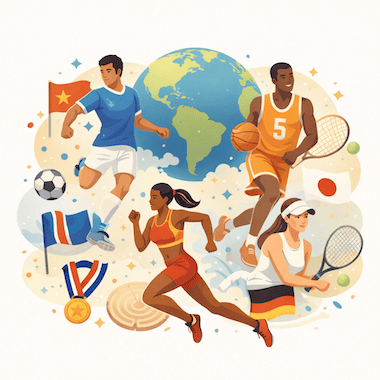
How Sports Unite the World
Hoe sport de wereld verbindt
 Learn EnglishGratis app met audio, quizzes en echte boeken
Belangrijke woorden
- athleteatleet
- tournamenttoernooi
- championshipkampioenschap
- diplomacydiplomatie
- trucewapenstilstand
- colonialismkolonialisme
- boycottboycot
- protestprotest
- racial integrationrassengelijkheid
- apartheidapartheid
- geopoliticsgeopolitiek
- ideologyideologie
Alle 30 woorden
- rivalryrivaliteit
- spectatortoeschouwer
- podiumpodium
- medalmedaille
- infrastructureinfrastructuur
- discriminationdiscriminatie
- fandomfandom
- tribaltribaal
- sprintsprint
- stadiumstadion
- self-determinationzelfbeschikking
- terrorismterrorisme
- ecological footprintecologische voetafdruk
- collectivecollectief
- transcendoverstijgen
- Cold WarKoude Oorlog
- disabilityhandicap
- unifyverenigen
On December 18, 2022, Argentina and France met in the World Cup final in Qatar, and FIFA estimated that close to 1.5 billion people watched it. Few events in history have held the attention of so many people at once. Sports can say things that are hard to put into words: a packed stadium roaring as one, a goal in the last minute or a record-breaking race means the same in Buenos Aires, Paris or Tokyo.
Op 18 december 2022 speelden Argentinië en Frankrijk in Qatar de WK-finale, en volgens schattingen van de FIFA keken bijna 1,5 miljard mensen. Weinig gebeurtenissen in de geschiedenis hebben zoveel mensen tegelijk weten te boeien. Sport zegt dingen die moeilijk in woorden te vangen zijn: een vol stadion dat als één man juicht, een doelpunt in de laatste minuut of een recordrace betekent hetzelfde in Buenos Aires, Parijs of Tokio.
But sports are more than a show. They are big business, a stage for politics and a source of national pride. Again and again, the playing field has reflected what was happening in the wider world: rivalries between countries, the fight for civil rights, even the birth of new nations. To understand sports is to understand a good deal about how societies work.
Maar sport is meer dan een show. Het is grote business, een podium voor politiek en een bron van nationale trots. Steeds weer heeft het speelveld weerspiegeld wat er in de wereld gebeurde: rivaliteit tussen landen, de strijd voor burgerrechten, zelfs het ontstaan van nieuwe naties. Wie sport begrijpt, begrijpt veel van hoe samenlevingen werken.
The Ancient Olympics: Sports and the Gods
De Olympische Spelen in de oudheid: sport en goden
The ancient Olympic Games were held at Olympia, in southern Greece. By tradition they began in 776 BCE, and they lasted for more than a thousand years. According to the usual account, the last games took place around 393 CE, after the Christian Roman emperor Theodosius I banned pagan festivals. The Olympics were never just a sports meeting. Held every four years, they were a religious festival in honor of Zeus, the king of the gods, and the races took place next to his great temple.
De antieke Olympische Spelen werden gehouden in Olympia, in het zuiden van Griekenland. Volgens de overlevering begonnen ze in 776 v.Chr., en ze bleven meer dan duizend jaar bestaan. Volgens het gangbare verhaal vonden de laatste Spelen plaats rond 393 n.Chr., nadat de christelijke Romeinse keizer Theodosius I heidense feesten had verboden. De Spelen waren nooit alleen een sportwedstrijd. Ze werden elke vier jaar gehouden als religieus feest ter ere van Zeus, de koning van de goden, en de wedlopen vonden plaats naast zijn grote tempel.
The games mattered in politics, too. Before each festival, messengers announced a sacred truce, the ekecheiria. It did not end the wars between Greek city-states, but it protected athletes and visitors on their way to Olympia and back. Only free Greek men could compete, yet they came from Greek cities all around the Mediterranean, from Sicily to Asia Minor. When the Frenchman Pierre de Coubertin organized the first modern Olympics in Athens in 1896, he hoped the games would once again bring nations together and help keep the peace.
De Spelen hadden ook politiek gewicht. Voor elk feest kondigden boodschappers een heilige wapenstilstand af, de ekecheiria. Die maakte geen einde aan de oorlogen tussen de Griekse stadstaten, maar beschermde atleten en bezoekers op weg naar Olympia en terug. Alleen vrije Griekse mannen mochten meedoen, maar zij kwamen uit Griekse steden rond de hele Middellandse Zee, van Sicilië tot Klein-Azië. Toen de Fransman Pierre de Coubertin in 1896 in Athene de eerste moderne Olympische Spelen organiseerde, hoopte hij dat de Spelen de volken weer dichter bij elkaar zouden brengen en zouden helpen de vrede te bewaren.
Football: The World's Game
Voetbal: het spel van de wereld
Football, which Americans call soccer, is the most popular sport on the planet. FIFA, the sport's world governing body, has 211 member associations, more than the 193 member states of the United Nations. This is possible because some places that are not independent countries, such as England, Scotland and Hong Kong, have their own national teams. Billions of people around the world follow the game.
Voetbal, dat Amerikanen soccer noemen, is de populairste sport ter wereld. De FIFA, de wereldvoetbalbond, heeft 211 aangesloten bonden, meer dan de 193 lidstaten van de Verenigde Naties. Dat kan omdat sommige gebieden die geen onafhankelijke staat zijn, zoals Engeland, Schotland en Hongkong, een eigen nationaal elftal hebben. Miljarden mensen over de hele wereld volgen het spel.
Football spread around the world with the British in the 19th and early 20th centuries. British sailors, merchants, engineers and teachers took it to ports and cities from Montevideo to Moscow. Local people quickly made the game their own, and many countries developed a style they are proud of: the Brazilian jogo bonito, the Dutch total football of the 1970s, the Spanish tiki-taka. The first World Cup was held in Uruguay in 1930. Today it is the most-watched tournament of any single sport, and every four years it puts much of the planet in front of the same screens.
In de 19e en vroege 20e eeuw verspreidde het voetbal zich met de Britten over de wereld. Britse zeelieden, handelaren, ingenieurs en leraren brachten het naar havens en steden van Montevideo tot Moskou. De lokale bevolking maakte het spel al snel tot iets van zichzelf, en veel landen ontwikkelden een stijl waar ze trots op zijn: het Braziliaanse jogo bonito, het Nederlandse totaalvoetbal uit de jaren zeventig, het Spaanse tiki-taka. Het eerste WK werd in 1930 in Uruguay gespeeld. Nu is het het best bekeken toernooi van welke sport dan ook, en elke vier jaar zit een groot deel van de wereld voor dezelfde schermen.
Sports and Civil Rights
Sport en burgerrechten
In the 20th century, sports became an important stage in the fight for equal rights. At the 1936 Olympics in Berlin, the African-American athlete Jesse Owens won four gold medals: in the 100 meters, the 200 meters, the long jump and the 4×100-meter relay. His success, in front of a Nazi regime that preached the superiority of the “Aryan race,” made headlines around the world.
In de 20e eeuw werd sport een belangrijk podium in de strijd voor gelijke rechten. Op de Olympische Spelen van 1936 in Berlijn won de Afro-Amerikaanse atleet Jesse Owens vier gouden medailles: op de 100 meter, de 200 meter, het verspringen en de 4×100 meter estafette. Zijn succes, vlak voor de ogen van een naziregime dat de superioriteit van het „Arische ras” predikte, haalde wereldwijd de krantenkoppen.
In 1947 Jackie Robinson joined the Brooklyn Dodgers and became the first Black player in modern Major League Baseball, breaking a color line that had kept Black players out since the 1880s. He faced insults and death threats, and his calm courage changed how many Americans thought about integration. At the 1968 Olympics in Mexico City, the sprinters Tommie Smith and John Carlos raised black-gloved fists on the medal podium, a protest against racism that is still remembered today. South Africa was shut out of most international sports for decades because of apartheid. After apartheid ended, Nelson Mandela wore the jersey of the Springboks, the national rugby team, when South Africa won the 1995 Rugby World Cup, a gesture that helped bring the country together.
In 1947 ging Jackie Robinson spelen voor de Brooklyn Dodgers en werd hij de eerste zwarte speler in de moderne Major League Baseball. Daarmee doorbrak hij een kleurgrens die zwarte spelers sinds de jaren 1880 had buitengesloten. Hij kreeg te maken met beledigingen en doodsbedreigingen, en zijn kalme moed veranderde hoe veel Amerikanen over rassenintegratie dachten. Op de Olympische Spelen van 1968 in Mexico-Stad staken de sprinters Tommie Smith en John Carlos op het erepodium hun vuist met een zwarte handschoen omhoog, een protest tegen racisme dat nog altijd wordt herinnerd. Zuid-Afrika was vanwege de apartheid tientallen jaren uitgesloten van de meeste internationale wedstrijden. Na het einde van de apartheid droeg Nelson Mandela het shirt van de Springboks, het nationale rugbyteam, toen Zuid-Afrika in 1995 het wereldkampioenschap rugby won, een gebaar dat het land hielp verenigen.
Cricket: A Colonial Game Made New
Cricket: een koloniaal spel in nieuwe handen
Cricket was first recorded in rural England in the late 16th century, and it spread with the British Empire. Today it is the leading sport in India, Pakistan, Bangladesh and Sri Lanka, and it is hugely popular in Australia, the Caribbean and parts of Africa. Most of the world's cricket fans live in South Asia, a region of about two billion people. The game's reach is a direct legacy of the empire.
Cricket werd voor het eerst vermeld op het Engelse platteland aan het eind van de 16e eeuw en verspreidde zich met het Britse Rijk. Nu is het de belangrijkste sport in India, Pakistan, Bangladesh en Sri Lanka, en het is zeer populair in Australië, het Caribisch gebied en delen van Afrika. De meeste cricketfans ter wereld wonen in Zuid-Azië, een regio met zo'n twee miljard inwoners. Dat bereik is een rechtstreekse erfenis van het imperium.
For many former colonies, cricket also became a way to stand up to their old rulers. In 1950 the West Indies, a team made up of players from several Caribbean countries, won a Test series in England for the first time, and a calypso about their victory at Lord's became famous across the Caribbean. The Trinidadian writer C.L.R. James argued in his book Beyond a Boundary (1963) that West Indian cricket was closely tied to the struggle for self-government. In the late 1970s and the 1980s the West Indies were the best team in the world, India won the World Cup in 1983 and Pakistan in 1992. The colonizers' game had been mastered by the people they once ruled.
Voor veel voormalige koloniën werd cricket ook een manier om de oude heersers te trotseren. In 1950 won West-Indië, een team met spelers uit verschillende Caribische landen, voor het eerst een testserie in Engeland, en een calypso over hun overwinning op Lord's werd in het hele Caribisch gebied beroemd. De schrijver C. L. R. James uit Trinidad betoogde in zijn boek Beyond a Boundary (1963) dat het West-Indische cricket nauw verbonden was met de strijd voor zelfbestuur. Eind jaren zeventig en in de jaren tachtig was West-Indië het beste team ter wereld, India won het WK in 1983 en Pakistan in 1992. Het spel van de kolonisators werd nu beheerst door de volken die zij ooit hadden overheerst.
Sports as Diplomacy: Ping-Pong and Beyond
Sport als diplomatie: pingpong en meer
In April 1971, during the world table tennis championships in Japan, the American team received a surprise invitation to visit China. Americans had hardly been able to travel there since the Communists took power in 1949. The players' trip helped prepare the way for President Richard Nixon's visit to Beijing in February 1972, which shifted the balance of the Cold War. Journalists called the episode “ping-pong diplomacy,” and the phrase is still used whenever sports open a door that politicians cannot.
In april 1971, tijdens het wereldkampioenschap tafeltennis in Japan, kreeg het Amerikaanse team een verrassende uitnodiging om China te bezoeken. Sinds de communisten in 1949 aan de macht waren gekomen, hadden Amerikanen er nauwelijks naartoe kunnen reizen. De reis van de spelers hielp de weg te banen voor het bezoek van president Richard Nixon aan Peking in februari 1972, dat het machtsevenwicht in de Koude Oorlog veranderde. Journalisten noemden de episode „pingpongdiplomatie”, en de term wordt nog steeds gebruikt als sport een deur opent die politici niet open krijgen.
Sports and politics have met many times since. At the 1972 Olympics in Munich, Palestinian terrorists killed eleven members of the Israeli team. In September of the same year, millions followed the Summit Series, an ice hockey contest between Canada and the Soviet Union that many saw as a clash between two political systems. The United States and dozens of other countries boycotted the 1980 Moscow Olympics, and the Soviet Union and most of its allies stayed away from Los Angeles in 1984. At the 2018 Winter Olympics in Pyeongchang, athletes from North and South Korea marched together under one flag. In times of high tension, sports have sometimes created human contact where diplomats could not.
Sindsdien zijn sport en politiek elkaar vaak tegengekomen. Op de Olympische Spelen van 1972 in München doodden Palestijnse terroristen elf leden van de Israëlische ploeg. In september van datzelfde jaar volgden miljoenen mensen de Summit Series, een ijshockeyduel tussen Canada en de Sovjet-Unie dat velen zagen als een botsing tussen twee politieke systemen. De Verenigde Staten en tientallen andere landen boycotten de Spelen van 1980 in Moskou, en de Sovjet-Unie en de meeste van haar bondgenoten bleven in 1984 weg uit Los Angeles. Op de Winterspelen van 2018 in Pyeongchang liepen sporters uit Noord- en Zuid-Korea samen onder één vlag binnen. In tijden van grote spanning heeft sport soms menselijk contact gelegd waar diplomaten dat niet lukte.
Why We Love Sports
Waarom we van sport houden
Why are people so happy when a team of strangers scores a goal? And why do fans feel real stress during a match, with a racing heart, rising stress hormones and tense muscles, as if they were playing themselves? Researchers who study the brain and group identity have found some answers.
Waarom zijn mensen zo blij als een team van onbekenden scoort? En waarom ervaren fans echte stress tijdens een wedstrijd, met een bonzend hart, stijgende stresshormonen en gespannen spieren, alsof ze zelf spelen? Onderzoekers die het brein en groepsidentiteit bestuderen, hebben enkele antwoorden gevonden.
For many fans, a team becomes part of who they are. Psychologists call this social identity: we see the groups we belong to as part of ourselves. Brain scans of fans watching their own team show activity in areas linked to reward and to thinking about the self, and studies have found that fans' hormone levels can rise and fall with their team's results. This is why a win feels like a personal success and a defeat can hurt for days. Supporting a team answers a very old human need: to belong to a group, to share its fortunes and to celebrate together.
Voor veel fans wordt een team een deel van wie ze zijn. Psychologen noemen dat sociale identiteit: we zien de groepen waar we bij horen als een deel van onszelf. Hersenscans van fans die naar hun eigen team kijken, tonen activiteit in gebieden die te maken hebben met beloning en met nadenken over jezelf, en onderzoek heeft laten zien dat hormoonspiegels van fans kunnen stijgen en dalen met de resultaten van hun team. Daarom voelt een overwinning als een persoonlijk succes en kan een nederlaag dagenlang pijn doen. Supporter zijn van een team beantwoordt aan een heel oude menselijke behoefte: bij een groep horen, het lot ervan delen en samen feestvieren.
Surprising Facts About Sports
Verrassende feiten over sport
The 1969 “Football War” between Honduras and El Salvador broke out soon after their World Cup qualifying matches, although its real causes were land and migration.
De „Voetbaloorlog” tussen Honduras en El Salvador brak in 1969 uit kort na hun WK-kwalificatiewedstrijden, maar de echte oorzaken waren land en migratie.
On June 30, 2002, the day of the World Cup final, Bhutan and Montserrat, then the two lowest-ranked teams in the world, played “The Other Final” in Thimphu. Bhutan won 4-0.
Op 30 juni 2002, de dag van de WK-finale, speelden Bhutan en Montserrat, toen de twee laagst geplaatste teams ter wereld, in Thimphu „de andere finale”. Bhutan won met 4-0.
The Paralympic Games were first held in Rome in 1960. Today they bring together more than 4,000 athletes from over 160 countries.
De Paralympische Spelen werden voor het eerst gehouden in Rome in 1960. Nu komen er meer dan 4.000 sporters uit meer dan 160 landen samen.
In kabaddi, a traditional contact sport from India, a raider must tag opponents and get back to his own side while chanting “kabaddi” in a single breath.
Bij kabaddi, een traditionele contactsport uit India, moet een aanvaller tegenstanders aantikken en terugkeren naar zijn eigen helft terwijl hij in één adem „kabaddi” roept.
The longest tennis match in history was played at Wimbledon in 2010 between John Isner and Nicolas Mahut. It lasted 11 hours and 5 minutes over three days, and the final set ended 70-68.
De langste tenniswedstrijd ooit werd in 2010 op Wimbledon gespeeld tussen John Isner en Nicolas Mahut. Hij duurde 11 uur en 5 minuten, verspreid over drie dagen, en de laatste set eindigde in 70-68.
British sailors played rugby in Yokohama as early as 1874, and in 1899 Edward Bramwell Clarke and Tanaka Ginnosuke taught the game at Keio University. In 2015 Japan beat South Africa 34-32 at the Rugby World Cup, one of the biggest upsets in the sport's history.
Britse zeelieden speelden al in 1874 rugby in Yokohama, en in 1899 leerden Edward Bramwell Clarke en Tanaka Ginnosuke het spel aan studenten van de Keio-universiteit. In 2015 versloeg Japan Zuid-Afrika met 34-32 op het WK rugby, een van de grootste verrassingen in de geschiedenis van de sport.
Problems Still to Solve
Problemen die nog om een oplossing vragen
Sports can bring people together, but they also reflect the inequalities of society. Women's sports have long received far less funding, media coverage and prize money than men's, although the gap is slowly closing. Many LGBTQ+ athletes have faced discrimination, and some countries that host major events still punish same-sex relationships by law. When the Olympics or the World Cup go to countries with poor human rights records, critics ask whether sport is simply helping those governments look good.
Sport kan mensen samenbrengen, maar weerspiegelt ook de ongelijkheid in de samenleving. Vrouwensport kreeg lange tijd veel minder geld, media-aandacht en prijzengeld dan mannensport, al wordt de kloof langzaam kleiner. Veel LHBTIQ+-sporters zijn gediscrimineerd, en sommige landen die grote evenementen organiseren, stellen relaties tussen mensen van hetzelfde geslacht nog altijd strafbaar. Als de Olympische Spelen of het WK naar landen gaan met een slechte reputatie op het gebied van mensenrechten, vragen critici zich af of sport die regeringen niet gewoon helpt er goed uit te zien.
There is also the environment. Mega-events like the Olympics need new stadiums, roads and hotels, and millions of fans fly in from around the world. Some venues, such as several stadiums built for the 2014 World Cup in Brazil, are hardly used once the event is over. Organizers now promise greener games, but critics say much more needs to change.
Dan is er nog het milieu. Megaevenementen zoals de Olympische Spelen vragen om nieuwe stadions, wegen en hotels, en miljoenen fans vliegen er vanuit de hele wereld naartoe. Sommige locaties, zoals verschillende stadions die voor het WK van 2014 in Brazilië zijn gebouwd, worden na afloop nauwelijks nog gebruikt. Organisatoren beloven nu groenere Spelen, maar volgens critici moet er nog veel meer veranderen.
Conclusion
Conclusie
Few things can make a billion people hold their breath at the same moment. Sports work like a language without words: a goal, a fall or a world record is understood everywhere. They show people at their best and sometimes at their worst, and once in a while an athlete or a team does something that seemed impossible until that day.
Weinig dingen kunnen een miljard mensen op hetzelfde moment de adem laten inhouden. Sport werkt als een taal zonder woorden: een doelpunt, een val of een wereldrecord begrijpt iedereen. Sport laat mensen op hun best zien en soms op hun slechtst, en af en toe doet een atleet of een team iets wat tot die dag onmogelijk leek.
People follow sports for many reasons: the wish to belong, pride in a team or a country, the beauty of a perfect movement and the drama of a close contest. These needs are as old as the games at Olympia, and they explain why, every four years, a large part of humanity sits down to watch the same match.
Mensen volgen sport om veel redenen: de wens ergens bij te horen, trots op een team of een land, de schoonheid van een perfecte beweging en de spanning van een nek-aan-nekrace. Die behoeften zijn zo oud als de Spelen in Olympia, en ze verklaren waarom elke vier jaar een groot deel van de mensheid gaat zitten om naar dezelfde wedstrijd te kijken.
In de gratis app hoor je de tekst voorgelezen en tik je op een woord om te zien wat het betekent.