Geteiltes Deutschland
Divided Germany
 Learn GermanFree app with audio, quizzes and real books
Key words
- DeutschlandGermany
- BundesrepublikFederal Republic
- Demokratiedemocracy
- Sozialismussocialism
- Marktwirtschaftmarket economy
- Planwirtschaftplanned economy
- Grenzeborder
- Mauerwall
- Familiefamily
- Freundfriend
- Wirtschafteconomy
- Konsumgutconsumer good
All 31 words
- Bildungeducation
- Reisetravel
- Freiheitfreedom
- Gesellschaftsociety
- Politikpolitics
- StasiStasi (secret police)
- Oppositionopposition
- Kulturculture
- Alltageveryday life
- Demonstrationdemonstration
- Wiedervereinigungreunification
- Ideologieideology
- Kaltem KriegCold War
- Kontrollecontrol
- Feiertagholiday
- Propagandapropaganda
- Spionageespionage
- Transformationtransformation
- Erinnerungmemory
Nach dem Zweiten Weltkrieg teilten die vier Siegermächte Deutschland in Besatzungszonen auf. 1949 entstanden daraus zwei Staaten: im Westen die Bundesrepublik Deutschland (BRD), im Osten die Deutsche Demokratische Republik (DDR). Die Grenze zwischen ihnen war zugleich die Grenze des Kalten Krieges: Auf der einen Seite standen Demokratie und Marktwirtschaft, auf der anderen Sozialismus und Planwirtschaft.
After the Second World War, the four victorious powers divided Germany into occupation zones. In 1949 these became two states: the Federal Republic of Germany (FRG) in the west and the German Democratic Republic (GDR) in the east. The border between them was also the front line of the Cold War: democracy and a market economy on one side, socialism and a planned economy on the other.
Über vierzig Jahre lang prägte die Teilung fast alles: den Alltag, die Politik, die Kultur und sogar das Bild der Städte. Die Grenze wurde streng bewacht, und viele Familien sahen ihre Verwandten auf der anderen Seite jahrelang nicht.
For more than forty years the division shaped almost everything: daily life, politics, culture and even the look of the cities. The border was tightly guarded, and many families went years without seeing their relatives on the other side.
Das Leben im Westen
Life in the West
In der Bundesrepublik wählten die Bürger ihre Regierung in freien Wahlen. Erster Bundeskanzler wurde 1949 Konrad Adenauer. Mit Hilfe des amerikanischen Marshallplans kam die Wirtschaft schnell wieder in Gang. In den 1950er Jahren sprach man vom „Wirtschaftswunder“: Bald konnten sich viele Familien einen Kühlschrank, einen Fernseher und oft sogar einen VW Käfer leisten.
In the Federal Republic, citizens chose their government in free elections. In 1949 Konrad Adenauer became the first chancellor. With help from the American Marshall Plan, the economy quickly got going again. In the 1950s people spoke of the "economic miracle": soon many families could afford a fridge, a television and often even a VW Beetle.
Der Lebensstandard stieg, und mit ihm wuchsen die Freiheiten. Junge Leute hörten Rock ’n’ Roll, trugen Jeans und fuhren in den Sommerferien nach Italien oder Spanien. Wer gute Noten hatte, konnte studieren und sich seinen Beruf selbst aussuchen.
Living standards rose, and so did people's freedoms. Young people listened to rock 'n' roll, wore jeans and spent their summer holidays in Italy or Spain. Anyone with good grades could go to university and choose their own career.
Auch die Medien waren vielfältig. Neben Zeitungen wie der „Süddeutschen Zeitung“ oder dem Nachrichtenmagazin „Der Spiegel“ gab es öffentlich-rechtliche Sender wie ARD und ZDF, die frei über Politik berichten konnten. Filme aus Hollywood und Musik aus den USA und Großbritannien, etwa von Elvis Presley oder den Beatles, prägten den Geschmack einer ganzen Generation.
The media were diverse too. Alongside newspapers such as the Süddeutsche Zeitung or the news magazine Der Spiegel, there were public broadcasters such as ARD and ZDF that could report freely on politics. Hollywood films and music from the USA and Britain, by Elvis Presley or the Beatles for example, shaped the taste of a whole generation.
Das Leben im Osten
Life in the East
In der DDR bestimmte die Staatspartei SED fast alle Bereiche des Lebens. Die Wirtschaft wurde nach Fünfjahrplänen gelenkt. Mieten und Grundnahrungsmittel waren billig, doch vieles war knapp. Wenn es Bananen oder andere Südfrüchte gab, bildeten sich vor den Geschäften lange Schlangen, und auf einen Trabant wartete man zehn Jahre und länger.
In the GDR, the ruling party, the SED, controlled almost every area of life. The economy was run according to five-year plans. Rents and basic foods were cheap, but many things were in short supply. Whenever bananas or other tropical fruit arrived, long queues formed outside the shops, and people waited ten years or more for a Trabant car.
Der Staat legte großen Wert auf das Kollektiv. Fast alle Kinder waren bei den Jungen Pionieren, die meisten Jugendlichen später in der Freien Deutschen Jugend (FDJ). Schulen und Universitäten vermittelten neben Fachwissen auch sozialistische Werte.
The state placed great emphasis on the collective. Almost all children belonged to the Young Pioneers, and most teenagers later joined the Free German Youth (FDJ). Schools and universities taught socialist values alongside subject knowledge.
Überall war die Staatssicherheit, kurz Stasi, präsent. Sie hörte Telefone ab, öffnete Briefe und hatte ein dichtes Netz von Spitzeln: Ende der 1980er Jahre waren es fast 190.000 inoffizielle Mitarbeiter. Weil niemand wusste, wer vielleicht berichtete, überlegten viele Menschen genau, was sie sagten, selbst unter Kollegen oder Nachbarn.
The State Security Service, the Stasi for short, was everywhere. It tapped phones, opened letters and ran a dense network of informers: by the late 1980s there were almost 190,000 of them. Because nobody knew who might be reporting, many people chose their words carefully, even with colleagues or neighbours.
Grenzen und Trennung
Borders and Separation
In der Nacht zum 13. August 1961 riegelte die DDR die Grenze nach West-Berlin ab, bald darauf stand dort eine Mauer. Plötzlich waren Straßen, Familien und Freundschaften getrennt. Wer trotzdem fliehen wollte, riskierte sein Leben: Allein an der Berliner Mauer starben mindestens 140 Menschen.
On the night of 13 August 1961 the GDR sealed off the border to West Berlin, and soon afterwards a wall stood there. Suddenly streets, families and friendships were cut in two. Anyone who still tried to escape risked their life: at the Berlin Wall alone, at least 140 people died.
Für die Menschen im Osten veränderte die Grenze den ganzen Alltag. Reisen in den Westen erlaubte der Staat meist nur Rentnern oder in dringenden Familienangelegenheiten. Westliche Zeitungen und Bücher waren verboten, und wer den Staat offen kritisierte, musste mit Gefängnis rechnen.
For people in the East, the border changed all of daily life. The state usually allowed trips to the West only for pensioners or for urgent family matters. Western newspapers and books were banned, and anyone who openly criticised the state could expect prison.
Kultur und Alltag
Culture and Everyday Life
Mit der Zeit entwickelte jeder der beiden Staaten seine eigene Kultur. Im Westen war der amerikanische Einfluss überall zu spüren, von der Popmusik bis zum Kino. Im Osten förderte der Staat Theater, Literatur und Film, solange sie eine sozialistische Botschaft hatten. Berühmt wurde etwa das Berliner Ensemble, das Theater von Bertolt Brecht in Ost-Berlin.
Over time each of the two states developed its own culture. In the West, American influence could be felt everywhere, from pop music to the cinema. In the East, the state supported theatre, literature and film as long as they carried a socialist message. One famous example was the Berliner Ensemble, Bertolt Brecht's theatre in East Berlin.
Im Alltag ähnelten sich die beiden Teile mehr, als man vielleicht denkt. Hier wie dort gingen die Menschen in den Sportverein, sangen im Chor oder arbeiteten in ihrem Schrebergarten. Im Osten fehlte es dafür aber oft an Material, und vieles musste man selbst reparieren oder improvisieren.
In everyday life the two halves were more alike than you might think. On both sides, people went to their sports club, sang in a choir or worked in their allotment garden. In the East, though, materials were often scarce, and many things had to be repaired or improvised at home.
Westdeutsche konnten in fast alle Länder der Welt reisen. DDR-Bürger durften dagegen nur in andere sozialistische Länder fahren. Beliebt waren zum Beispiel der Plattensee in Ungarn und die Schwarzmeerküste in Bulgarien. Kontakte zwischen Ost und West gab es trotzdem: bei Sportwettkämpfen, Konzerten und Besuchen von Verwandten.
West Germans could travel to almost any country in the world. GDR citizens, on the other hand, were only allowed to go to other socialist countries. Popular destinations included Lake Balaton in Hungary and Bulgaria's Black Sea coast. Even so, there was contact between East and West: at sports events, at concerts and when relatives came to visit.
Politische Spannungen
Political Tensions
BRD und DDR gehörten zu zwei feindlichen Blöcken: Die Bundesrepublik trat 1955 der NATO bei, die DDR war Mitglied des Warschauer Pakts. Auf beiden Seiten waren Hunderttausende ausländische Soldaten stationiert, und Spionage und Propaganda gehörten zum Alltag. Als die Kubakrise 1962 die Welt an den Rand eines Atomkriegs brachte, fürchteten viele Deutsche, ihr Land könnte als Erstes zum Schlachtfeld werden.
The FRG and the GDR belonged to two hostile blocs: West Germany joined NATO in 1955, while East Germany was a member of the Warsaw Pact. Hundreds of thousands of foreign soldiers were stationed on both sides, and espionage and propaganda were part of everyday life. When the Cuban Missile Crisis of 1962 brought the world to the brink of nuclear war, many Germans feared their country would be the first battlefield.
Trotzdem suchten beide Seiten immer wieder nach Wegen zueinander. Zu Weihnachten 1963 durften West-Berliner zum ersten Mal seit dem Mauerbau ihre Verwandten im Ostteil der Stadt besuchen. 1972 regelte der Grundlagenvertrag die Beziehungen zwischen den beiden Staaten. Danach wurden Besuche und Telefonate etwas einfacher, blieben aber streng kontrolliert.
Even so, both sides kept looking for ways to reach each other. At Christmas 1963, West Berliners were allowed to visit their relatives in the eastern part of the city for the first time since the Wall went up. In 1972 the Basic Treaty set out relations between the two states. After that, visits and phone calls became somewhat easier, but they remained tightly controlled.
Vor dem Mauerfall
Before the Fall of the Wall
Ende der 1980er Jahre geriet die DDR immer stärker unter Druck. Das Land war hoch verschuldet, und im Sommer 1989 flohen Tausende über Ungarn in den Westen. In Leipzig gingen jeden Montag mehr Menschen auf die Straße und riefen: „Wir sind das Volk!“
By the late 1980s the GDR was under growing pressure. The country was deep in debt, and in the summer of 1989 thousands fled to the West through Hungary. In Leipzig, more people took to the streets every Monday, chanting: "We are the people!"
Am Abend des 9. November 1989 öffnete die DDR überraschend die Grenzübergänge in Berlin. Tausende strömten in den Westen, Fremde fielen sich in die Arme, und am Brandenburger Tor tanzten die Menschen auf der Mauer. Am 3. Oktober 1990 war Deutschland nach 41 Jahren wieder ein Staat.
On the evening of 9 November 1989, the GDR unexpectedly opened the border crossings in Berlin. Thousands streamed into the West, strangers hugged each other, and at the Brandenburg Gate people danced on top of the Wall. On 3 October 1990, after 41 years, Germany was one country again.
Was geblieben ist
What Remains
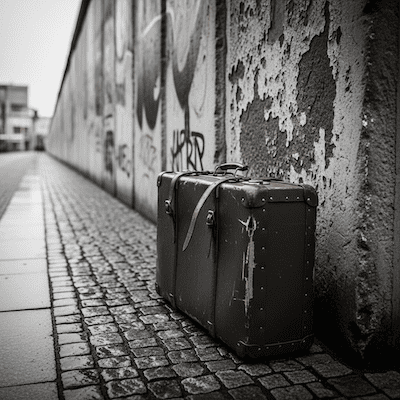
Von der Mauer ist heute nur wenig übrig. In Berlin zeigt eine doppelte Reihe aus Pflastersteinen, wo sie einmal stand. An der East Side Gallery kann man noch ein über einen Kilometer langes, bunt bemaltes Stück sehen.
Little of the Wall is left today. In Berlin, a double row of cobblestones shows where it once stood. At the East Side Gallery you can still see a colourfully painted stretch more than a kilometre long.
Ganz verschwunden ist die Teilung aber nicht. Löhne und Renten sind im Osten oft noch niedriger als im Westen, und viele Menschen erzählen bis heute gern, auf welcher Seite der Mauer sie aufgewachsen sind.
But the division has not disappeared completely. Wages and pensions in the East are often still lower than in the West, and to this day many people like to tell you which side of the Wall they grew up on.
In the free app you can listen to this text read aloud and tap any word to see what it means.